Dunham in Brome-Missisquoi, Québec — Central Canada (French-Canadian)
Elizabeth Ann Beach
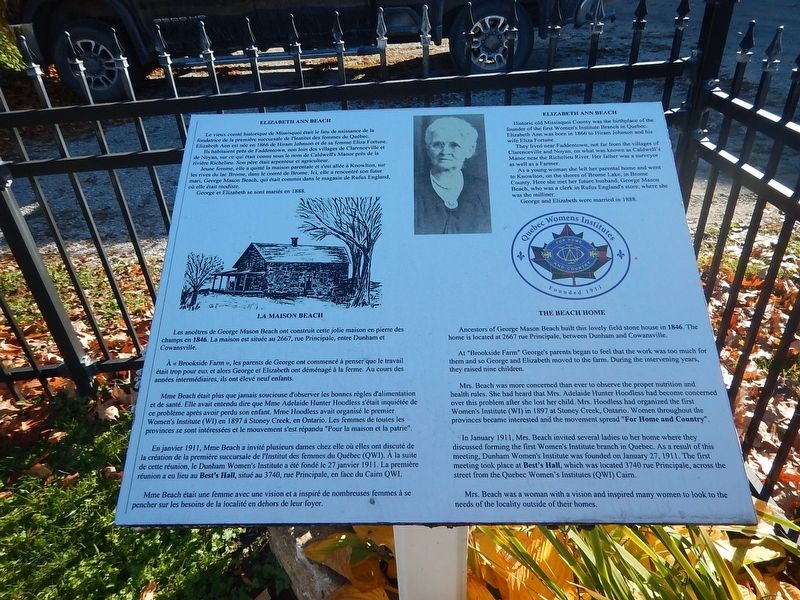
Photographed by Kevin Craft, October 20, 2026
1. Elizabeth Ann Beach Marker
{English text}
Historic old Missisquoi County was the birthplace of the founder of the first Women’s Institute Branch in Quebec. Elizabeth Ann was born in 1866 to Hiram Johnson and his wife Eliza Fortune.
They lived near Faddentown, not far from the villages of Clarenceville and Noyan, on what was known as Caldwell’s Manor near the Richelieu River. Her father was a surveyor as well as a Farmer.
As a young woman she left her parental home and went to Knowlton, on the shores of Brome Lake, in Brome County. Here she met her future husband, George Mason Beach, who was a clerk in Rufus England’s store, where she was the milliner.
George and Elizabeth were married in 1888.
THE BEACH HOME
Ancestors of George Mason Beach built this lovely field stone house in 1846. The home is located at 2667 rue Principale, between Dunham and Cowansville.
At “Brookside Farm” George’s parents began to feel that the work was too much for them and so George and Elizabeth moved to the farm. During the intervening years, they raised nine children.
Mrs. Beach was more concerned than ever to observe the proper nutrition and health rules. She had heard that Mrs.
this page online
In January 1911, Mrs. Beach invited several ladies to her home where they discussed forming the first Women’s Institute branch in Quebec. As a result of this meeting, Dunham Women’s Institute was founded on January 27, 1911. The first meeting took place at Best’s Hall, which was located 3740 rue Principale, across the street from the Quebec Women’s Institutes (QWI) Cairn.
Mrs. Beach was a woman with a vision and inspired many women to look to the needs of the locality outside of their homes.
{French text}
Le vieux comté historique de Missisquoi était le lieu de naissance de la fondatrice de la première succursale de l’Institut des femmes du Québec. Elizabeth Ann est née en 1866 de Hiram Johnson et de sa femme Eliza Fortune.
Ils habitaient près de Faddentown, non loin des villages de Clarenceville et de Noyan, sur ce qui était connu sous le nom de Caldwell’s Manor
Photographed by Kevin Craft, October 20, 2026
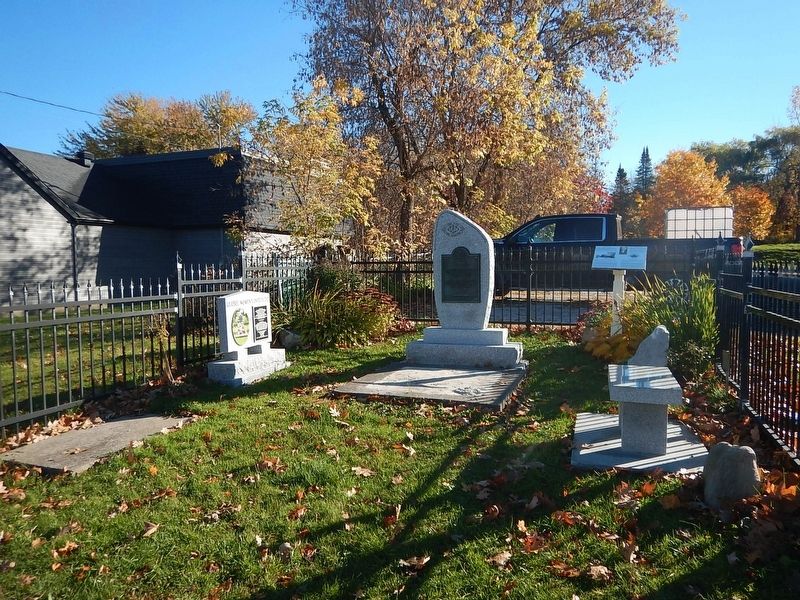
2. Wideview of Elizabeth Ann Beach Marker
Jeune femme, elle a quitté la maison parentale et s’est allée à Knowlton, sur les rives du lac Brome, dans le comté de Brome. Ici, elle a rencontré son futur mari, George Mason Beach, qui était commis dans le magasin de Rufus England, où elle était modiste.
George et Elizabeth se sont mariés en 1888.
LA MAISON BEACH
Les ancêtres de George Mason Beach ont construit cette jolie maison en pierre des champs en 1846. La maison est située au 2667, rue Principale, entre Dunham et Cowansville.
À « Brookside Farm », les parents de George ont commencé à penser que le travail était trop pour eux et alors George et Elizabeth ont déménagé à la ferme. Au cours des années intermédiaires, ils ont élevé neuf enfants.
Mme Beach était plus que jamais soucieuse d’observer les bonnes règles d’alimentation et de santé. Elle avait entendu dire que Mme Adelaide Hunter Hoodless s’était inquiétée de ce problème après avoir perdu son enfant. Mme Hoodless avait organisé le premier Women’s Institute (WI) en 1897 à Stoney Creek, en Ontario. Les femmes de toutes les provinces se sont intéressées et le mouvement s’est répandu “Pour la maison et la patrie”.
En janvier 1911, Mme Beach a invité plusieurs dames chez elle où elles ont discuté de la création de la première succursale de l’Institut des femmes du Québec (QWI). À la suite de cette réunion, le Dunham Women’s Institute a été fondé le 27 janvier 1911. La première réunion a eu lieu au Best’s Hall, situé au 3740, rue Principale, en face du Cairn QWI.
Mme Beach était une femme avec une vision et a inspiré de nombreuses femmes à se pencher sur les besoins de la localité en dehors de leur foyer.
Topics. This historical marker is listed in these topic lists: Charity & Public Work • Education • Women. A significant historical date for this entry is January 27, 1911.
Location. 45° 7.928′ N, 72° 48.026′ W. Marker is in Dunham, Québec, in Brome-Missisquoi. It is on Rue Principale (Québec Route 202) 0.2 kilometers north of Rue Bruce, on the right when traveling north. Touch for map. Marker is at or near this postal address: 3745 Rue Principale, Dunham QC J0E 1M0, Canada. Touch for directions.

Regionally, this marker is in the Outaouais & Eastern Townships. It is also in Central Canada. Globally, it is in North America, the Western Hemisphere, and the Western World. Historically, it finds itself in what was once a British colony, the Viceroyalty of New France, the Haudenosaunee (Iroquois) Confederacy, and Rupert’s Land.
Other nearby markers. At least 8 other markers are within 16 kilometers of this marker, measured as the crow flies: Quebec Women's Institutes (here, next to this marker); First Women's Institute (a few steps from this marker); Adélard Godbout (approx. 9 kilometers away); The Pike River / La Rivière aux Brochets (approx. 9.1 kilometers away); Cornell Mill (approx. 9.1 kilometers away); a different marker also named Cornell Mill (approx. 9.1 kilometers away); In honour of Capt. Caleb Tree (approx. 9.3 kilometers away); Grange Alexander-Solomon-Walbridge (approx. 14.8 kilometers away). Touch for a list and map of all markers in Dunham.
Credits. This page was last revised on November 4, 2026. It was originally submitted on November 4, 2026, by Kevin Craft of Bedford, Quebec. This page has been viewed 5 times since then. Photos: 1, 2. submitted on November 4, 2026, by Kevin Craft of Bedford, Quebec.
