Castlefield in Manchester in Greater Manchester, England, United Kingdom — Northwestern Europe (the British Isles)
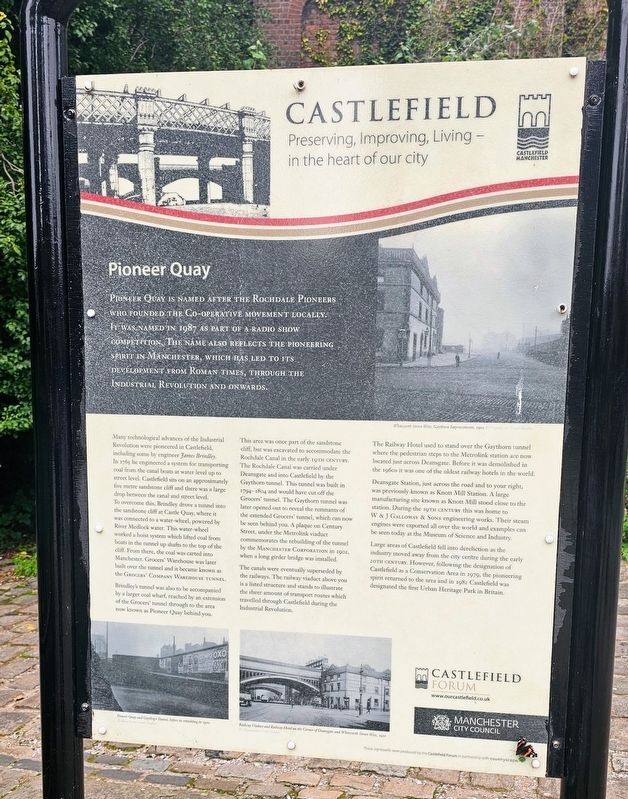
Pioneer Quay
⎯⎯⎯
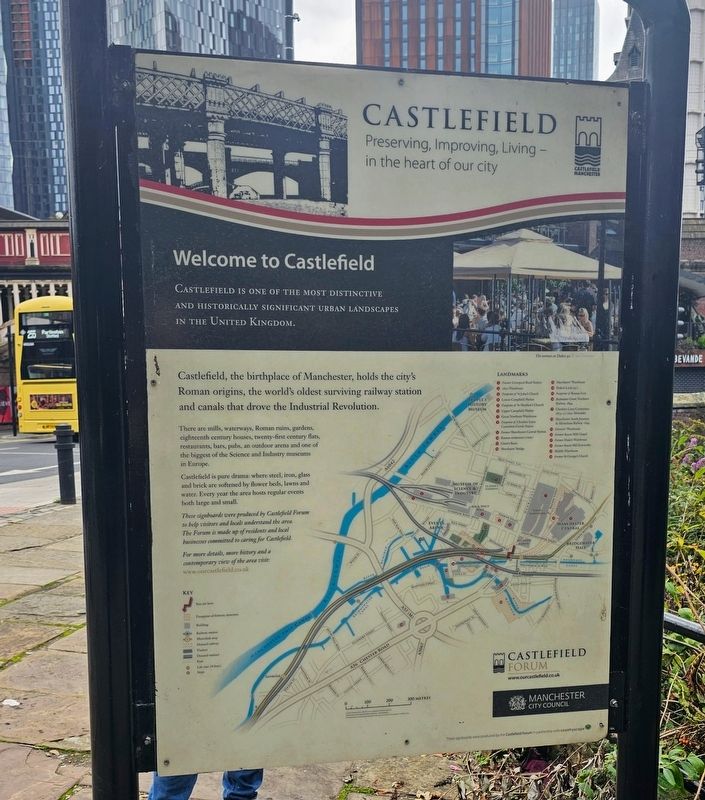
Welcome to Castlefield
Photographed by Ian Lefkowitz, September 14, 2026
1. Pioneer Quay side of marker
Pioneer Quay is named after the Rochdale Pioneers who founded the Co-operative movement locally. It was named in 1987 as part of a radio show competition. The name also reflects the pioneering spirit in Manchester, which has led to its development from Roman times, through the Industrial Revolution and onwards.
Many technological advances of the Industrial Revolution were pioneered in Castlefield, including some by engineer James Brindley. In 1765 he engineered a system for transporting coal from the canal boats at water level up to street level. Castlefield sits on an approximately five metre sandstone cliff and there was a large drop between the canal and street level. To overcome this, Brindley drove a tunnel into the sandstone cliff at Castle Quay, where it was connected to a water-wheel, powered by River Medlock water. This water-wheel worked a hoist system which lifted coal from boats in the tunnel up shafts to the top of the cliff. From there, the coal was carried into Manchester. Grocers’ Warehouse was later built over the tunnel and it became known as the Grocers’ Company Warehouse tunnel.
Brindley’s
this page online
This area was once part of the sandstone cliff, but was excavated to accommodate the Rochdale Canal in the early 19th century. The Rochdale Canal was carried under Deansgate and into Castlefield by the Gaythorn tunnel. This tunnel was built in 1794–1804 and would have cut off the Grocers’ tunnel. The Gaythorn tunnel was later opened out to reveal the remnants of the extended Grocers’ tunnel, which can now be seen behind you. A plaque on Century Street, under the Metrolink viaduct commemorates the rebuilding of the tunnel by the Manchester Corporation in 1902, when a long girder bridge was installed.
The canals were eventually superseded by the railways. The railway viaduct above you is a listed structure and stands to illustrate the sheer amount of transport routes which travelled through Castlefield during the Industrial Revolution.
The Railway Hotel used to stand over the Gaythorn tunnel where the pedestrian steps to the Metrolink station are now located just across Deansgate.
Photographed by Ian Lefkowitz, September 14, 2026
2. Welcome to Castlefield side of marker
Deansgate Station, just across the road and to your right, was previously known as Knott Mill Station. A large manufacturing site known as Knott Mill stood close to the station. During the 19th century this was home to W & J Galloway & Sons engineering works. Their steam engines were exported all over the world and examples can be seen today at the Museum of Science and Industry.
Large areas of Castlefield fell into dereliction as the industry moved away from the city centre during the early 20th century. However, following the designation of Castlefield as a Conservation Area in 1979, the pioneering spirit returned to the area and in 1982 Castlefield was designated the first Urban Heritage Park in Britain.
(Captions)
Whitworth Street West, Gaythorn Improvement, 1902
Pioneer Quay and Gaythorn Tunnel, before its rebuilding in 1902
Railway Viaduct and Railway Hotel on the Corner of Deansgate and Whitworth Street West, 1910
Welcome to Castlefield
Castlefield is one of the most distinctive and historically significant urban landscapes in the United Kingdom.
Castlefield,
Photographed by Ian Lefkowitz, September 14, 2026
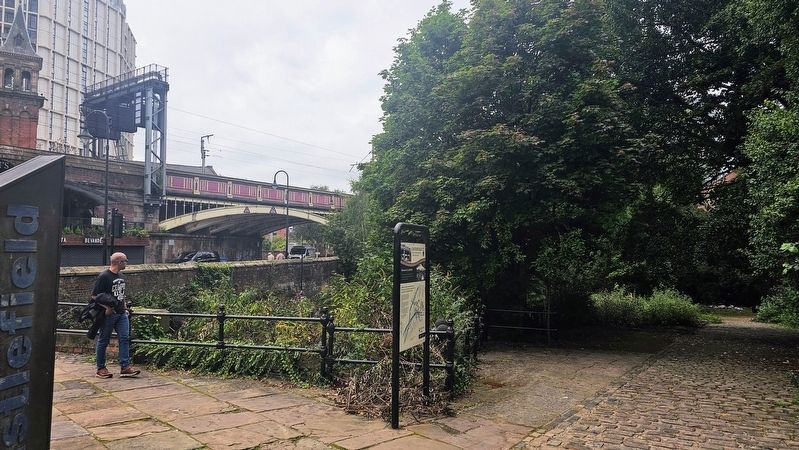
3. Pioneer Quay / Welcome to Castlefield Marker
The signboard is located near a welcome sign for the Castlefield neighborhood. A railway viaduct can be seen in the distance.
There are mills, waterways, Roman ruins, gardens, eighteenth century houses, twenty-first century flats, restaurants, bars, pubs, an outdoor arena and one of the biggest of the Science and Industry museums in Europe.
Castlefield is pure drama: where steel, iron, glass and brick are softened by flower beds, lawns and water. Every year the area hosts regular events both large and small.
These signboards were produced by Castlefield Forum to help visitors and locals understand the area. The Forum is made up of residents and local businesses committed to caring for Castlefield.
For more details, more history and a contemporary view of the area visit: www.ourcastlefield.co.uk
Erected by Castlefield Forum.
Topics. This historical marker is listed in these topic lists: Industry & Commerce • Railroads & Streetcars • Waterways & Vessels. A significant historical year for this entry is 1765.
Location. 53° 28.478′ N, 2° 15.119′ W. Marker is in Manchester, England, in Greater Manchester. It is in Castlefield. It is at the intersection of Deansgate and Whitworth Street West, on the left when traveling north on Deansgate. Touch for map. Marker is at or near this postal address: 374 Deansgate, Manchester, England M3 4LY, United Kingdom. Touch for directions.

Regionally, this marker is in North West England. Globally, it is on the Atlantic Ocean, in the North Atlantic Region, in Europe, in Atlantic Europe, on one of the British Isles, in the Western World, and in the Anglosphere. Historically, it finds itself in what was once the Roman Empire.
Other nearby markers. At least 8 other markers are within walking distance of this marker: The North Gate / Roman Settlement in Manchester (about 150 meters away, measured in a direct line); The Roman Fort (about 150 meters away); Roman Manchester / Welcome to Castlefield (about 180 meters away); Campfield Markets & Fairs / Liverpool Road (about 180 meters away); Western Wall & Roman Granary (about 210 meters away); Two Cylinder Crossley Engine (approx. 0.3 kilometers away); James (approx. 0.3 kilometers away); John Owens (approx. 0.4 kilometers away). Touch for a list and map of all markers in Manchester.
Credits. This page was last revised on November 6, 2026. It was originally submitted on November 6, 2026, by Ian Lefkowitz of New York, New York. This page has been viewed 5 times since then. Photos: 1, 2, 3. submitted on November 6, 2026, by Ian Lefkowitz of New York, New York. • Andrew Ruppenstein was the editor who published this page.
