Castlefield in Manchester in Greater Manchester, England, United Kingdom — Northwestern Europe (the British Isles)
The North Gate
⎯⎯⎯
Roman Settlement in Manchester
Photographed by Ian Lefkowitz, September 14, 2026
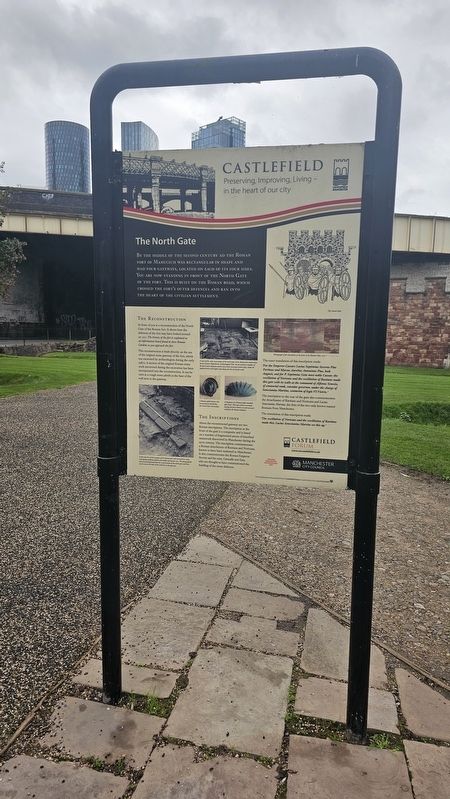
1. The North Gate side of marker
By the middle of the second century AD the Roman fort of Mamucium was rectangular in shape and had four gateways, located on each of its four sides. You are now standing in front of the North Gate of the fort. This is built on the Roman road, which crossed the fort’s outer defences and ran into the heart of the civilian settlement.
The Reconstruction
In front of you is a reconstruction of the North Gate of the Roman fort. It shows how the defences of the fort may have looked around AD 200. The history of the fort is explained on an information board found in these Roman Gardens as you approach the fort.
This reconstruction is built directly on the site of the original stone gateway of the fort, which was excavated by archaeologists during the early 1980s. A section of the original Roman stone work uncovered during the excavation has been incorporated into the reconstruction. It can be seen as a rough stone plinth at the base of the wall next to the gateway.
The Inscriptions
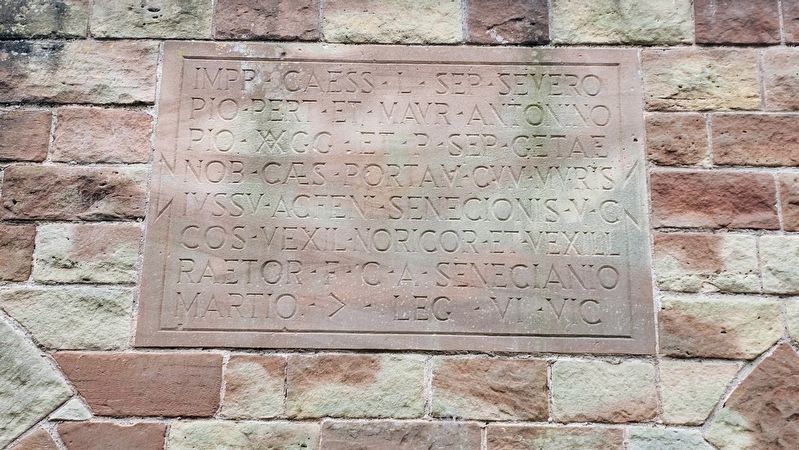
Above the reconstructed gateway are two Roman inscriptions. The inscription at the front of the gate is a composite and is based on a number of fragmented pieces of inscribed stonework discovered in Manchester during the 19th century. The inscription commemorates a Roman detachment of Raetians and Noricans, known to have been stationed in Manchester. It also commemorates the Roman Emperor Severus and his sons, Caracalla and Geta, who are thought to have commissioned the building of the stone defences.
The exact translation of this inscription reads:
‘For the Emperor-Caesars Lucius Septimius Severus Pius Pertinax and Marcus Aurelius Antoninus Pius, both Augusti, and for P. Septimius Geta most noble Caesar; the vexillation of Noricans and the vexillation of Raetians made this gate with its walls at the command of Alfenus Senecio, of senatorial rank, consular governor, under the charge of Senecianius Martius, centurion of legio VI Victrix.’
The
this page online
The translation of this inscription reads:
‘The vexillation of Noricans and the vexillation of Raetians made this; Lucius Senecianius Martius set this up.’
These signboards were produced by the Castlefield Forum in partnership with countryside
(Captions)
The North Gate
A view of the 1980 excavations of the north gate of the Roman fort undertaken by the Greater Manchester Archaeological Unit. In this picture a number of the fort’s outer defensive ditches have been excavated (centre left), while the modern brick wall (right) runs along the line of the fort wall.
A Roman gilded bronze disc brooch discovered during the North Gate excavations.
A fragment of a Roman pillar-moulded glass bowl. This type of bowl was made during the first century AD and was used widely by the Roman military.
A close-up view of the remains of the Roman fort wall excavated in 1980, with facing sandstone plinths and rubble and mortar core. The facing plinths have been incorporated into the reconstruction of the north gate and these can be seen at the base of the wall close to the gateway.
Photograph of the inscription at the front of the Roman Gate, 2011 © Countryscope
Roman Settlement in Manchester
The
Photographed by Ian Lefkowitz, September 14, 2026
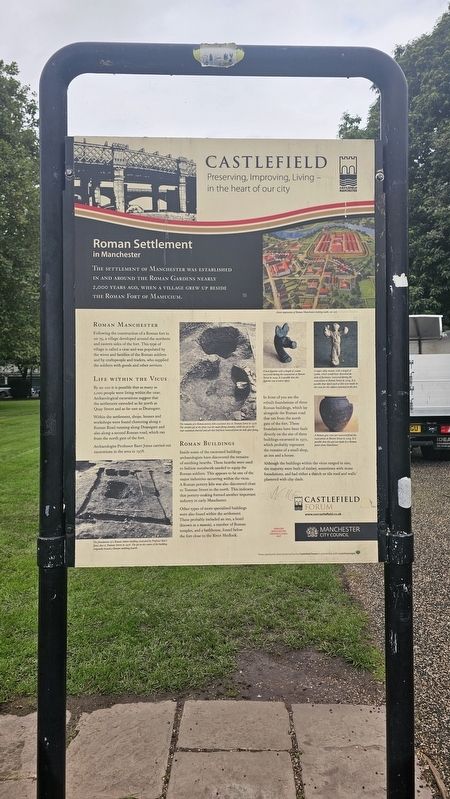
2. Roman Settlement in Manchester side of marker
Roman Manchester
Following the construction of a Roman fort in AD 79, a village developed around the northern and eastern sides of the fort. This type of village is called a vicus and was populated by the wives and families of the Roman soldiers and by craftspeople and traders, who supplied the soldiers with goods and other services.
Life within the Vicus
By AD 200 it is possible that as many as 2,000 people were living within the vicus. Archaeological excavations suggest that the settlement extended as far north as Quay Street and as far east as Deansgate. Within the settlement, shops, houses and workshops were found clustering along a Roman Road running along Deansgate and also along a second Roman road, which ran from the north gate of the fort. Archaeologist Professor Barri Jones carried out excavations in the area in 1978.
Roman Buildings
Inside some of the excavated buildings archaeologists have discovered the remains of smithing hearths. These hearths were used to fashion metalwork needed to equip the Roman soldiers. This appears to be one of the major industries occurring within the vicus. A Roman pottery kiln was also discovered close to Tonman Street to the north. This indicates that pottery-making formed another important industry in early Manchester.
Other types of more specialised buildings were also found within the settlement. These probably included an inn, a hotel (known as a mansio), a number of Roman temples, and a bathhouse, found below the fort close to the River Medlock.
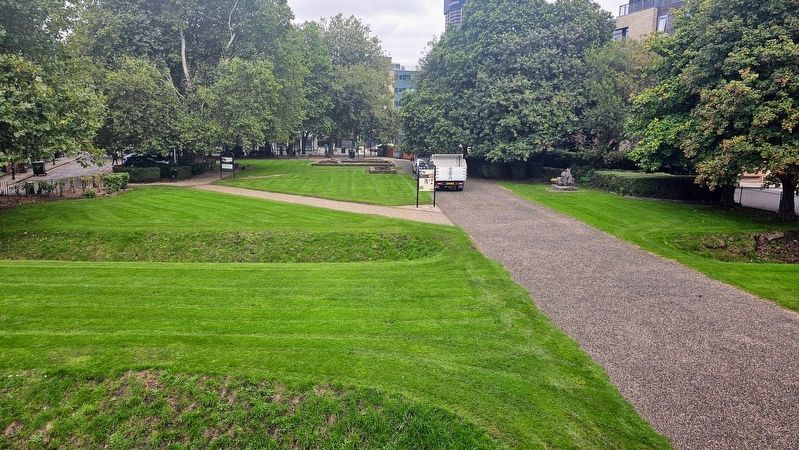
In front of you are the rebuilt foundations of three Roman buildings, which lay alongside the Roman road that ran from the north gate of the fort. These foundations have been built directly
Photographed by Ian Lefkowitz, September 14, 2026
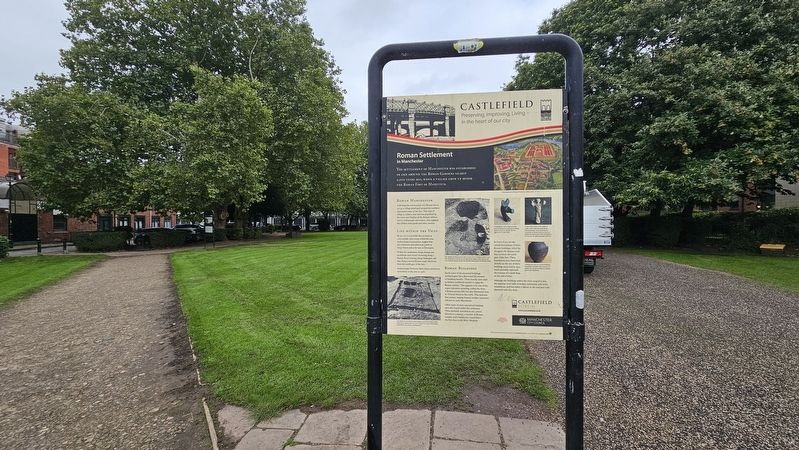
3. The North Gate / Roman Settlement in Manchester Marker
The signboard is located within Castlefield Urban Heritage Park.
Although the buildings within the vicus ranged in size, the majority were built of timber, sometimes with stone foundations, and had either a thatch or tile roof and walls plastered with clay daub.
(Captions)
Artist impression of Roman Manchester, looking south, AD 200 © Graham Sumner.
The remains of a Roman pottery kiln excavated close in Tonman Street in 1978. The circular pit at the front was the main firing chamber, while the pit to the rear contained charcoal and ash that had been removed from the kiln after firing.
A lead figurine with a length of 52mm recovered during the excavations at Barton Street in 2004. It is possible that this figurine was a votive object.
A copper alloy mount, with a length of 25mm, which would have decorated an item of furniture, recovered during the excavations at Barton Street in 2004. It is possible that objects such as this were made in the vicus for the soldiers stationed in the fort.
A Roman grey ware pot recovered from the excavations at Barton Street in 2004. It is possible that this pot was made by a Roman potter from Manchester.
The foundations of a Roman timber building excavated by Professor Barri Jones close to Tonman Street in 1978. The pit in the centre of the building originally housed a Roman smithing hearth.
Erected by Castlefield
Photographed by Ian Lefkowitz, September 14, 2026
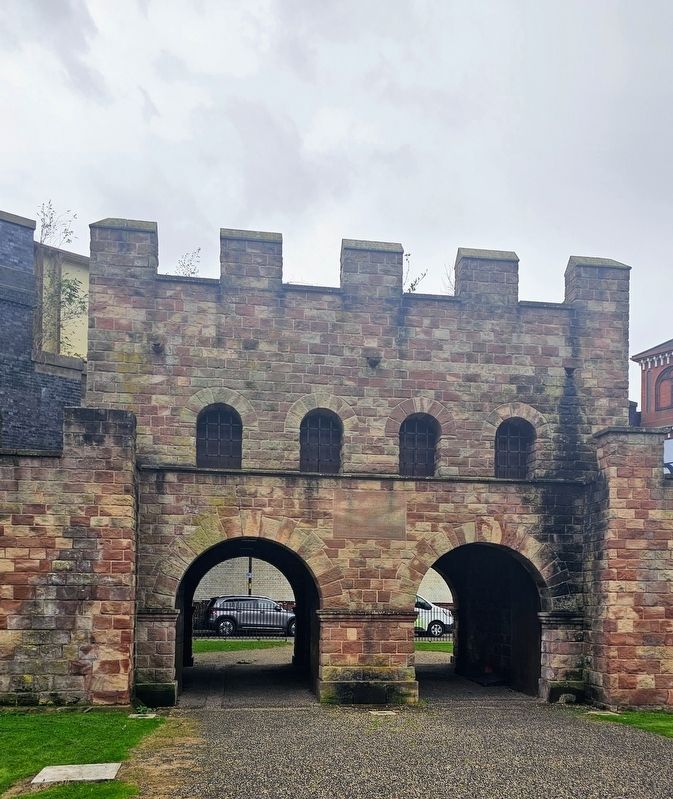
4. The North Gate
The reconstructed North Gate of Mamucium, Manchester's Roman fortress.
Topics. This historical marker is listed in these topic lists: Anthropology & Archaeology • Forts and Castles. A significant historical year for this entry is 79 CE.
Location. 53° 28.538′ N, 2° 15.219′ W. Marker is in Manchester, England, in Greater Manchester. It is in Castlefield. It is at the intersection of Collier Street and Bridgewater Street, on the left when traveling north on Collier Street. Touch for map. Marker is at or near this postal address: 147 Duke Street, Manchester, England M3 1FB, United Kingdom. Touch for directions.

Regionally, this marker is in North West England. Globally, it is on the Atlantic Ocean, in the North Atlantic Region, in Europe, in Atlantic Europe, on one of the British Isles, in the Western World, and in the Anglosphere. Historically, it finds itself in what was once the Roman Empire.
Other nearby markers. At least 8 other markers are within walking distance of this marker: The Roman Fort (within shouting distance of this marker); Roman Manchester / Welcome to Castlefield (within shouting distance of this marker); Campfield Markets & Fairs / Liverpool Road (about 90 meters
Photographed by Ian Lefkowitz, September 14, 2026
5. Composite Inscription
The reconstructed inscription referred to on the signboard.
Photographed by Ian Lefkowitz, September 14, 2026
6. Castlefield Urban Heritage Park
A view of the reconstructed Roman building foundations and Castlefield Urban Heritage Park, as seen from Mamucium. This signboard is the one in the foreground of the photo.
Credits. This page was last revised on November 6, 2026. It was originally submitted on November 6, 2026, by Ian Lefkowitz of New York, New York. This page has been viewed 4 times since then. Photos: 1, 2, 3, 4, 5, 6. submitted on November 6, 2026, by Ian Lefkowitz of New York, New York. • Andrew Ruppenstein was the editor who published this page.
