Napierville in Les Jardins-de-Napierville, Québec — Central Canada (French-Canadian)
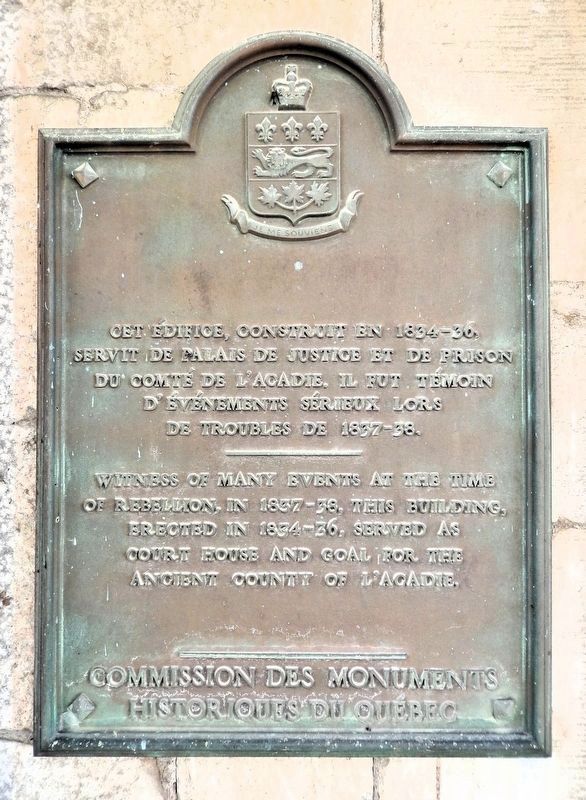
Palais de Justice et prison du comté de L'Acadie
⎯⎯⎯
Acadie County Court House and Goal
Photographed by Cosmos Mariner, May 19, 2024
1. Palais de Justice et prison du comté de L'Acadie / Acadie County Court House and Goal Marker

Erected by Commission des Monuments Historiques du Québec.
Topics. This historical marker is listed in these topic lists: Architecture • Law Enforcement • Notable Buildings. A significant historical year for this entry is 1834.
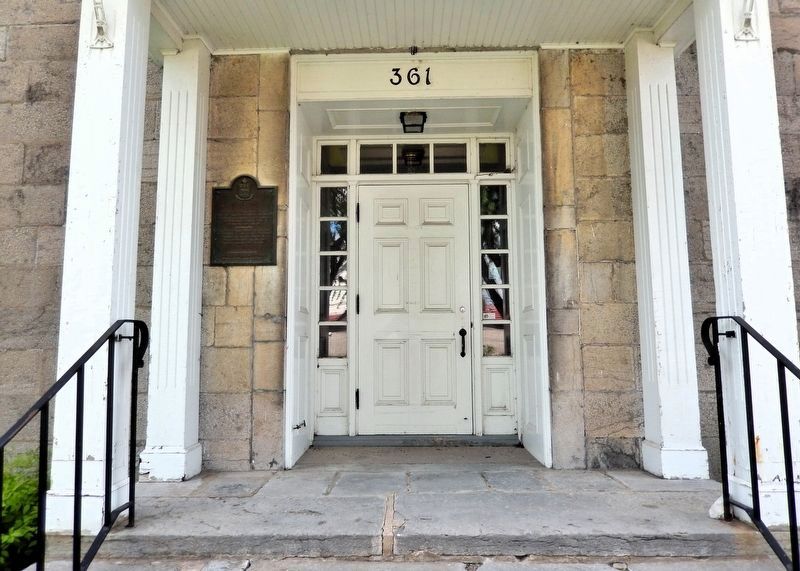
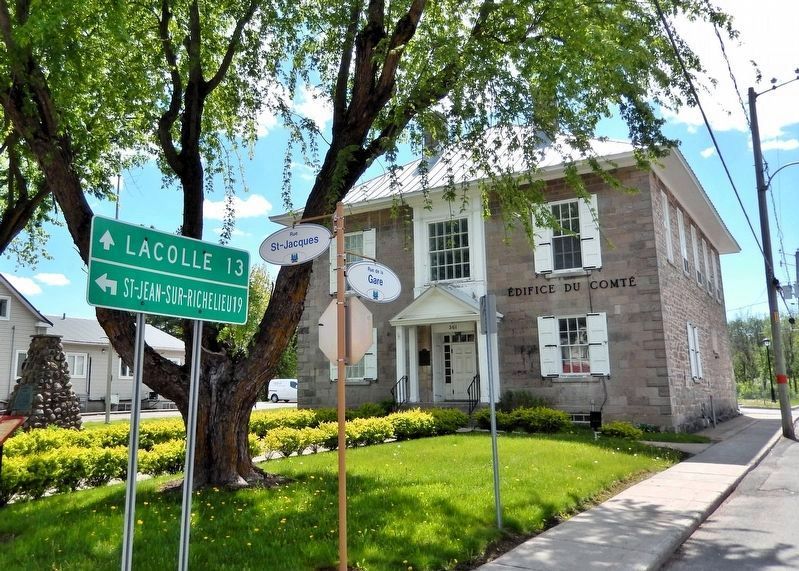
Location. 45° 11.268′ N, 73° 24.375′ W. Marker is in Napierville, Québec, in Les Jardins-de-Napierville. It is at the intersection of Rue Saint-Jacques (Québec Route 219/221) and Rue de la Gare, on the left when traveling north on Rue Saint-Jacques. The marker is mounted directly on the old Acadie County Courthouse, on the left side of the front entrance. Touch for map. Marker is at or near this postal address: 361 Rue Saint-Jacques, Napierville QC J0J 1L0, Canada. Touch for directions.

Regionally, this marker is in Central Canada.
this page online
Other nearby markers. At least 8 other markers are within walking distance of this marker: La Prison (a few steps from this marker); Docteur C.-H.-O. Côté, m.d. (within shouting distance of this marker); C'est ici que fut proclamée la République du Bas-Canada (about 120 meters away, measured in a direct line); Jean-Baptiste Lukin N.P. (about 150 meters away); Loop Odell (about 150 meters away); Napierville Historique (about 210 meters away); Magasin d'Allen Clark (about 240 meters away); La Chapelle-Presbytère (1825-1886) (about 240 meters away). Touch for a list and map of all markers in Napierville.
Related markers. Click here for a list of markers that are related to this marker.
Also see . . .
1. Palais de justice de Napierville (Heritage Guide).
Excerpt (English translation): The Napierville courthouse was built in 1834, after the subdivision of Huntingdon County(Submitted on November 7, 2026, by Cosmos Mariner of Cape Canaveral, Florida.)(1829), to house the court of L'Acadie County, for which Napierville became the county seat. Only two county courthouses were built for this purpose in Lower Canada before 1857, those of Napierville and Saint-Hyacinthe. The heritage value of the Napierville courthouse also lies in its rarity and age. It is the only surviving county courthouse from the first half of the 19th century and is also the oldest preserved county courthouse in Quebec.Photographed by Cosmos Mariner, May 19, 20242. Palais de Justice et prison du comté de L'Acadie / Acadie County Court House and Goal MarkerThe marker is on the left side of the front entrance.
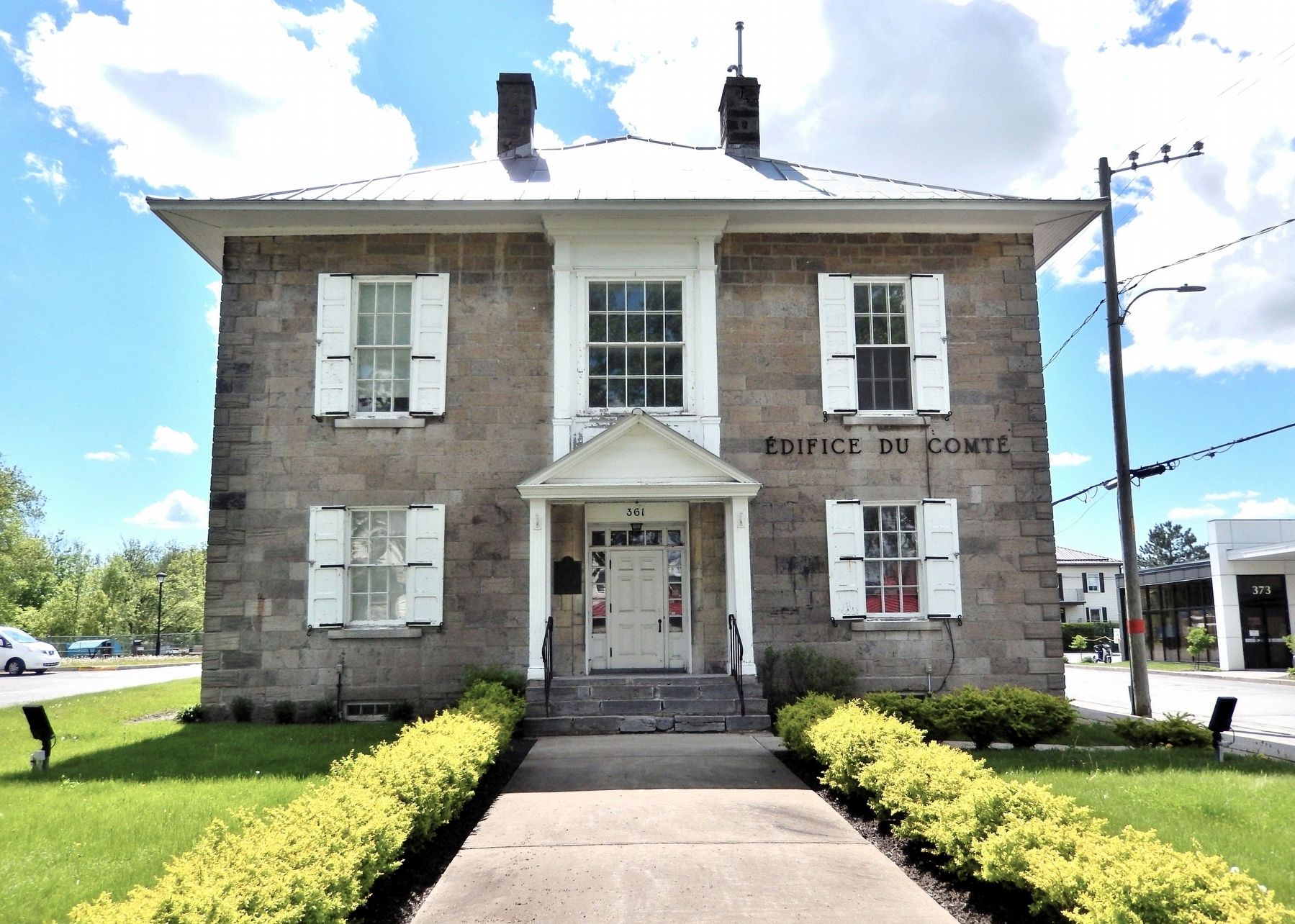
The heritage value of the Napierville courthouse also comes from its architectural interest. The Montreal architects Thompson and Parry designed the plans. They drew inspiration from the Palladian style, which originated in Great Britain in the first half of the 18th century and was popular in Quebec at the turn of the 19th century. The old courthouse is a striking example of how this style was used in public buildings, as the government wanted to assert a British presence in the colony and project an image of lasting power and authority. Modest in size, it recalls English bourgeois homes with its dressed stone facade and simple layout, its low-pitched hipped roof, chimneys symmetrically placedon either side of the ridge, and classic decoration, mainly made up of a porch with a pediment topped by a large central window.Photographed by Cosmos Mariner, May 19, 20243. Palais de Justice et prison du comté de L'Acadie / Acadie County Court House and Goal
The heritage value of the Napierville courthouse also lies in the interest of its layout. Indeed, it still reflects its original functions with its two floors: the ground floor housed the prison and the jailer's residence, while the upper floor was the courthouse. The main front entrance gave access to the courtroom, and the side entrance led to the prison. In the entrance hall, the grand staircase leads to the old courtroom, which still retains some elements of its interior decor, notably its plaster vaulted ceiling and some woodwork.
The heritage value of the Napierville courthouse also rests on the continuity of its institutional function. The building, which was long used as a town hall, now houses the offices of the Les Jardins-de-Napierville RCM. It has therefore maintained its public character since it was built in 1834.
2. Palais de justice de Napierville (Canadian Register of Historic Places).
Excerpt (English translation):(Submitted on November 7, 2026, by Cosmos Mariner of Cape Canaveral, Florida.)The Napierville courthouse, formally recognized: 1961/06/21, is an institutional building with Palladian inspiration built in 1834. The two-story stone building has a hipped roof pierced by two stone chimneys symmetrically placed on either side of the ridge. The courthouse is highlighted by a large, landscaped area in front.Photographed by Cosmos Mariner, May 19, 20244. Palais de Justice et prison du comté de L'Acadie / Acadie County Court House and Goal
The key elements related to the architectural interest of the Napierville courthouse include:
• its Palladian-influenced features, such as the rectangular layout, raised foundation, low-pitched hipped roof forming a cornice, stone façade, corner quoins, small-pane sash windows, two symmetrically placed chimneys on either side of the ridge, the pedimented porch, and the wooden door with pilasters and entablature framing the central front window;
• its materials, including the sheet metal roof with battens, masonry, window sills, door and window frames, as well as the two stone chimneys; and
• its openings, including the front door with side panels and transom, the door with transom on the side, the large central window, and the paneled shutters on the front and on the ground floor sides.
Credits. This page was last revised on November 7, 2026. It was originally submitted on November 6, 2026, by Cosmos Mariner of Cape Canaveral, Florida. This page has been viewed 6 times since then. Photos: 1, 2, 3, 4. submitted on November 7, 2026, by Cosmos Mariner of Cape Canaveral, Florida.
