Starkville in Oktibbeha County, Mississippi — The American South (East South Central)
David Samuel Minor
1840 - 1929
Brush Arbor Cemetery
Historic Starkville
| — | Mississippi's College Town | — |
Photographed by Delaney Shaw, October 29, 2026
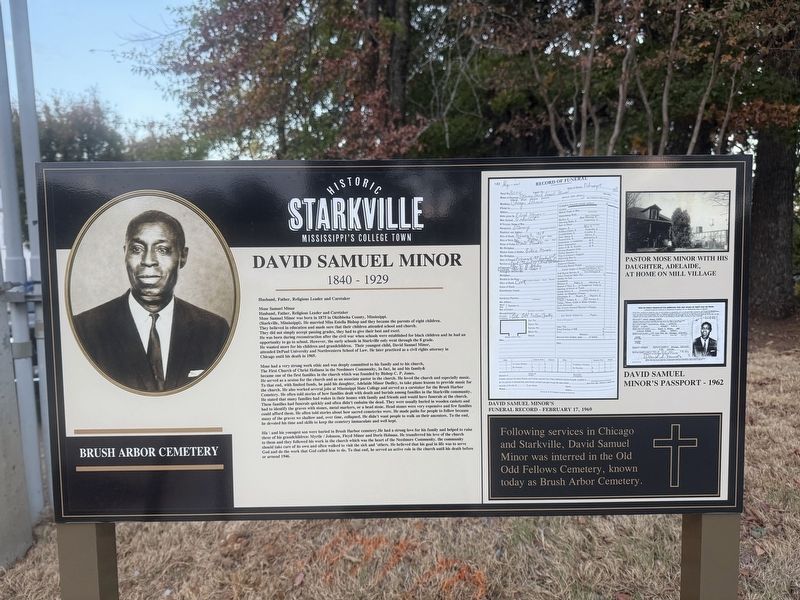
1. Brush Arbor Cemetery Marker
Husband, Father, Religious Leader and Caretaker
Mose Samuel Minor
Husband, Father, Religious Leader and Caretaker
Mose Samuel Minor was born in 1875 in Oktibbeha County, Mississippi. (Starkville, Mississippi). He married Miss Estella Bishop and they became the parents of eight children. They believed in education and made sure that their children attended school and church. They did not simply accept passing grades, they had to give their best and excel. He was born during reconstruction after the civil war when schools were established for black children and he had an opportunity to go to school. However, the early schools in Starkville only went through the 8 grade. He wanted more for his children and grandchildren. Their youngest child, David Samuel Minor, attended DePaul University and Northwestern School of Law. He later practiced as a civil rights attorney in Chicago until his death in 1969.
Mose had a very strong work ethic and was deeply committed to his family and to his church, The First Church of Christ Holiness in the Needmore Community, In fact, he and his family & became one of the first families
this page online
His \ and his youngest son were buried in Brush Harbor cemetery. He had a strong love for his family and helped to raise three of his grandchildren: Myrtle / Johnson, Floyd Minor and Doris Holman. He transferred his love of the church to them and they followed his work in the church which was the heart of the Needmore Community. the community should take care of its own and often walked to visit the sick and 'others. He believed that his goal in life was to serve God and do the work that God called him to do. To that end, he served an active role in the church until his death before or around 1946.
Erected 2026 by Historic Starkville.
Topics. This historical marker is listed in these topic lists: African Americans • Cemeteries & Burial Sites • Education • Religion & Religious Structures. A significant historical year for this entry is 1840.
Location. 33° 27.772′ N, 88° 48.35′ W. Marker is in Starkville, Mississippi, in Oktibbeha County. It is on University Drive west of North Nash Street, on the right when traveling west. Touch for map. Marker is at or near this postal address: 517 University Dr, Starkville MS 39759, United States of America. Touch for directions.

Regionally, this marker is in East Mississippi, in the Black Prairie, and in the Golden Triangle. It is also in the American South, specifically in the Deep South, and in the Black Belt. Globally, it is in North America, a Gulf of Mexico state, the Western Hemisphere, the Western World, and the Anglosphere. Historically, it finds itself in what was once the territory of the Mississippian Culture, one of the Confederate States of America, and the Antebellum South.
Other nearby markers. At least 8 other markers are within walking distance of this marker: George Washington Chiles (here, next to this marker); Brush Arbor Cemetery (within shouting distance of this marker); Nash Street Historic District (about 500 feet away, measured in a direct line); Oktibbeha County Blues (approx. ¼ mile away); The Borden Milk Plant (approx. ¼ mile away); First Presbyterian Church (approx. 0.4 miles away); Oktibbeha Gardens (approx. 0.4 miles away); Needmore Community (approx. 0.4 miles away). Touch for a list and map of all markers in Starkville.
Credits. This page was last revised on November 10, 2026. It was originally submitted on November 6, 2026, by Delaney Shaw of Seneca, South Carolina. This page has been viewed 11 times since then. Photo 1. submitted on November 6, 2026, by Delaney Shaw of Seneca, South Carolina. • Devry Becker Jones was the editor who published this page.
