Dover in Kent, England, United Kingdom — Northwestern Europe (the British Isles)
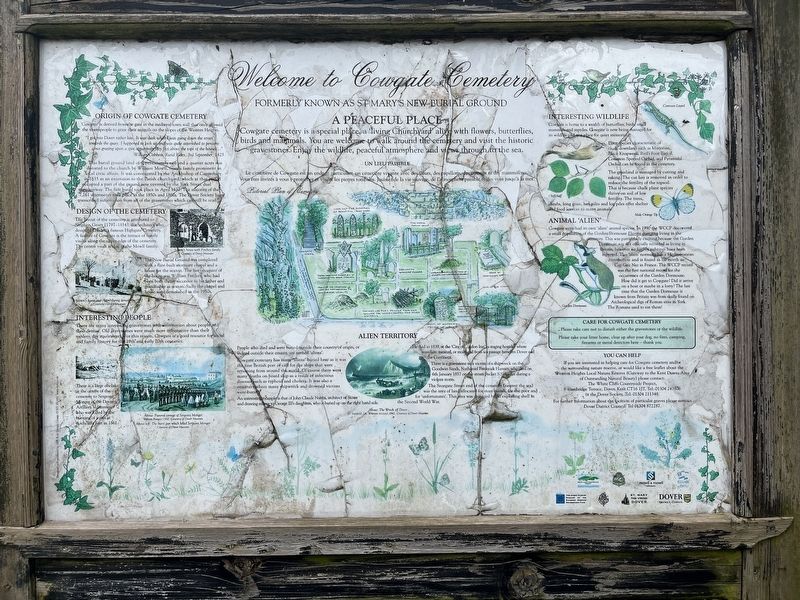
Welcome to Cowgate Cemetery
Photographed by Ray Gurganus, April 2, 2026
1. Welcome to Cowgate Cemetery Marker
Formerly known as St Mary's New Burial Ground
A Peaceful Place
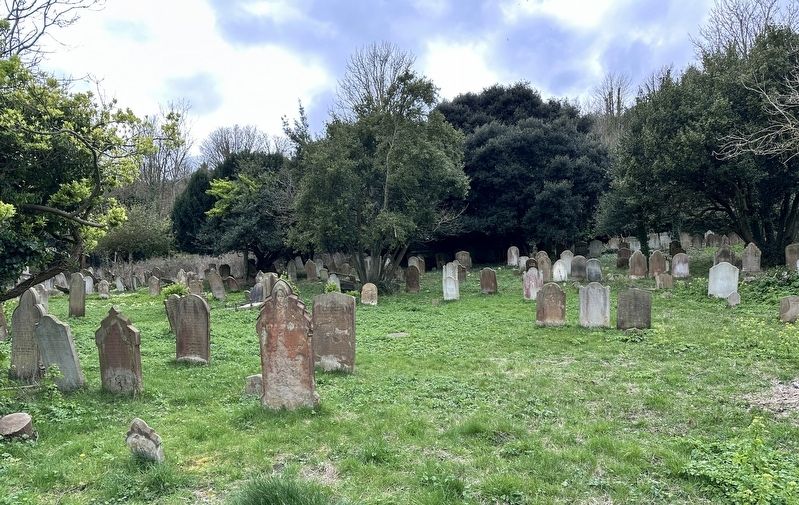
Cowgate cemetery is a special place, a living churchyard alive with flowers, butterflies, birds, and mammals. You are welcome to walk around the cemetery and visit historic gravestones. Enjoy the wildlife, peaceful atmosphere, and views through to the sea.
Origin of Cowgate Cemetery
Cowgate is derived from the gate in the medieval town that once allowed the townspeople to graze their animals on the slopes of the Western Heights.
"I got into Dover rather late. It was dusk when I was going down the street towards the quay. I happened to look up and was quite astonished to perceive cows grazing upon a spot apparently fifty feet above the tops of the houses..."
-- William Cobbett, Rural Rides, 3rd September 1823
This burial ground land of approximately two and a quarter acres was donated to the church by William Mowll, from a family prominent in local civic affairs. It was consecrated by the Archbishop of Canterbury in 1835 as an extension to the Parish churchyard, which at that period occupied a part of the ground now covered by the York Street dual
this page online
Design of the Cemetery
The layout of the cemetery is attributed to Stephen Geary (1797-1854), the architect who designed London's famous Highgate Cemetery. A feature of Cowgate is the terrace of family vaults along the upper edge of the cemetery. The centre vault is that of the Mowll family.
The new Burial Ground was completed with flint-built mortuary chapel and a house for the sexton. The last occupant of the house was William Petchey, who had been born there, successor to his father and grandfather as sexton. Sadly the chapel and house were demolished in the 1950s.
Interesting People
There are many interesting gravestones with information about people and their demise. Old gravestones were much more informative than their modern day equivalents. For this reason, Cowgate is a good resource for social and family history for the 19th and early 20th centuries.
There is a large obelisk at the centre
Photographed by Ray Gurganus, April 2, 2026
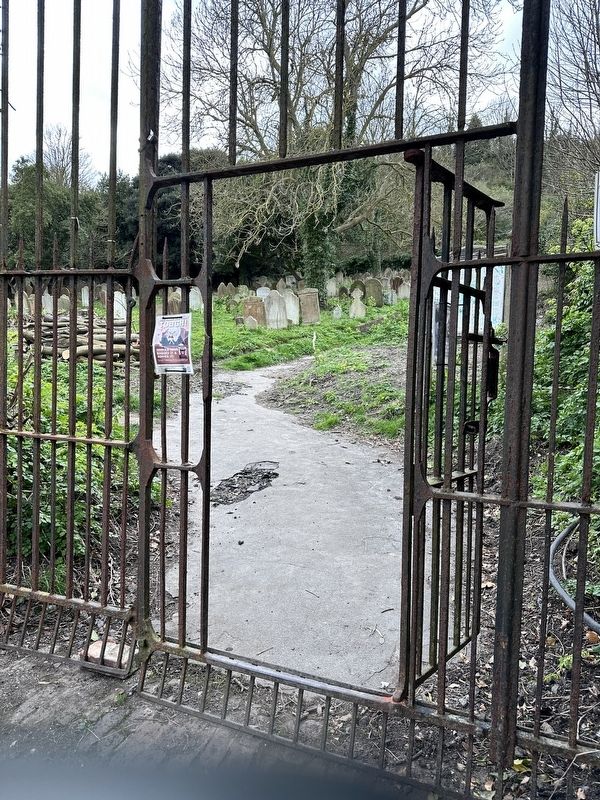
2. The entrance to Cowgate Cemetery
Alien Territory
People who died and were buried outside their country of origin, or indeed outside their country, are termed 'aliens'.
Cowgate has many 'aliens' buried here as it was the first British port of call for the ships that were returning from around the world. Of course there were many deaths on board ships a result of infectious diseases such as typhoid and cholera. It was also a cemetery where many shipwreck and drowned victims were buried.
An interesting example is that of John Charles Nattes, architect of Stowe and drawing master to George III's daughters, who is buried up on the right hand side.
He died in 1839, at the 'City of London Inn', a staging hostel where travellers awaited, or recovered from sea passage between Dover and the Continent.
There is a gravestone to the victim of a shipwreck on the Goodwin Sands, Nathaniel Frederick Harmer, who died on 6th January 1857 on the steam packet SS Violet during a violent storm.
The Snargate Street end of the cemetery
Photographed by Ray Gurganus, April 2, 2026
3. Cowgate Cemetery
Interesting Wildlife
Cowgate is home to a wealth of butterflies, birds, small mammals and reptiles. Cowgate is now being managed for its wildlife and as a place for quiet memorial.
Plant species characteristic of chalk downland such as Marjoram, Black Knapweed, Bird's Foot Trefoil, Common Spotted Orchid, and Pyramidal Orchid can be found in the cemetery.
The grassland is managed by cutting and raking. The cut hay is removed in order to reduce the fertility of the topsoil. This is because chalk plant species thrive on soil of low fertility. The trees, shrubs, long grass, hay piles and log piles offer shelter and food sources to many animals.
Animal Alien
Cowgate even had its own 'alien' animal species'. In 1990 the WCCP discovered a small population of Garden Dormouse Eliomys quercinus living in the cemetery. This was particularly exciting because the Garden Dormouse was not officially recorded as living in Britain, however no further sightings have been reported. This 'alien' normally has a Mediterranean distribution and is found as far north as Cap Griz Nez in France. The WCCP record was the first national record for the occurrence of the Garden Dormouse. How did it get to Cowgate? Did it arrive on a boat or maybe in a lorry? The last time that the Garden Dormouse is known from Britain was from skulls found on archeological digs of Roman sites in York. The Romans used to eat them!
Erected by The Dover Society.
Topics. This historical marker is listed in these topic lists: Animals • Cemeteries & Burial Sites. A significant historical year for this entry is 1835.
Location. 51° 7.458′ N, 1° 18.63′ E. Marker is in Dover, England, in Kent. It is on Cowgate Hill. The marker is located at the entrance to the cemetery, just within the gates. Touch for map. Marker is at or near this postal address: 12 Cowgate Hill, Dover, England CT17 9AY, United Kingdom. Touch for directions.

Regionally, this marker is in the Greater South East. Globally, it is on the Atlantic Ocean, in the North Atlantic Region, in Europe, in Atlantic Europe, on one of the British Isles, in the Western World, and in the Anglosphere. Historically, it finds itself in what was once the Roman Empire.
Other nearby markers. At least 8 other markers are within walking distance of this marker: Instruments of Punishment (about 210 meters away, measured in a direct line); Rebuilt Bank (about 210 meters away); Old Market Hall (about 210 meters away); Market Square (about 210 meters away); a different marker also named Market Square (about 240 meters away); St. Mary’s Church and Cannon Street (approx. 0.2 kilometers away); Thomas Pattenden (approx. 0.3 kilometers away); Dr Reginald Koettlitz (approx. 0.3 kilometers away). Touch for a list and map of all markers in Dover.
Credits. This page was last revised on November 10, 2026. It was originally submitted on November 6, 2026, by Ray Gurganus of Washington, District of Columbia. This page has been viewed 4 times since then. Photos: 1, 2, 3. submitted on November 6, 2026, by Ray Gurganus of Washington, District of Columbia. • Andrew Ruppenstein was the editor who published this page.
