Manchester in Greater Manchester, England, United Kingdom — Northwestern Europe (the British Isles)
Edward Schunck
PhD DSc FRS
| — | 1820–1903 | — |
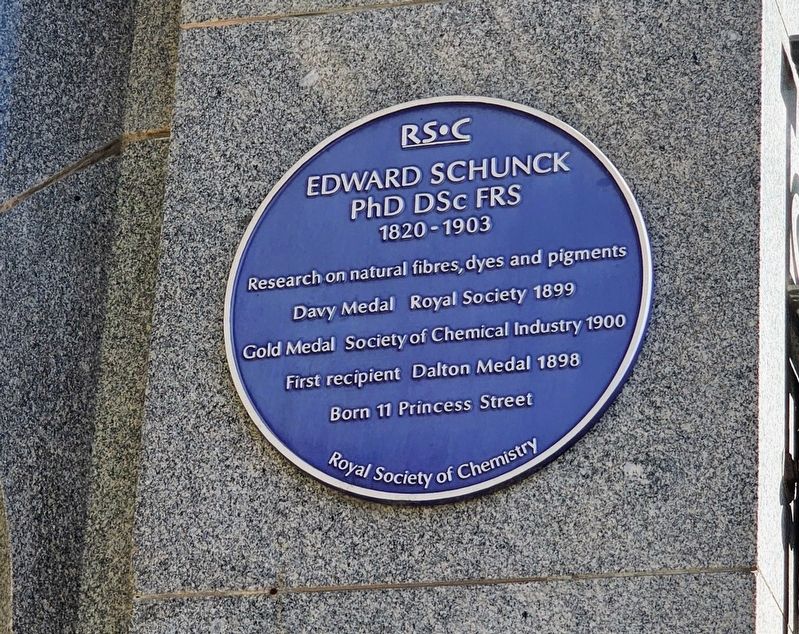
Photographed by Ian Lefkowitz, September 14, 2026
1. Edward Schunck Marker
Davy Medal • Royal Society 1899
Gold Medal • Society of Chemical Industry 1900
First recipient • Dalton Medal 1898
Born 11 Princess Street
Erected by Royal Society of Chemistry.
Topics. This historical marker is listed in this topic list: Science & Medicine. A significant historical year for this entry is 1898.
Location. 53° 28.803′ N, 2° 14.676′ W. Marker is in Manchester, England, in Greater Manchester. It is on Princess Street west of Clarence Street, on the left when traveling east. Touch for map. Marker is at or near this postal address: 7 Princess St, Manchester, England M2 4JW, United Kingdom. Touch for directions.

Regionally, this marker is in North West England. Globally, it is on the Atlantic Ocean, in the North Atlantic Region, in Europe, in Atlantic Europe, on one of the British Isles, in the Western World, and in the Anglosphere. Historically, it finds itself in what was once the Roman Empire.
Other nearby markers. At least 8 other markers are within walking distance of this marker: Ernest Jones (within shouting distance of this marker); John Benjamin Dancer
this page online
Also see . . . Edward Schunck and the History of Dyeing (The University of Manchester Rylands Blog).
Schunck’s special interest was the chemistry of colouring matters found in natural products. He successfully identified the chemical constitution of dyes yielded by plants such as madder and indigo, and although Schunck did not manufacture dyes himself, this research was commercially valuable to the dyeing industry. His work on alizarin, the colouring agent present in madder, paved the way for the synthetic dye alizarine in the 1860s and 1870s.(Submitted on November 8, 2026, by Ian Lefkowitz of New York, New York.)
Additional keywords. blue plaque
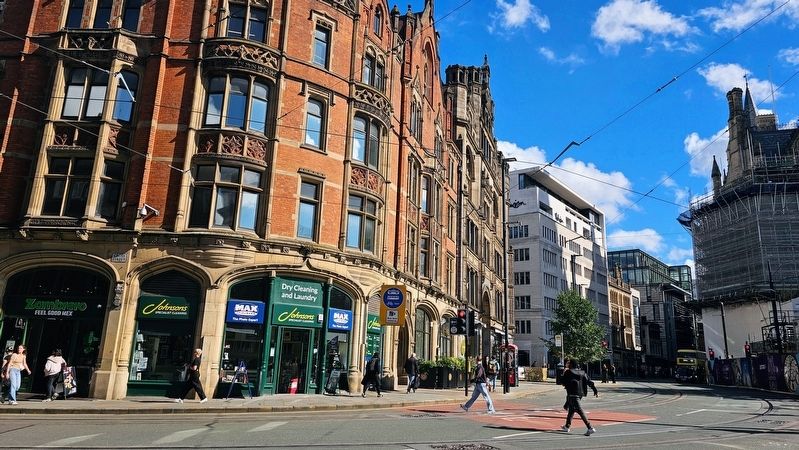
Photographed by Ian Lefkowitz, September 14, 2026
2. Edward Schunck Marker
The plaque is found in the portico of the Northern Assurance Buildings (the archway facing the viewer in this image).
Credits. This page was last revised on November 9, 2026. It was originally submitted on November 8, 2026, by Ian Lefkowitz of New York, New York. This page has been viewed 6 times since then. Photos: 1, 2. submitted on November 8, 2026, by Ian Lefkowitz of New York, New York. • Andrew Ruppenstein was the editor who published this page.
