Near Richmond in Madison County, Kentucky — The American South (East South Central)
Slavery at Pleasant View Farm
Photographed by Lee Hattabaugh, May 6, 2010
1. Slavery at Pleasant View Farm Marker
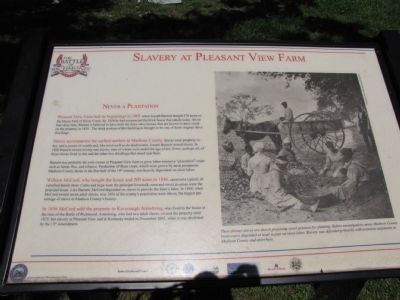
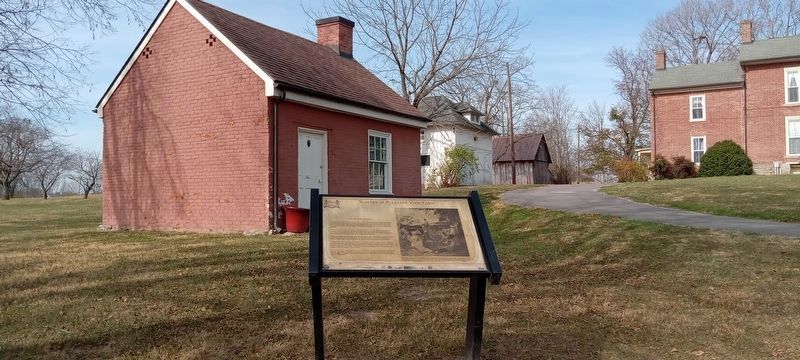
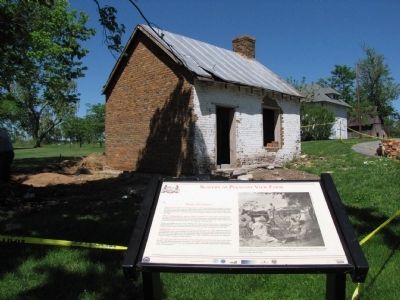
Pleasant View Farm had its beginnings in 1801 when Joseph Barnett bought 578 acres on the Hayes Fork of Silver Creek. By 1824 he had constructed the brick house that stands today. About the same time, Barnett is believed to have built the three slave houses that are known to have stood on the property in 1850. The brick portion of this building is thought to be one of those original slave dwellings.
Slaves accompanied the earliest settlers to Madison County. Slaves were property, labor, and a source of wealth and, like most well-to-do landowners, Joseph Barnett owned slaves. In 1820 Barnett owned twenty-one slaves, nine of whom were under the age of ten. Some, perhaps all, of those slaves lived in this and the other two dwellings that stood near here.
Barnett was probably the only owner of Pleasant View farm to grow labor-intensive "plantation" crops such as hemp, flax, and tobacco. Production of these crops, which were grown by most prosperous Madison County farms in the first half of the 19th century, was heavily dependent on slave labor.
William McCord, who bought the house and 200 acres in 1846, operated
this page online
In 1856 McCord sold the property to Kavenaugh Armstrong, who lived in the house at the time of the Battle of Richmond. Armstrong, who had two adult slaves, owned the property until 1875, but slavery at Pleasant View and in Kentucky ended in December 1865, when it was abolished by the 13th Amendment.
Erected by Civil War Discovery Trail.
Topics. This historical marker is listed in this topic list: War, US Civil. A significant historical month for this entry is December 1865.
Location. 37° 39.844′ N, 84° 15.063′ W. Marker is near Richmond, Kentucky, in Madison County. It can be reached from Battlefield Memorial Highway (U.S. 421), on the right when traveling south. Marker is located on the grounds of the Pleasant View Farm; the Battle of Richmond battlefield park. Touch for map. Marker is
Photographed by Lee Hattabaugh, May 6, 2010
2. Slavery at Pleasant View Farm Marker
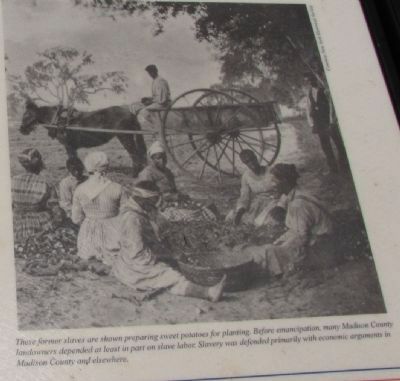
These former slaves are shown preparing sweet potatoes for planting. Before emancipation, many Madison County landowners depended at least in part on slave labor. Slavery was defended primarily with economic arguments in Madison County and elsewhere.

Regionally, this marker is in the American South, specifically in the Upper South, in Appalachia, and specifically in Southern Appalachia. Globally, it is in North America, the Western Hemisphere, the Western World, and the Anglosphere. Historically, it finds itself in what was once the territory of the Mississippian Culture and also the Antebellum South.
Other nearby markers. At least 8 other markers are within walking distance of this marker: Battle of Richmond (here, next to this marker); a different marker also named The Battle of Richmond (here, next to this marker); In Honor and Remembrance (a few steps from this marker); General Thomas Churchill (about 300 feet away, measured in a direct line); The Union Trail (about 300 feet away); "Good, Common-Sense Soldiering" (about 400 feet away); Sharpshooters Check The Union Right (about 500 feet away); Saving the Richmond Battlefield (about 600 feet away). Touch for a list and map of all markers in Richmond.
Additional commentary.
1. Archaeology at Pleasant View
At the time of
Photographed by Craig Doda, November 10, 2022
3. Slavery at Pleasant View Farm Marker
The "Slave Quarters" have been repaired.
— Submitted June 7, 2010, by Lee Hattabaugh of Capshaw, Alabama.
Photographed by Lee Hattabaugh, May 6, 2010
4. Slavery at Pleasant View Farm Marker
Credits. This page was last revised on December 2, 2022. It was originally submitted on June 7, 2010, by Lee Hattabaugh of Capshaw, Alabama. This page has been viewed 2,502 times since then and 89 times this year. Photos: 1, 2. submitted on June 7, 2010, by Lee Hattabaugh of Capshaw, Alabama. 3. submitted on November 15, 2022, by Craig Doda of Napoleon, Ohio. 4. submitted on June 7, 2010, by Lee Hattabaugh of Capshaw, Alabama. • Craig Swain was the editor who published this page.
