
Mitte in Hannover in Region Hannover, Lower Saxony, Germany — Central Europe
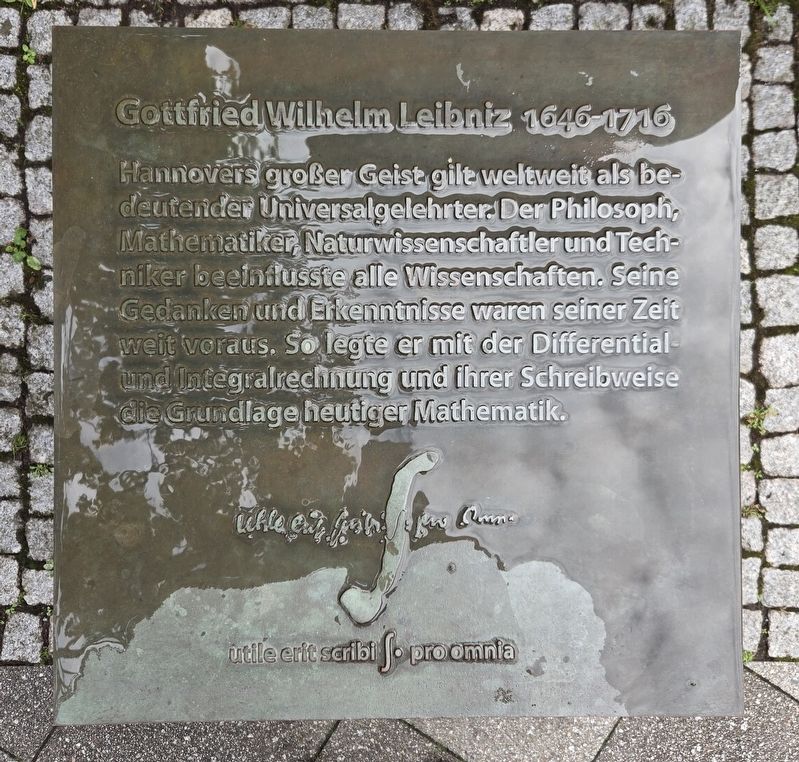
Gottfried Wilhelm Leibniz
1646-1716
Photographed by James Hulse, October 8, 2026
1. Gottfried Wilhelm Leibniz Marker

utile erit scribi ∫ pro omnia
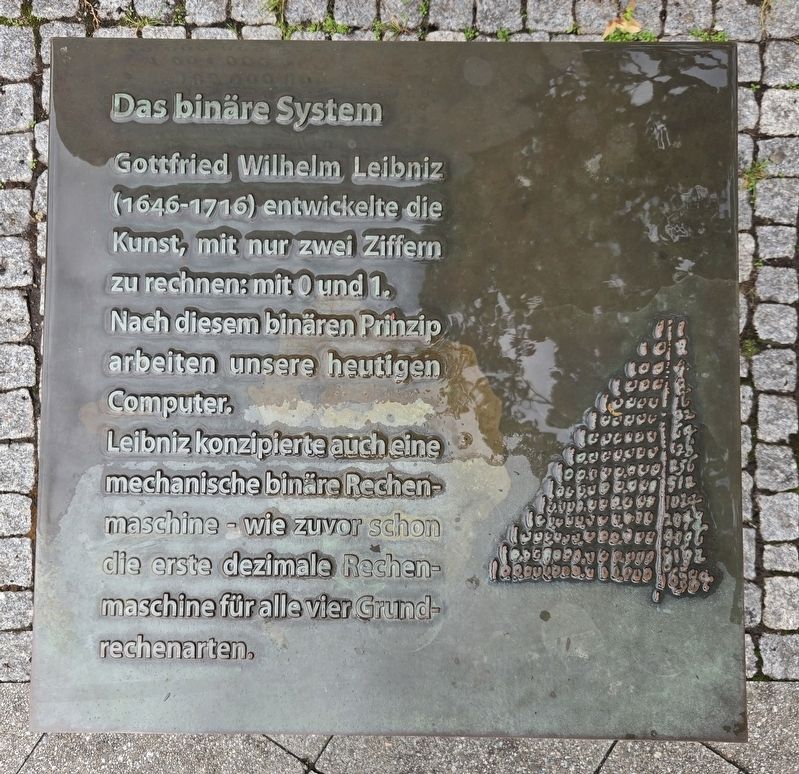
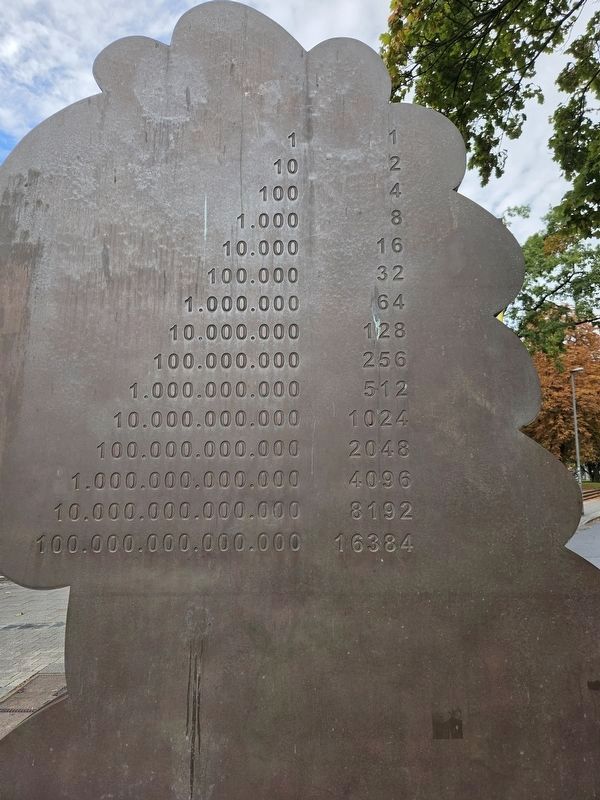
Das binäre System
Gottfried Wilhelm Leibniz (1646-1716) entwickelte die Kunst, mit nur zwei Ziffern zu rechnen: mit 0 und 1. Nach diesem binären Prinzip arbeiten unsere heutigen Computer. Leibniz konzipierte auch eine mechanische binäre Rechenmaschine - wie zuvor schon die erste dezimale Rechenmaschine für alle vier Grundrechenarten.
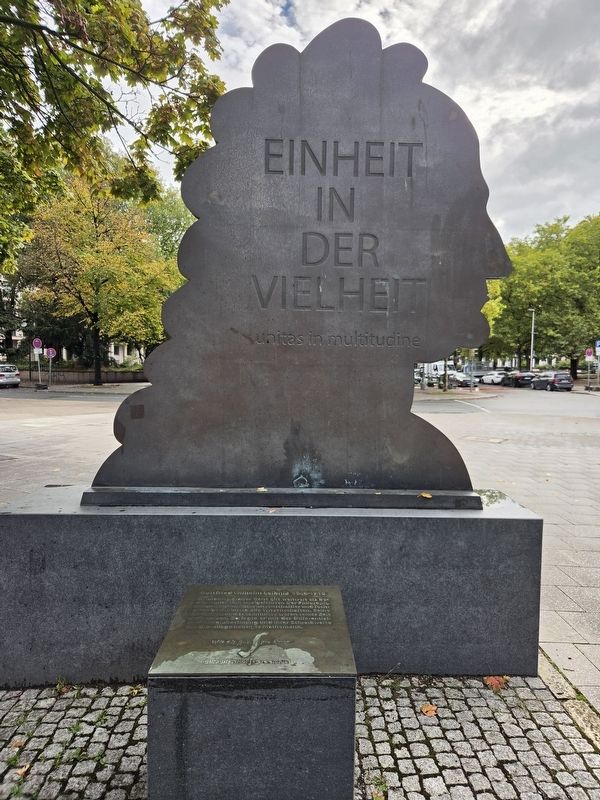
Einheit in der Vielheit
unitas in multitudine
Hanover’s great thinker is recognized worldwide as an important universal scholar. The philosopher, mathematician, natural scientist and engineer influenced every field of knowledge. His thoughts and discoveries were far ahead of his time. Through differential and integral calculus and its notation, he laid the foundation of modern
this page online
It will be useful to write ∫ for all.
The Binary System
Gottfried Wilhelm Leibniz (1646-1716) developed the art of calculating with only two digits: 0 and 1. Today’s computers operate according to this binary principle. Leibniz also designed a mechanical binary calculating machine - as he had previously designed the first decimal calculating machine for all four basic arithmetic operations.
Unity in Diversity
unity in multiplicity
Erected 2008 by H.R.H. Prince Ernst August of Hannover, Duke of Brunswick and Lüneburg, Fritz Behrens Foundation, Deutsche Bank Hannover, Sparda-Bank Hannover Foundation, BHF-BANK Hannover, Volkswagen Commercial Vehicles, CeBIT Hannover, Madsack Publishing Company, Laves Foundation, Hannover Press Club.
Topics. This historical marker is listed in this topic list: Science & Medicine.
Location. 52° 22.281′ N, 9° 44.496′ E. Marker is in Hannover, Niedersachsen (Lower Saxony), in Region Hannover. It is in Mitte. It is at the intersection of Georgstraße and Georgspl., on the right when traveling north on Georgstraße. Touch for map.
Photographed by James Hulse, October 8, 2026
2. Gottfried Wilhelm Leibniz Marker

Regionally, it is in Europe, the European Union, Atlantic Europe, Central Europe, the Schengen Area, Western Europe, and the Western World. Historically, it finds itself in what was once the Holy Roman Empire and also the former West Germany.
Other nearby markers. At least 8 other markers are within walking distance of this marker: Hannoversche Bank / Karl Börgemann (a few steps from this marker); Calenberg Grubenhagensche Landschaft / Calenberg-Grubenhagen Assembly of Estates (about 90 meters away, measured in a direct line); Haus Ebelin (about 120 meters away); Holocaust - Mahnmal / Holocaust Memorial (about 120 meters away); Stadtmauer / City Wall (about 180 meters away); Künstlerhaus / Artists’ House (about 180 meters away); Haus Jasper (about 210 meters away); Sophienstraße 7 (about 210 meters away). Touch for a list and map of all markers in Hannover.
Also see . . . Gottfried Wilhelm Leibniz. Wikipedia
Gottfried Wilhelm Leibniz (or Leibnitz; 1 July 1646 [O.S. 21 June] – 14 November 1716) was a German(Submitted on November 9, 2026, by James Hulse of Medina, Texas.)polymath active as a mathematician, philosopher, scientist, engineer, inventor, historian and diplomat. Alongside Isaac Newton, he is widely credited with the invention of calculus. He is also credited with making foundational contributions to other areas of mathematics, such as binary arithmetic and statistics.Photographed by James Hulse3. Gottfried Wilhelm Leibniz Marker
Photographed by James Hulse
4. The Binary System
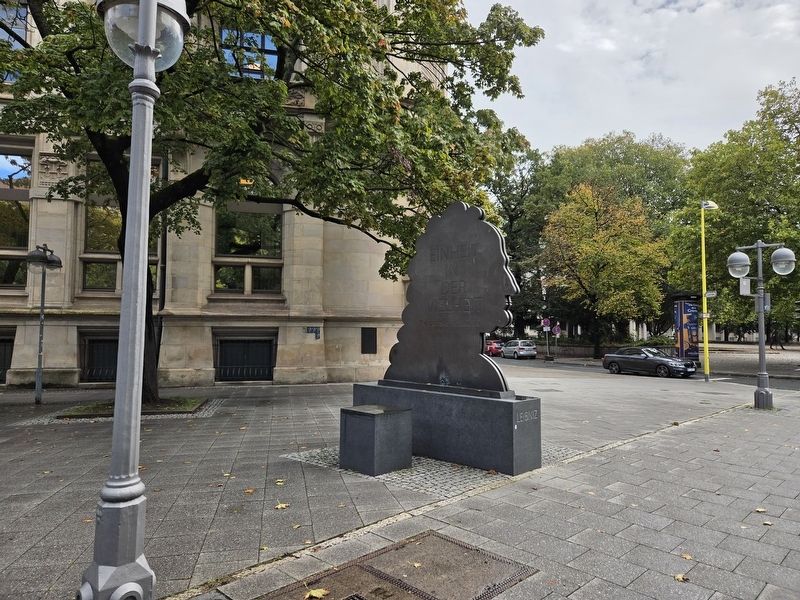
Photographed by James Hulse, October 8, 2026
5. Gottfried Wilhelm Leibniz Marker
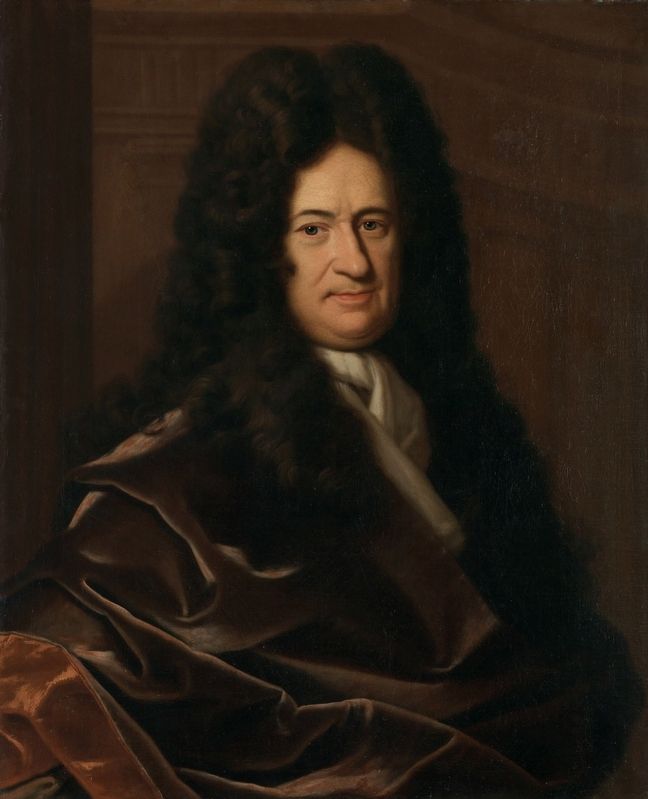
Public Domain via Wikipedia Commons and Artist, Christoph Bernhard Francke, 1695
6. Gottfried Wilhelm Leibniz
Credits. This page was last revised on November 9, 2026. It was originally submitted on November 9, 2026, by James Hulse of Medina, Texas. This page has been viewed 8 times since then. Photos: 1, 2, 3, 4, 5, 6. submitted on November 9, 2026, by James Hulse of Medina, Texas.
