Mitte in Hannover in Region Hannover, Lower Saxony, Germany — Central Europe
Gewerkschaftshaus und Volksheim
⎯⎯⎯
Trade Union Building and People’s Home
Photographed by James Hulse
1. Gewerkschaftshaus und Volksheim / Trade Union Building and People’s Home Marker

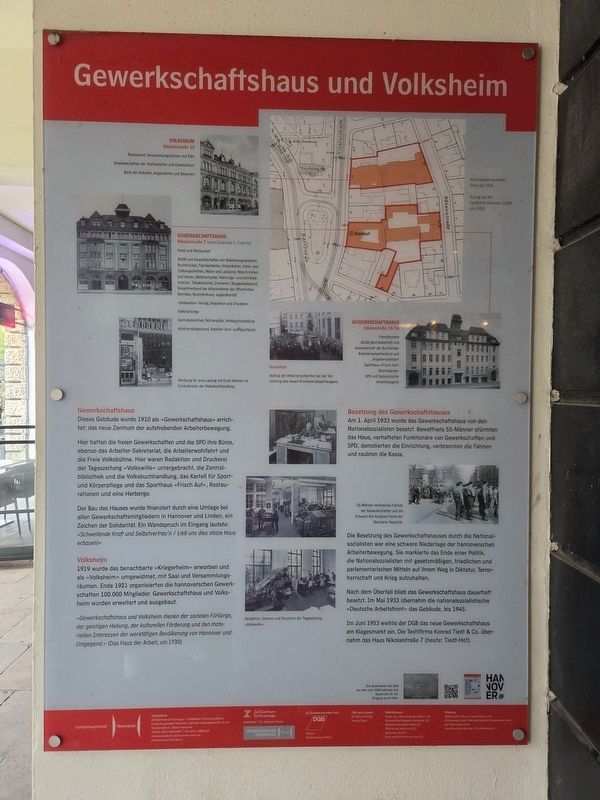
Volksheim – Nikolaistraße 10
Restaurant, Versammlungsräume und Säle; Gewerkschaften der Textilarbeiter und Eisenbahner; Bank der Arbeiter, Angestellten und Beamten.
Gewerkschaftshaus – Nikolaistraße 7, heute Goseriede 4, Tiedt-Hof
Hotel und Restaurant; ADGB und Gewerkschaften der Bekleidungsarbeiter, Buchdrucker, Fabrikarbeiter, Holzarbeiter, Hotel- und Caféangestellten, Maler und Lackierer, Maschinisten und Heizer, Metallarbeiter, Nahrungs- und Getränkearbeiter, Tabakarbeiter, Zimmerer; Baugewerksbund, Gesamtverband der Arbeitnehmer der öffentlichen Betriebe, Beamtenbund, Jugendkartell; »Volkswille«: Verlag, Redaktion und Druckerei; Volksfürsorge; Zentralbibliothek, Büchergilde, Volksbuchhandlung; Arbeitersängerbund, Arbeiter-Turn- und Sportbund.
Gewerkschaftshaus – Odeonstraße 15/16
Fremdenheim; ADGB (Bezirkskartell) und Gewerkschaft der Buchbinder; Arbeitersamariterbund und Arbeiterwohlfahrt; Sporthaus »Frisch Auf«; Reichsbanner; SPD und Sozialistische Arbeiterjugend.
Gewerkschaftshaus
Dieses Gebäude wurde 1910 als »Gewerkschaftshaus« errichtet: das neue Zentrum
this page online
Hier hatten die freien Gewerkschaften und die SPD ihre Büros, ebenso das Arbeiter-Sekretariat, die Arbeiterwohlfahrt und die Freie Volksbühne. Hier waren Redaktion und Druckerei der Tageszeitung »Volkswille« untergebracht, die Zentralbibliothek und die Volksbuchhandlung, das Kartell für Sport- und Körperpflege und das Sporthaus »Frisch Auf«, Restaurationen und eine Herberge.
Der Bau des Hauses wurde finanziert durch eine Umlage bei allen Gewerkschaftsmitgliedern in Hannover und Linden, ein Zeichen der Solidarität. Ein Wandspruch im Eingang lautete: »Schwellende Kraft und Selbstvertrau’n / Ließ uns dies stolze Haus erbauen!«
Volksheim
1919 wurde das benachbarte »Kriegerheim« erworben und als »Volksheim« umgewidmet, mit Saal und Versammlungsräumen. Ende 1921 organisierten die hannoverschen Gewerkschaften 100.000 Mitglieder. Gewerkschaftshaus und Volksheim wurden erweitert und ausgebaut.
»Gewerkschaftshaus und Volksheim dienen der sozialen Fürsorge, der geistigen Hebung, der kulturellen Förderung und den materiellen Interessen der werktätigen Bevölkerung von Hannover und Umgegend.« (Das
Photographed by James Hulse, October 8, 2026
2. Gewerkschaftshaus und Volksheim / Trade Union Building and People’s Home Marker
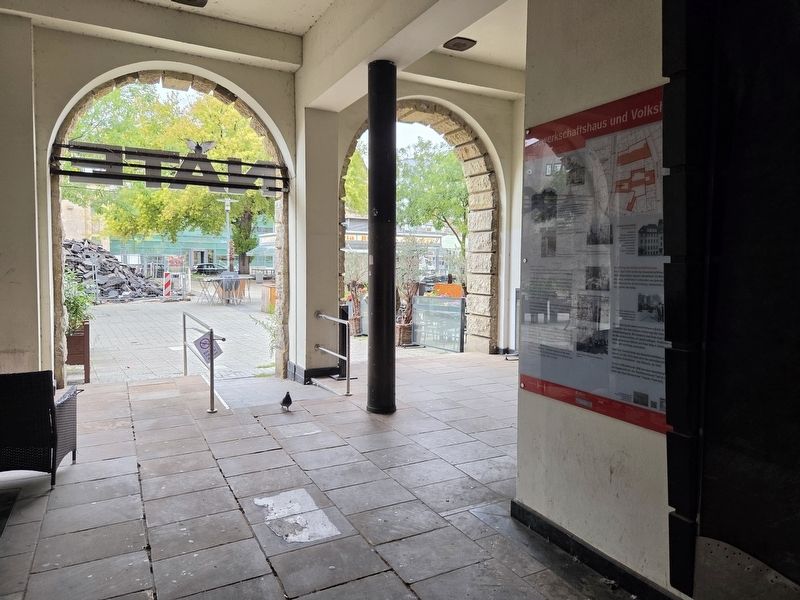
The marker is located under the portico.
Besetzung des Gewerkschaftshauses
Am 1. April 1933 wurde das Gewerkschaftshaus von den Nationalsozialisten besetzt. Bewaffnete SS-Männer stürmten das Haus, verhafteten Funktionäre von Gewerkschaften und SPD, demolierten die Einrichtung, verbrannten die Fahnen und raubten die Kasse.
Die Besetzung des Gewerkschaftshauses durch die Nationalsozialisten war eine schwere Niederlage der hannoverschen Arbeiterbewegung. Sie markierte das Ende einer Politik, die Nationalsozialisten mit gesetzmäßigen, friedlichen und parlamentarischen Mitteln auf ihrem Weg in Diktatur, Terrorherrschaft und Krieg aufzuhalten.
Nach dem Überfall blieb das Gewerkschaftshaus dauerhaft besetzt. Im Mai 1933 übernahm die nationalsozialistische »Deutsche Arbeitsfront« das Gebäude, bis 1945.
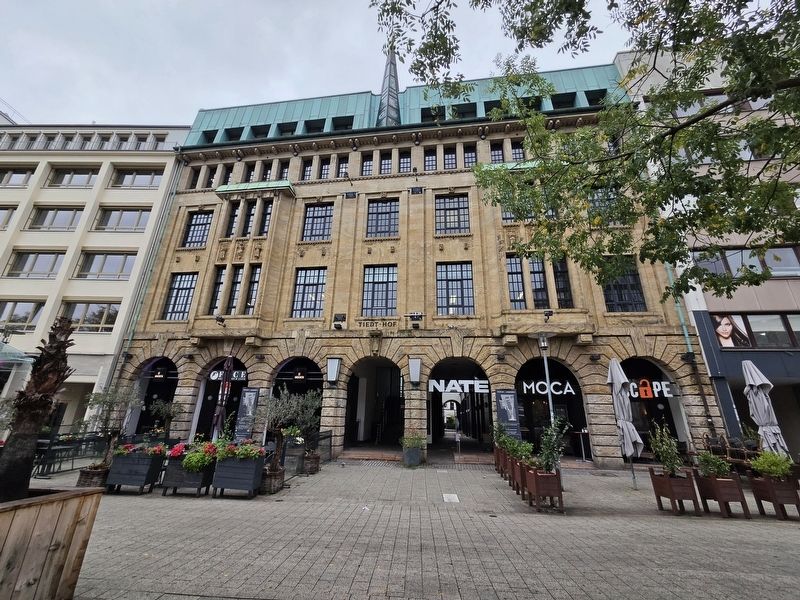
Im Juni 1953 weihte der DGB das neue Gewerkschaftshaus am Klagesmarkt ein. Die Textilfirma Konrad Tiedt & Co. übernahm das Haus Nikolaistraße 7 (heute: Tiedt-Hof).
Trade Union Building and People’s Home
People’s Home – Nikolaistraße 10
Restaurant, meeting rooms and halls; unions of textile workers and railway workers;
Photographed by James Hulse, October 8, 2026
3. Gewerkschaftshaus und Volksheim / Trade Union Building and People’s Home Marker
Trade Union Building – Nikolaistraße 7, now Goseriede 4, Tiedt-Hof
Hotel and restaurant; General German Trade Union Federation and unions of garment workers, printers, factory workers, woodworkers, hotel and café employees, painters and varnishers, machinists and stokers, metalworkers, food and beverage workers, tobacco workers and carpenters; Building Trades Federation, General Federation of Employees of Public Enterprises, Civil Servants’ Federation and Youth Council; »Volkswille« publishing house, editorial office and printing plant; workers’ welfare insurance; central library, book guild and people’s bookshop; Workers’ Singers Federation and Workers’ Gymnastics and Sports Federation.
Trade Union Building – Odeonstraße 15/16
Guesthouse; district organization of the General German Trade Union Federation and the Bookbinders’ Union; Workers’ Samaritan Federation and Workers’ Welfare Association; »Frisch Auf« sporting-goods store; Reichsbanner; Social Democratic Party and Socialist Workers’ Youth.
Trade Union Building
This building was constructed in 1910 as the »Trade Union Building«, the new center of the growing labor movement.
The independent trade unions and the Social Democratic Party maintained their offices here, as did the Workers’ Secretariat, the Workers’ Welfare Association and the Free People’s Theater. The building also housed the editorial office and printing plant of the daily newspaper »Volkswille«, the central library and people’s bookshop, the Federation for Sports and Physical Fitness, the »Frisch Auf« sporting-goods store, restaurants and a hostel.
Construction of the building was financed through an assessment paid by every trade-union member in Hannover and Linden, demonstrating their solidarity. An inscription in the entrance read: »Growing strength and self-confidence / Let us build this proud house!«
People’s Home
In 1919, the neighboring »Veterans’ Home« was acquired and converted into a »People’s Home« with a hall and meeting rooms. By the end of 1921, Hannover’s trade unions represented 100,000 members. The Trade Union Building and People’s Home were enlarged and improved.
»The Trade Union Building and People’s Home serve the social welfare, intellectual advancement, cultural development and material interests of the working population of Hannover and the surrounding area.« (The House of Labor, about 1930)
Occupation of the Trade Union Building
On April 1, 1933, the National Socialists occupied the Trade Union Building. Armed SS men stormed the building, arrested trade-union and Social Democratic Party officials, demolished the furnishings, burned the flags and stole the treasury.
The National Socialist occupation of the Trade Union Building was a severe defeat for Hannover’s labor movement. It marked the end of a policy that sought to stop the National Socialists on their path toward dictatorship, terror and war through lawful, peaceful and parliamentary means.
Following the raid, the Trade Union Building remained permanently occupied. In May 1933, the National Socialist »German Labor Front« took over the building and retained it until 1945.
In June 1953, the German Trade Union Confederation dedicated its new Trade Union Building on Klagesmarkt. The textile company Konrad Tiedt & Co. took over the building at Nikolaistraße 7, now known as Tiedt-Hof.
Erected 2021 by City of Hannover, German Trade Union Confederation, Lower Saxony-Central District.
Topics. This historical marker is listed in these topic lists: Labor Unions • Notable Buildings. A significant historical date for this entry is April 1, 1933.
Location. 52° 22.64′ N, 9° 43.967′ E. Marker is in Hannover, Niedersachsen (Lower Saxony), in Region Hannover. It is in Mitte. It is at the intersection of Goseriede and Kurt-Schumacher-Straße, on the right when traveling north on Goseriede. Touch for map. Marker is at or near this postal address: Goseriede 4, Hannover NI 30159, Germany. Touch for directions.

Regionally, it is in Europe, the European Union, Atlantic Europe, Central Europe, the Schengen Area, Western Europe, and the Western World. Historically, it finds itself in what was once the Holy Roman Empire and also the former West Germany.
Other nearby markers. At least 8 other markers are within walking distance of this marker: Nicolaikapelle / St. Nicholas Chapel (within shouting distance of this marker); Anzeiger-Hochhaus / Anzeiger High-Rise (within shouting distance of this marker); Justus Bier (within shouting distance of this marker); Der St. Nikolai-Friedhof / St. Nikolai Cemetery (about 90 meters away, measured in a direct line); Isidor Maissner (about 180 meters away); Bernhard Maissner (about 180 meters away); Regina Rivka Maissner (about 180 meters away); Isaac Maissner (about 180 meters away). Touch for a list and map of all markers in Hannover.
Credits. This page was last revised on November 12, 2026. It was originally submitted on November 10, 2026, by James Hulse of Medina, Texas. This page has been viewed 6 times since then. Photos: 1, 2, 3. submitted on November 12, 2026, by James Hulse of Medina, Texas.
