Mitte in Hannover in Region Hannover, Lower Saxony, Germany — Central Europe
Der St. Nikolai-Friedhof
Geschichte und bedeutende Grabmale
⎯⎯⎯
St. Nikolai Cemetery
History and Significant Grave Monuments
Photographed by James Hulse, October 8, 2026
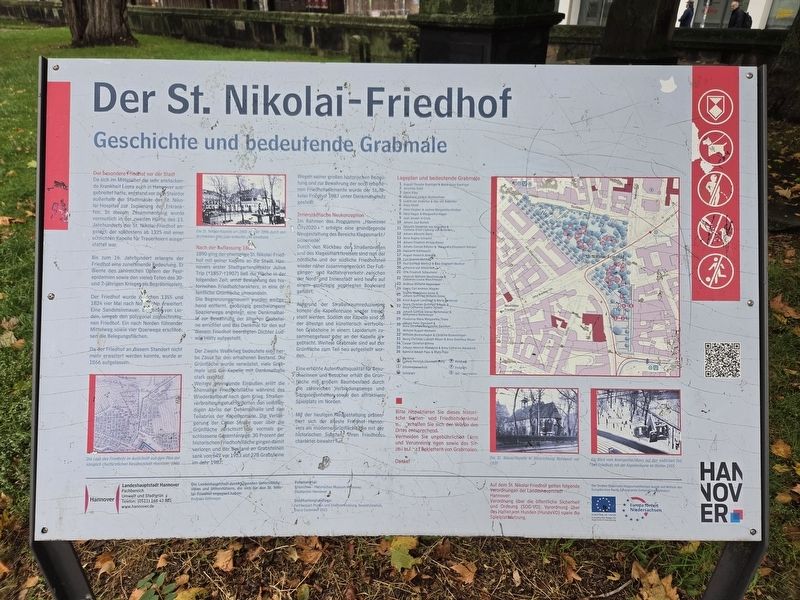
1. Der St. Nikolai-Friedhof / St. Nikolai Cemetery Marker

Da sich im Mittelalter die sehr ansteckende Krankheit Lepra auch in Hannover ausgebreitet hatte, entstand vor dem Steintor außerhalb der Stadtmauer das St. Nikolai-Hospital zur Isolierung der Erkrankten. In diesem Zusammenhang wurde vermutlich in der zweiten Hälfte des 13. Jahrhunderts der St. Nikolai-Friedhof angelegt, der spätestens ab 1325 mit einer schlichten Kapelle für Trauerfeiern ausgestattet war.
Bis zum 16. Jahrhundert erlangte der Friedhof eine zunehmende Bedeutung. Er diente den zahlreichen Opfern der Pestepidemien sowie den vielen Toten des 30- und 7-jährigen Krieges als Begräbnisplatz.
Der Friedhof wurde zwischen 1355 und 1824 vier Mal nach Norden hin erweitert. Eine Sandsteinmauer, begleitet von Linden, umgab den polygonal zugeschnittenen Friedhof. Ein nach Norden führender Mittelweg sowie vier Querwege erschlossen die Belegungsflächen.
Da der Friedhof an diesem Standort nicht mehr erweitert werden konnte, wurde er 1866 aufgelassen.
Nach der Auflassung 1890
1890 ging der ehemalige St. Nikolai-Friedhof mit seiner Kapelle an die Stadt. Hannovers erster
this page online
Die Begrenzungsmauern wurden weitgehend entfernt, großzügig geschwungene Spazierwege angelegt, eine Denkmalhalle zur Bewahrung der ältesten Grabsteine errichtet und das Denkmal für den auf diesem Friedhof beerdigten Dichter Ludwig Hölty aufgestellt.
Der Zweite Weltkrieg bedeutete eine herbe Zäsur für den erhaltenen Bestand. Die Grünfläche wurde verwüstet, viele Grabmale und die Kapelle mit Denkmalhalle stark zerstört.
Weitere gravierende Einbußen erlitt die ehemalige Friedhofsfläche während des Wiederaufbaus nach dem Krieg. Straßenverbreiterungen erforderten den vollständigen Abriss der Denkmalhalle und den Teilabriss der Kapellenruine. Die Verlängerung der Celler Straße quer über die Grünfläche zerschnitt die vormals geschlossene Gesamtanlage. 30 Prozent der historischen Friedhofsfläche gingen damit verloren und der Bestand an Grabsteinen sank von 667 vor 1953 auf 278 Grabsteine im Jahr 1987.
Wegen seiner großen historischen Bedeutung und zur
Photographed by James Hulse, October 7, 2026
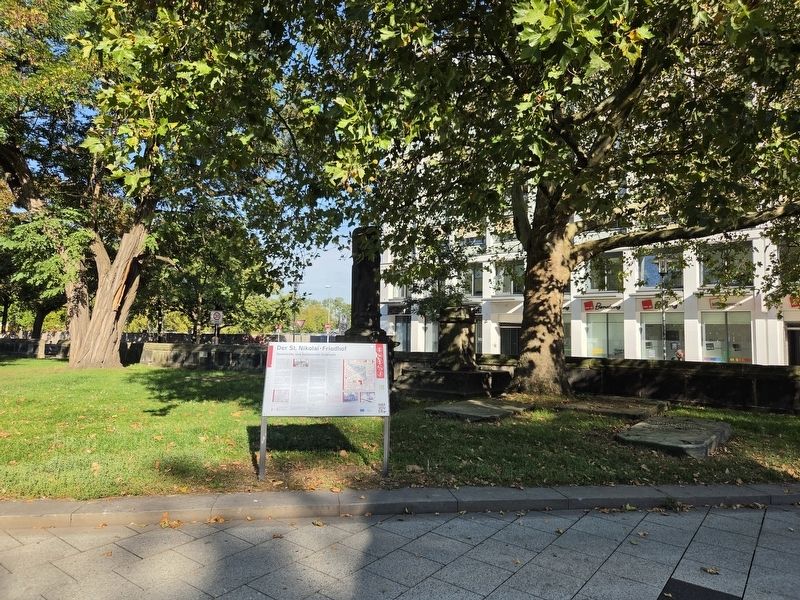
2. Der St. Nikolai-Friedhof / St. Nikolai Cemetery Marker
Innerstädtische Neukonzeption
Im Rahmen des Programms 'Hannover City2020+' erfolgte eine grundlegende Neugestaltung des Bereichs Klagesmarkt/Goseriede.
Durch den Rückbau der Straßenbreiten und des Klagesmarktkreisels sind nun der nördliche und der südliche Friedhofsteil wieder näher zusammengerückt. Der Fußgänger- und Radfahrerverkehr zwischen der Nord- und Innenstadt wird heute auf einem großzügig angelegten Boulevard geführt.
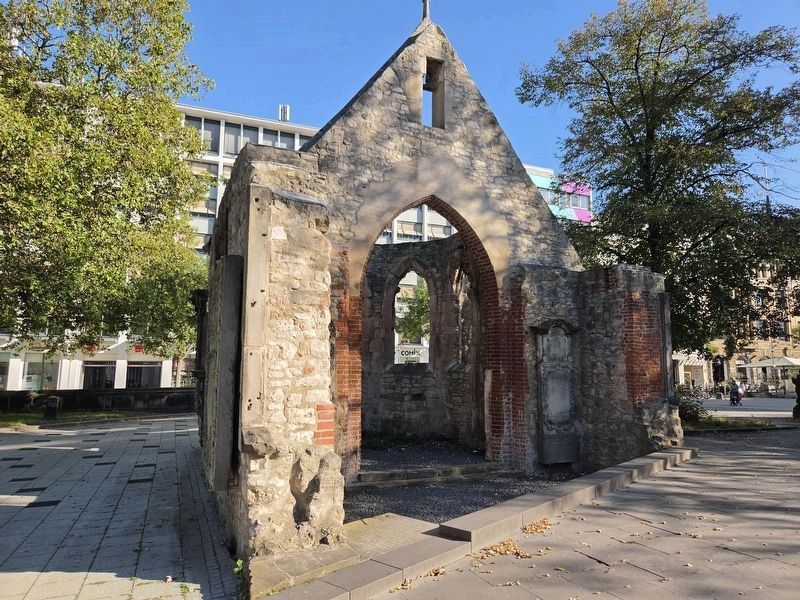
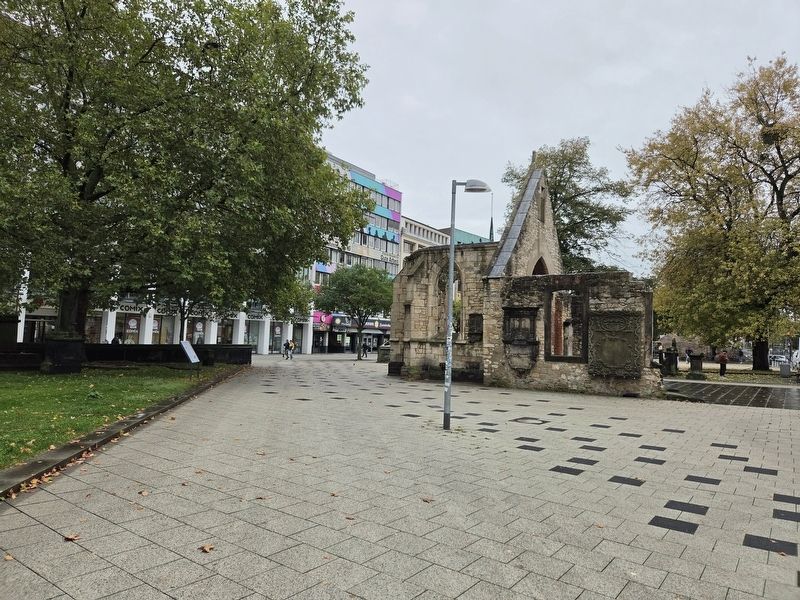
Aufgrund der Straßenraumreduzierung konnte die Kapellenruine wieder freigestellt werden. Südlich der Kapelle sind 26 der ältesten und künstlerisch wertvollsten Grabsteine in einem Lapidarium zusammengefasst oder an der Kapelle angebracht. Weitere Grabmale sind auf der Grünfläche zum Teil neu aufgestellt worden.
Eine erhöhte Aufenthaltsqualität für Besucherinnen und Besucher erhält die Grünfläche mit großem Baumbestand durch die zahlreichen Verbindungswege und Sitzgelegenheiten sowie den attraktiven Spielplatz im Norden.
Mit der heutigen Neugestaltung präsentiert sich der älteste Friedhof
Photographed by James Hulse, October 8, 2026
3. St. Nikolai Chapel
Die St. Nikolai-Kapelle um 1900 mit der 1898 durch den Architekten Otto Lüer erbauten Denkmalhalle.
Die Lage des Friedhofs im Ausschnitt aus dem Plan der königlich churfürstlichen Residenzstadt Hannover, 1800.
Die St. Nikolai-Kapelle in Blickrichtung Nordwest, vor 1939.
Ein Blick vom Anzeigerhochhaus auf den südlichen Teil des Friedhofs mit der Kapellenruine im Winter 1955.
The Special Cemetery Outside the City
Because the highly contagious disease leprosy had also spread through Hannover during the Middle Ages, St. Nikolai Hospital was established outside the city wall beyond the Steintor to isolate those suffering from the disease. In connection with the hospital, St. Nikolai Cemetery was probably established during the second half of the 13th century. By 1325 it had been provided with a simple chapel for funeral services.
By the 16th century, the cemetery had gained increasing importance. It served as the burial place for numerous victims of plague epidemics and for many of those who
Photographed by James Hulse, October 8, 2026
4. Der St. Nikolai-Friedhof / St. Nikolai Cemetery Marker
Between 1355 and 1824, the cemetery was expanded northward four times. A sandstone wall lined with linden trees surrounded the irregularly shaped cemetery. A central path leading north and four cross paths provided access to the burial sections.
Because the cemetery could no longer be expanded at this location, it was closed in 1866.
After Its Closure in 1890
In 1890, the former St. Nikolai Cemetery and its chapel were transferred to the city. Hannover’s first municipal garden director, Julius Trip (*1857–†1907), subsequently converted the grounds into a public green space while preserving their historic cemetery character.
Most of the boundary walls were removed, broad curving paths were laid out, a memorial hall was erected to preserve the oldest gravestones and a monument was installed for the poet Ludwig Hölty, who had been buried in this cemetery.
The Second World War caused a severe disruption to the surviving historic features. The green space was devastated, and many grave monuments and the chapel with its memorial hall were badly damaged.
The former
Photographed by James Hulse, October 8, 2026
5. Der St. Nikolai-Friedhof / St. Nikolai Cemetery Marker
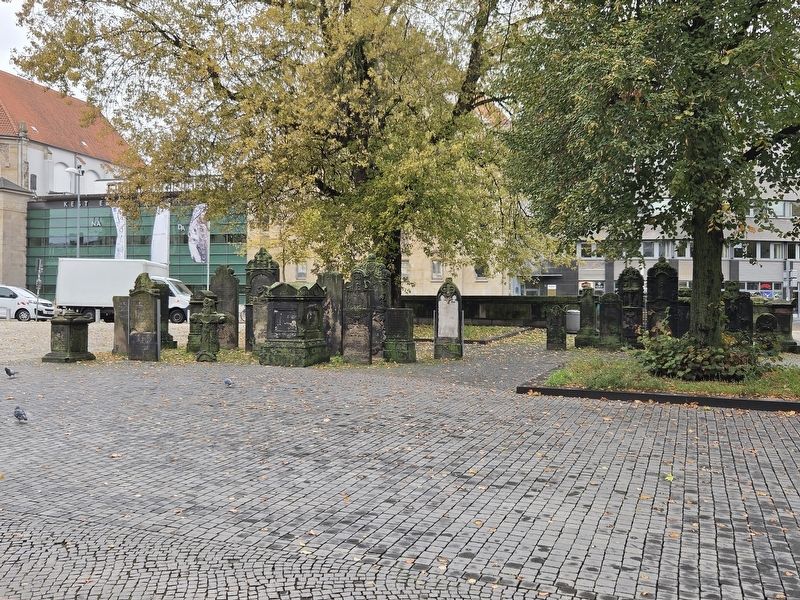
A section of graves next to the ruins of the chapel.
Because of its great historical importance and to preserve the remaining cemetery features, St. Nikolai Cemetery was placed under historic preservation protection in 1987.
Redesign of the Inner-City Area
As part of the 'Hannover City2020+' program, the Klagesmarkt and Goseriede area underwent a fundamental redesign.
The narrowing of the streets and removal of the Klagesmarkt traffic circle brought the northern and southern sections of the cemetery closer together again. Pedestrian and bicycle traffic between the northern and central parts of the city now travels along a generously designed boulevard.
The reduction of the street space allowed the chapel ruins to be exposed once again. South of the chapel, 26 of the oldest and most artistically significant gravestones have been assembled in a lapidarium or attached to the chapel. Other grave monuments have been reinstalled in various places throughout the green space.
The green space, with its large population of mature trees, offers visitors an improved environment through its numerous connecting paths, seating areas and attractive playground in the northern section.
With its present redesign, Hannover’s oldest cemetery appears as a modern green space that preserves its cemetery character through the survival of its historic features.
St. Nikolai Chapel around 1900 with the memorial hall built in 1898 by architect Otto Lüer.
The cemetery’s location in a section of the plan of the Electoral Residence City of Hannover, 1800.
St. Nikolai Chapel viewed toward the northwest, before 1939.
A view from the Anzeiger high-rise building across the southern section of the cemetery and the chapel ruins in the winter of 1955.
Erected 2015 by City of Hannover, Department of Environment and Urban Green Spaces.
Topics. This historical marker is listed in this topic list: Cemeteries & Burial Sites. A significant historical year for this entry is 1325.
Location. 52° 22.683′ N, 9° 43.937′ E. Marker is in Hannover, Niedersachsen (Lower Saxony), in Region Hannover. It is in Mitte. It is on Goseriede 0.1 kilometers south of Celler Str., on the left when traveling south. Touch for map. Marker is at or near this postal address: Goseriede 12D, Hannover NI 30159, Germany. Touch for directions.

Regionally, it is in Europe, the European Union, Atlantic Europe, Central Europe, the Schengen Area, Western Europe, and the Western World. Historically, it finds itself in what was once the Holy Roman Empire and also the former West Germany.
Other nearby markers. At least 8 other markers are within walking distance of this marker: Nicolaikapelle / St. Nicholas Chapel (a few steps from this marker); Gewerkschaftshaus und Volksheim / Trade Union Building and People’s Home (about 90 meters away, measured in a direct line); Justus Bier (about 90 meters away); Anzeiger-Hochhaus / Anzeiger High-Rise (about 120 meters away); a different marker also named Der St. Nikolai-Friedhof / St. Nikolai Cemetery (about 120 meters away); Der Klagesmarkt (about 150 meters away); Isidor Maissner (approx. 0.2 kilometers away); Bernhard Maissner (approx. 0.2 kilometers away). Touch for a list and map of all markers in Hannover.
More about this marker. This is one of two identical markers in the cemetery, each at a different locations in the cemetery.
Credits. This page was last revised on November 12, 2026. It was originally submitted on November 10, 2026, by James Hulse of Medina, Texas. This page has been viewed 7 times since then. Photos: 1, 2, 3, 4, 5. submitted on November 12, 2026, by James Hulse of Medina, Texas.
