
Saint Marks in Wakulla County, Florida — The American South (South Atlantic)
St. Marks & the Civilian Conservation Corps
Photographed by Cosmos Mariner, September 22, 2024
1. St. Marks & the Civilian Conservation Corps Marker
A Peacetime Army
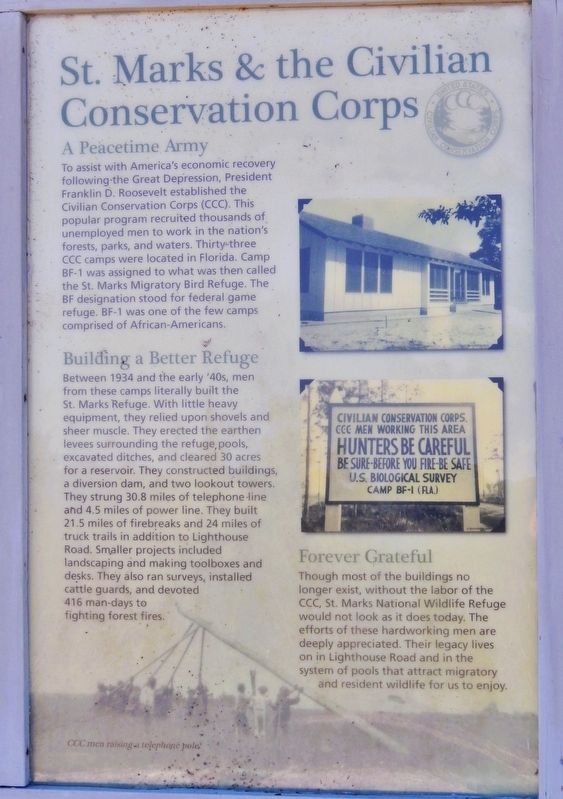
To assist with America's economic recovery following the Great Depression, President Franklin D. Roosevelt established the Civilian Conservation Corps (CCC). This popular program recruited thousands of unemployed men to work in the nation's forests, parks, and waters. Thirty-three CCC camps were located in Florida. Camp BF-1 was assigned to what was then called the St. Marks Migratory Bird Refuge. The BF designation stood for federal game refuge. BF-1 was one of the few camps comprised of African-Americans.
Building a Better Refuge
Between 1934 and the early '40s, men from these camps literally built the St. Marks Refuge. With little heavy equipment, they relied upon shovels and sheer muscle. They erected the earthen levees surrounding the refuge, pools, excavated ditches, and cleared 30 acres for a reservoir. They constructed buildings, a diversion dam, and two lookout towers. They strung 30.8 miles of telephone line and 4.5 miles of power line. They built 21.5 miles of firebreaks and 24 miles of truck trails in addition to Lighthouse Road. Smaller projects included landscaping and making toolboxes and desks.
this page online
Forever Grateful
Though most of the buildings no longer exist, without the labor of the CCC, St. Marks National Wildlife Refuge would not look as it does today. The efforts of these hardworking men are deeply appreciated. Their legacy lives on in Lighthouse Road and in the system of pools that attract migratory and resident wildlife for us to enjoy.
[background image caption] CCC men raising a telephone pole
Topics and series. This historical marker is listed in these topic lists: African Americans • Charity & Public Work • Parks & Recreational Areas. In addition, it is included in the Civilian Conservation Corps (CCC) series list. A significant historical year for this entry is 1934.
Location. 30° 7.796′ N, 84° 8.707′ W. Marker is in Saint Marks, Florida, in Wakulla County. It is on Lighthouse Road (County Road 59) 5½ miles south of U.S. 98, on the right when traveling south. The marker is in the Saint Marks National Wildlife Refuge, in a pullout just north of the Light House Road Boat Ramp. Touch for map. Marker is in this post
Courtesy St. Marks NWR file photo
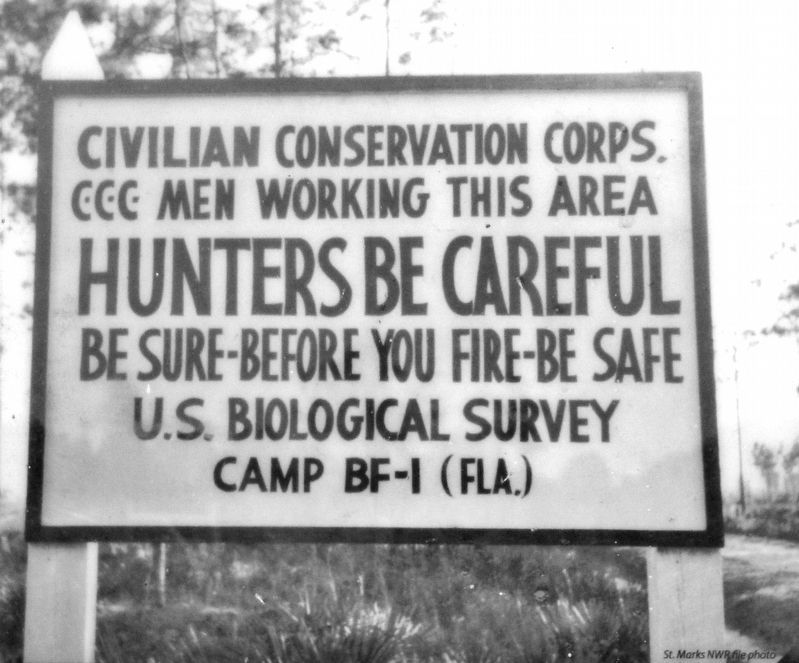
2. Marker detail: CCC Camp BF-1 Sign
CCC men working this area
Hunters Be Careful
Be sure – before you fire – be safe
U.S. Biological Survey
Camp BF-1 (Fla.)

Regionally, this marker is in Florida’s Big Bend and in Greater Tallahassee. It is also in the American South, specifically in the Deep South, and on the Gulf Coast. Globally, it is in the North Atlantic Region, North America, a Gulf of Mexico state, the Western Hemisphere, the Western World, and the Anglosphere. Historically, it finds itself in what was once New Spain, the territory of the Mississippian Culture, one of the Confederate States of America, and the Antebellum South.
Other nearby markers. At least 8 other markers are within 4 miles of this marker, measured as the crow flies: Salt Works (here, next to this marker); Port Leon (approx. 1½ miles away); Fatal B-17 Crash On St. Marks National Wildlife Refuge (approx. 3.2 miles away); Bo Lynn's Grocery (approx. 3.9 miles away); a different marker also named Port Leon (approx. 3.9 miles away); Telltale Bones (approx. 3.9 miles away); St. Marks Bike Trail Park (approx. 4 miles away); The City of St. Marks (approx. 4 miles away).
Another marker is no longer nearby. Port Leon
Photographed by Cosmos Mariner, September 22, 2024
3. St. Marks & the Civilian Conservation Corps Marker
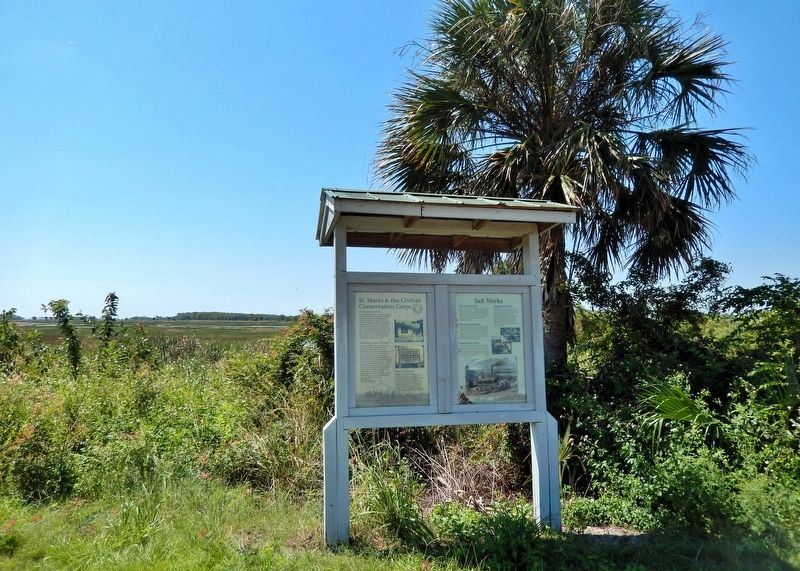
This marker is the leftmost of two panels in the interpretive kiosk at this location.
Also see . . . Civilian Conservation Corps (CCC) (St. Marks Wildlife Refuge).
Excerpt: Between 1934 and the early 1940s, men from this camp built the refuge. Heavy equipment used to construct roads and impoundments included dump trucks, draglines, a bulldozer, and a rock crusher, but most of the work depended on the muscles and skills of the men. Almost everything was fabricated by the CCC men. Poles that carried the power and telephone lines, fence posts, and cypress for siding and roofing were cut on the refuge and trimmed by hand. They strung 30.8 miles of telephone line and 4.5 miles of power line, cleared a 24-mile truck trail, 21.5 miles of firebreaks, ran surveys, installed cattle guards, and devoted 416 man-days to fighting forest fires. Smaller projects included building toolboxes and desks, and landscaping. Their work was deeply appreciated by the staff.(Submitted on November 14, 2026, by Cosmos Mariner of Cape Canaveral, Florida.)
Credits. This page was last revised on November 14, 2026. It was originally submitted on November 13, 2026, by Cosmos Mariner of Cape Canaveral, Florida. This page has been viewed 9 times since then. Photos: 1, 2, 3. submitted on November 13, 2026, by Cosmos Mariner of Cape Canaveral, Florida.
