
Gay Village in Manchester in Greater Manchester, England, United Kingdom — Northwestern Europe (the British Isles)
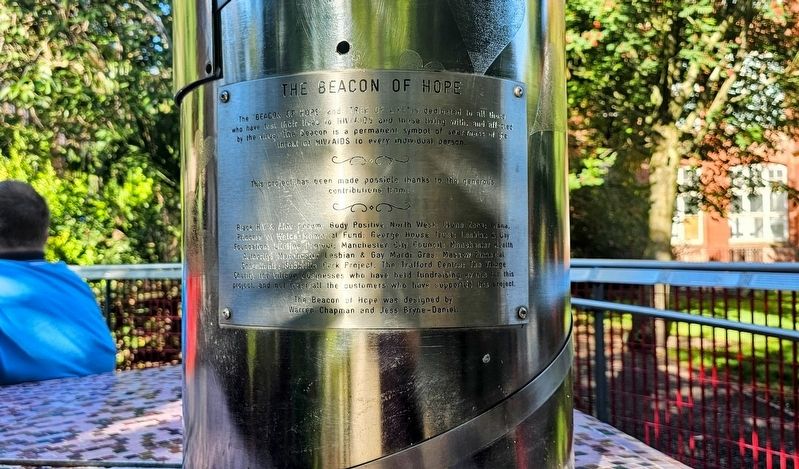
The Beacon of Hope
Photographed by Ian Lefkowitz, September 14, 2026
1. The Beacon of Hope Marker
The Beacon of Hope
The “Beacon of Hope” and “Tree of Life” is dedicated to all those who have lost their lives to HIV/AIDS and those living with, and affected by the virus. The Beacon is a permanent symbol of awareness of the threat of HIV/AIDS to every individual person.
This project has been made possible thanks to the generous contributions from:
Black HIV & AIDS Forum • Body Positive North West • Clone Zone • Diana, Princess of Wales Memorial Fund • George House Trust • Lesbian & Gay Foundation • Lifeline Project • Manchester City Council • Manchester Health Authority • Manchester Lesbian & Gay Mardi Gras • Massow Financial Consultants • Sackville Park Project • The Trafford Centre • The Village Charity • the Village businesses who have held fundraising events for this project, and not least all the customers who have supported this project.
The Beacon of Hope was designed by
Warren Chapman and Jess Bryne-Daniel.
1981
Rumour: First signs of the epidemic in the USA and the New York press reports on a kind of cancer. Panic and politics ignite the West Coast of America as the US Centre for Disease Control publish the first
this page online
1982
Beginnings: Gay Related Immune Deficiency (GRID) becomes Acquired Immunodeficiency Syndrome (AIDS) as symptoms are reported beyond the gay community. Doctors continue to investigate but the public remain ill-informed and frightened. A gay man called Terry Higgins dies of AIDS in a London hospital. His friends set up a trust in his name to start the fight against the disease.
1983
Virus: Doctors isolate the virus which is thought to lead to AIDS (later named as HIV). However, arguments in the scientific community over who discovered the virus delay vital research into treatment and testing. As death rates continue to rise, London Gay Switchboard calls a public meeting. The Terry Higgins Trust becomes the Terrence Higgins Trust and produces the UKs first leaflet on AIDS.
1984
Myths: Knowledge of HIV grows, but in the wider community the epidemic is still characterised by myth. With reported cases of AIDS on the rise in the UK, gay men still remain the group most affected, prompting attacks in

Photographed by Ian Lefkowitz, September 14, 2026
2. The Beacon of Hope Marker
The marker is affixed to the Beacon of Hope, a public artwork in Sackville Gardens.
1985
Communities: The first commercial anti-HIV drug becomes widely available. However, the drug is expensive and poorer countries remain devastated by HIV. In the western world, communities come together to fight the virus. Body Positive (London) opens as the first self help group for people living with HIV. Manchester AIDSline counters rising anxiety with an information helpline.
1986
Growth: Infection rates rise amongst drug users, pregnant mothers and their babies. Manchester City Council is one of the first local authorities to agree a policy on HIV and AIDS while Manchester AIDSline expands its services to include a Welfare Fund, a buddying scheme and weekly meetings for its Body Positive group. The first major AIDS health campaign is censored by the Government.
1987
Ignorance: The British Government delivers an AIDS information leaflet to every home in the country bearing the line ‘Don’t Die of Ignorance.’ As a result, the country witnesses fear and loathing on a national scale as the myth grows around AIDS. Princess Diana makes worldwide front - page news when she holds the hand of an AIDS patient and becomes a vital figure in the fight against HIV.
1988
Firsts: The World Health Organisation estimates that around 10 million people are infected worldwide as the first World AIDS Day places the issues under a global spotlight. Despite social and medical improvements, London Lighthouse experiences a hostile climate when it becomes the first centre to offer care and support to those living with HIV and AIDS. In Manchester, the first fundraiser to fight the epidemic is held on Canal Street.
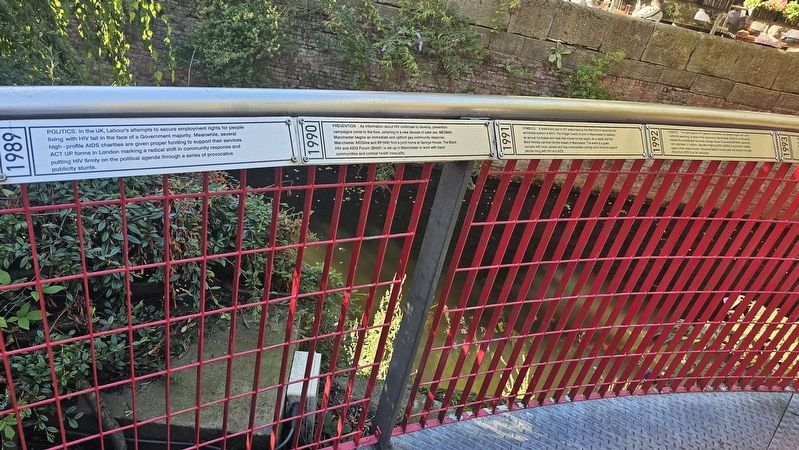
1989
Politics: In the UK, Labour’s attempts to secure employment

Photographed by Ian Lefkowitz, September 14, 2026
3. The Beacon of Hope Marker (1981-1984)
1990
Prevention: As information about HIV continues to develop, prevention campaigns come to the fore, ushering in a new decade of safer sex. MESMAC Manchester begins an immediate and upfront gay community response. Manchester AIDSline and BP(NW) find a joint home at George House. The Black HIV and AIDS Forum (BHAF) is set up in Manchester to work with black communities and combat health inequality.
1991
Symbols: A watershed year in HIV awareness as the Red Ribbon becomes the worldwide symbol of AIDS. The Village Charity is born in Manchester to develop an annual fundraiser and raise vital money for the region. As a result, the first Bank Holiday carnival hits the streets of Manchester. The event is a great success with local Lesbian and Gay communities coming out in force to support people living with

Photographed by Ian Lefkowitz, September 14, 2026
4. The Beacon of Hope Marker (1985-1988)
1992
Debate: The fight against HIV gathers momentum as debate rages over local authority spending. In spite of the arguments, Manchester AIDSline continues to expand its services and becomes George House Trust whilst BP(NW) opens its own premises. In London, Gay Men Fighting AIDS (GMFA) is launched. Debate rages further when a world-renowned fashion house uses the picture of a man flying from AIDS in an ad campaign.
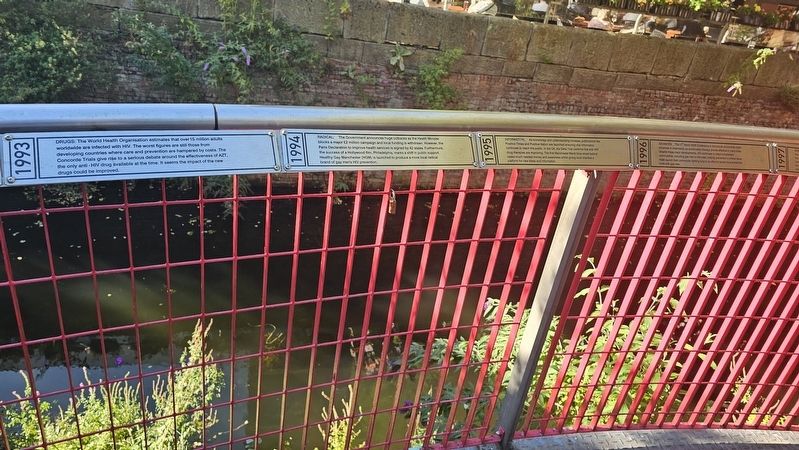
1993
Drugs: The World Health Organisation estimates that over 15 million adults worldwide are infected with HIV. The worst figures are still those from developing countries where care and prevention are hampered by costs. The Concorde Trials give rise to a serious debate around the effectiveness of AZT, the only anti-HIV drug available at the time. It seems the impact of the new drugs could be improved.
1994
Radical: The Government announces huge cutbacks as the Health Minister blocks a major £2 million campaign and local funding is withdrawn. However, the Paris Declaration to improve health services is signed by 42 states. Furthermore, the success of a Hollywood film, Philadelphia, marks a shift in public support.
Photographed by Ian Lefkowitz, September 14, 2026
5. The Beacon of Hope Marker (1989-1992)
1995
Information: As knowledge and understanding increases, publications like Positive Times and Positive Nation are launched ensuring vital information continues to reach the public. In the UK, the Delta Trial confirms that anti-HIV drug therapies are improving. The first Manchester Mardi Gras street festival raises much needed money and awareness whilst giving local charities a platform for new ideas and information.
1996
Advances: The 11th World AIDS Conference in Vancouver announces major advances in treatments, as combination therapy proves effective in many trials. Despite these major developments, HIV continues to infect complacent communities, including gay men in the west, making prevention a critical issue. HGM launch their community fighting fund in an effort to boost local prevention work with gay men.
1997
Events: The nation mourns the tragic death of Princess Diana, a figurehead in the fight against the virus. As the Manchester Mardi Gras continues to bloom, the Village Charity is forced to close. Therapies continue
Photographed by Ian Lefkowitz, September 14, 2026
6. The Beacon of Hope Marker (1993-1996)
1998
Voices: Despite a falling death rate in the West, more continue to be infected with HIV throughout the world prompting concerns over the cost and availability of treatment. In the face of Government cuts, communities in the UK continue to strengthen. Those living with HIV find a real voice when many come together to fight political attempts to criminalise HIV transmission, plus the increasing threat of funding cuts.
1999
Statistics: Concern continues for care services, treatment and prevention strategies throughout the world as statistics prove the health crisis has not gone away. In the UK, 30,000 people are infected with HIV (less than the early years predicted) although more than 10,000 are unaware of their infection. Globally, it is estimated there are over 34 million people living with HIV while over 16 million people have died from AIDS.
2000
Life: The Beacon of Hope marks a new century of support, prevention, and therapy. Hoped for further treatment advances, a lowering of infection rates and improved quality of life have all become realities. Foundations are in place for significant change. Remembrance remains for those who went before us, who we have lost, who made the difference to our futures and who will never be forgotten.
2001
Concern: 20 years of the epidemic. Concerns are raised about the increasing levels of drug-resistant strains of the virus along with the increased levels of complacency about the issue of HIV and AIDS. The United Nations Security Council discusses HIV and AIDS for the first time and UN Secretary General Kofi Annan maps a plan of action calling for the creation of a global fund on AIDS and Health.
2002
Doubled: 20th anniversary of Terry Higgins’ death and the founding of Terrence Higgins Trust. UK Government scraps ring-fenced funding for HIV prevention work as new figures show numbers diagnosed with HIV are rising. Between 1998 and 2002, the number of newly diagnosed HIV cases annually has more than doubled from 2696 to 5854. Globally, HIV is the leading cause of death in people aged 15 to 59.
2003
Prejudice: A National AIDS Trust report entitled ‘Are You HIV Prejudiced?’ presents a number of case studies of people in the UK facing prejudice as a result of their HIV status and concludes that the issue is still a big problem. The first person in England is prosecuted for the transmission of HIV. New HIV infections around the world number 5 million, the greatest number in a single year since the epidemic began.
2004
Therapies: Over 20 million people have died of AIDS around the world since 1981. As the emphasis on simpler therapies continues, two new combination drugs and two new protease inhibitors are released. It was announced that between 1997 and 2003 there was a 35% increase in the diagnosis of heterosexually acquired HIV infections in the UK, 70% of which is accounted for by people of African origin.
2005
Prophylaxis: Chris Smith MP announces that he is HIV positive. Anti-retroviral Post Exposure Prophylaxis (PEP) is recommended for people exposed to HIV from rapes, accidents or occasional unsafe sex or drug use. Royal Assent is given to the Disability Discrimination Act giving legal protection against discrimination for people living with HIV from the point of diagnosis.
2006
Unaware: The cumulative number of people living with HIV in the UK is estimated at 73,000. A third of these people are thought to be unaware of their infection. A report in March states that HIV transmission through injecting drug use is at its highest level since 1992. In June, the case of the second woman in the UK to be sent to jail for infecting a lover with HIV raises fears that anyone who is infected with HIV could potentially create a case.
2007
Contamination: The UK Coalition of People with HIV closes. An independent inquiry looks at cases of HIV that occurred amongst haemophiliacs during the 1970s and 1980s as a result of contaminated blood products. It is thought that 1243 haemophiliac patients were exposed to HIV. There are 7734 new HIV diagnoses, the highest number ever recorded in the UK.
2008
Testing: Nick Partridge, Chief Executive of the Terrence Higgins Trust, awarded a knighthood for his work in tackling HIV and AIDS in the UK. New HIV testing guidelines, supported by the Department of Health, recommend that all men and women between the ages of 15 and 59 in high risk areas of England should be offered a HIV test by their GP. The guidelines also suggest that gay men should be tested annually.
2009
Late: The ‘Testing Targets’ report, informed by the UK Gay Men’s Sex Survey, indicates an increase in the number of gay men who have had an HIV test. 42% of new diagnoses are among men who have sex with men. The Health Protection Agency release the ‘HIV in the United Kingdom’ report. 52% of people diagnosed with HIV are diagnosed late. The cumulative total of HIV diagnoses in the UK reaches nearly 112,000.
2010
Manchester: George House Trust’s 25th birthday. Manchester Prides HIV Candlelit Vigil is attended by over 3000 people. The Lesbian and Gay Foundation’s free condom and lube distribution scheme for gay and bisexual men celebrates its 16th birthday. By December there are 114,726 people in the UK living with HIV. 8330 people in the North West are living with HIV with 3980 of those in Greater Manchester. Since 1996 there have been 233 AIDS related deaths in Greater Manchester.
2011
Offer: General Assembly of the United Nations issues a Political Declaration stating their intention to intensify efforts to eliminate HIV and AIDS completely. NHS staff in Manchester are told to offer and recommend HIV tests to everyone using accident and emergency services and registering as new patients with GP practices. 34 million people around the world are living with HIV but new cases of diagnosed HIV worldwide have decreased over the previous 10 years.
2012
PrEP: HIV treatment is made free of charge to people from overseas. The first National HIV Testing Week takes place coordinated by HIV Prevention England. Trials of PrEP (Pre-Exposure Prophylaxis) begin to ascertain its effectiveness in preventing the acquisition of HIV and early data proves promising.
2013
90–90–90: The British HIV Association (BHIVA) publishes Standards of Care for People Living with HIV. New awareness campaign, It Starts With Me, is rolled out, funded by HIV Prevention England and backed by the Department of Health, encouraging HIV testing. The 25th World AIDS Day is marked on December 1st. UNAIDS introduces the 90–90–90 campaign, aiming for 90% of people to know their HIV status, 90% of people living with HIV to have access to treatment and 90% of all people in treatment to have an undetectable viral load by 2020.
2014
Undetectable — First results from the PARTNER study indicate that no HIV transmissions had occurred in sero-discordant couples routinely not using condoms where the person living with HIV had an undetectable viral load. The Greater Manchester free condom and lube scheme is 20 years old following its inception by Healthy Gay Manchester in 1994. The Lesbian and Gay Foundation continue to manage one of the longest running schemes of its kind in the UK. Joep Lange, Dutch HIV researcher, advocate and former President of the International AIDS Society dies on board Malaysian flight MH17 along with many other HIV researchers and scientists en route to the 20th International AIDS Conference in Melbourne.
2015
Community — The first approved HIV self-test kit allowing people to get a result in 15 minutes at home goes on sale in England, Scotland and Wales. George House Trust marks 30 years of providing HIV support to people in the North West of England. 17 million people — almost half of all people living with HIV worldwide — now have access to treatment. BHA for Equality celebrates 25 years of providing HIV prevention and support services for black and ethnic minority communities across Greater Manchester. LGBT Foundation and BHA for Equality launch a new community rapid HIV testing service across Greater Manchester.
2016
U=U — The lifetime ban on men who have sex with men giving blood is lifted and replaced with a one year deferral. National AIDS trust wins landmark appeal after arguing that the NHS could fund PrEP (Pre-Exposure Prophylaxis). NHS announces that they will fund a large-scale trial as the first stage of a wider national rollout. The global Prevention Access Campaign issues a U=U (Undetectable equals Untransmittable) consensus statement stating that the risk of HIV transmission from a person living with HIV, on treatment and with an undetectable viral load is negligible to non-existent following further results from the PARTNER study. New diagnosis rates amongst gay and bi men fall by almost half across four London clinics compared to the previous year.
2017
PaSH: The PaSH (Passionate about Sexual Health) Partnership of BHA for Equality, George House Trust and LGBT Foundation launch a new integrated HIV prevention and support programme across Greater Manchester. U=U advocates and activists hold a press conference with global leaders at the International AIDS Society conference in Paris to endorse the U=U message and to call for universal access to HIV treatment.
2018
Leadership: Greater Manchester is launched as a Fast Track City Region and commits to ending all new HIV transmissions by 2030. All 10 Greater Manchester boroughs sign up. A Public Health England report shows that the UK is one of the first countries to meet the UNAIDS 90–90–90 targets. The British HIV Association (BHIVA) publishes an updated version of Standards of Care for People Living with HIV providing an important benchmark for quality of care.
2019
Study: Welsh rugby player Gareth Thomas publicly shares that he is living with HIV. Final results from the PARTNER study are published in the Lancet medical journal providing conclusive evidence that people living with HIV and on effective treatment cannot pass HIV to someone else during sex. LGBT Foundation marks 25 years of the free condom and lube scheme.
2020
Together : 1.5 million new HIV diagnoses are reported around the world, a figure compounded by waning public and political engagement, funding shortages and the Covid-19 pandemic. The PaSH partnership launches the ‘HIV: Let’s Sort This Together’ campaign. The UK Government announces that PrEP will be made available free on the NHS in England to people at high risk of acquiring HIV. George House Trust marks 35 years of providing HIV support.
2021
Progress : 40 years since the first cases of a mysterious illness which was later to become known as HIV were reported in the US, Channel 4 launches ‘It’s a Sin’, written by Russell T Davies, depicting the lives of a group of gay men and their friends in London in the 1980s at the height of the AIDS crisis. On World AIDS Day, Manchester Foundation Trust launches opt-out HIV testing in Emergency Departments. The National Institute for Health and Care Excellence (NICE) approves a long-lasting injectable HIV treatment in England. The Department of Health and Social Care launches its ‘Towards Zero’ Action Plan.
2023
Rising — Cases of HIV have risen steeply among heterosexuals, rising by 36% in men and 30% in women. To support those receiving a positive HIV diagnosis through opt-out testing in emergency departments George House Trust recruited their first Peer Navigator to provide support and be an initial point of contact after diagnosis.
2024
Scandal — Lenacapavir was seen as the breakthrough of the year with its twice-yearly injectable PrEP proven successful in preventing transmissions in trials. NHS England expanded access to PrEP across all sexual health departments. In May 2024, the public inquiry into the Infected Blood Scandal found that there had been systemic failures by UK authorities relating to the risk of infections and dealing with the consequences of the people and families of those affected.
2025
George House Trust marked its 40th anniversary and four decades of HIV activism in Greater Manchester with a public exhibition at Manchester Central Library. The year also marked 40 years since Roger Yod was detained at Monsall Hospital as a 'public health risk' - a story that continues to highlight the enduring impact of HIV stigma. Keir Starmer became the first sitting UK Prime Minister to take an HIV test publicly. On World AIDS Day, the new HIV Action Plan for England was launched, reaffirming the government’s goal to end new HIV diagnoses by 2030 and reduce HIV-related stigma.
Erected 2000.
Topics. This historical marker is listed in this topic list: Science & Medicine. A significant historical year for this entry is 1981.
Location. 53° 28.618′ N, 2° 14.197′ W. Marker is in Manchester, England, in Greater Manchester. It is in Gay Village. It can be reached from the intersection of Sackville Street and Canal Street, on the left when traveling west. Touch for map. Marker is at or near this postal address: 28-30 Canal Street, Manchester, England M1 3NF, United Kingdom. Touch for directions.

Regionally, this marker is in North West England. Globally, it is on the Atlantic Ocean, in the North Atlantic Region, in Europe, in Atlantic Europe, on one of the British Isles, in the Western World, and in the Anglosphere. Historically, it finds itself in what was once the Roman Empire.
Other nearby markers. At least 8 other markers are within walking distance of this marker: A different marker also named The Beacon of Hope (here, next to this marker); Alan Mathison Turing (within shouting distance of this marker); a different marker also named Alan Mathison Turing (within shouting distance of this marker); Former Manchester Gay Centre (about 120 meters away, measured in a direct line); New York New York (about 120 meters away); Co-operative Insurance Company (about 180 meters away); Trades Union Congress (about 180 meters away); Les Dawson (approx. 0.4 kilometers away). Touch for a list and map of all markers in Manchester.
Also see . . . The Beacon of Hope (George House Trust).
Manchester’s Beacon of Hope is the UK's first permanent HIV memorial. Situated in Sackville Gardens, overlooking Manchester's world famous Canal Street, it was conceived in 1997 as a response to HIV and erected in 2000 and stands as a memorial to everyone lost to HIV and as a symbol of solidarity with everyone living with HIV today. The Beacon of Hope was designed by Warren Chapman and Jess Bryne-Daniels.(Submitted on November 14, 2026, by Ian Lefkowitz of New York, New York.)
Additional keywords. LGBT; LGBTQ; 🏳️🌈
Credits. This page was last revised on November 14, 2026. It was originally submitted on November 14, 2026, by Ian Lefkowitz of New York, New York. This page has been viewed 7 times since then. Photos: 1, 2, 3, 4, 5, 6. submitted on November 14, 2026, by Ian Lefkowitz of New York, New York. • Andrew Ruppenstein was the editor who published this page.
Editor’s want-list for this marker. Photo of 2022 plaque • Can you help?
