
Old Montreal in Montréal, Québec — Central Canada (French-Canadian)
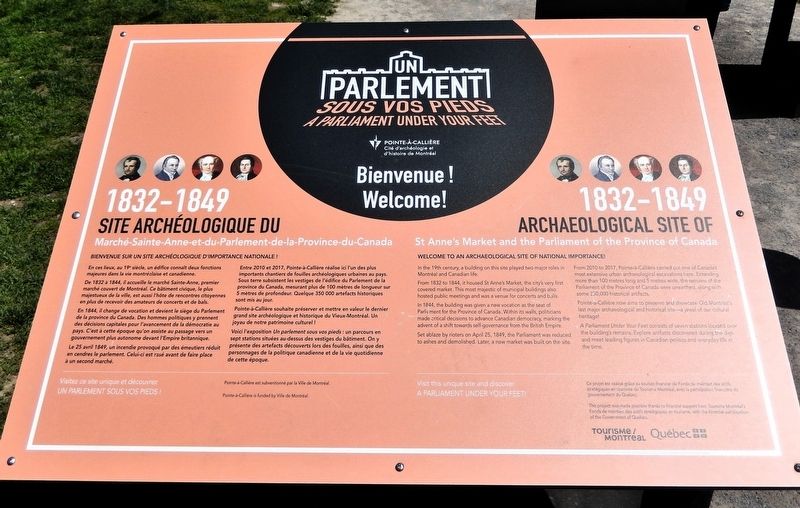
Site archéologique du Marché-Sainte-Anne-et-du-Parlement-de-la-province-du-Canada
Archaeological Site of St Anne's Market and the Parliament of the Province of Canada
| — | 1832 — 1849 | — |
Photographed by Cosmos Mariner, May 20, 2024
1. Site archéologique du Marché-Sainte-Anne-et-du-Parlement-de-la-province-du-Canada Marker

Bienvenue sur un site archéologique d'importance nationale !
En ces lieux, au 19e siècle, un édifice connaît deux fonctions majeures dans la vie montréalaise et canadienne.
De 1832 à 1844, il accueille le marché Sainte-Anne, premier marché couvert de Montréal. Ce bâtiment civique, le plus majestueux de la ville, est aussi l'hôte de rencontres citoyennes en plus de recevoir des amateurs de concerts et de bals.
En 1844, il change de vocation et devient le siège du Parlement de la province du Canada. Des hommes politiques y prennent des décisions capitales pour l'avancement de la démocratie au pays. C'est à cette époque qu'on assiste au passage vers un gouvernement plus autonome devant l'Empire britannique.
Le 25 avril 1849, un incendie provoqué par des émeutiers réduit en cendres le parlement. Celui-ci est rasé avant de faire place à un second marché.
Entre 2010 et 2017, Pointe-à-Callière réalise ici l'un des plus importants chantiers de fouilles archéologiques urbaines au pays. Sous terre subsistent les vestiges de l'édifice Parlement de la province du Canada, mesurant plus de 100 mètres de longueur sur 5
this page online
Pointe-à-Callière souhaite préserver et mettre en valeur de dernier grand site archéologique et historique du Vieux-Montréal. Un joyau de notre patrimoine culturel !
Voici l'exposition Un parlement sous vos pieds : un parcours en sept stations situées au-dessus des vestiges du bâtiment. On y présente des artefacts découverts lors des fouilles, ainsi que dans personnages de la politique canadienne et de la vie quotidienne de cette époque.
Visitez ce site unique et découvrez un parlement sous vos pieds !
Pointe-à-Callière est subventionné par la Ville de Montréal.
Ce projet est réalisé grâce au soutien financier du Fonds de maintien des actifs stratégiques en tourisme de Tourisme Montréal, avec la participation financière du gouvernement du Québec.
Welcome to an archaeological site of national importance!
In the 19th century, a building on this site played two major roles in Montreal and Canadian life.
From 1832 to 1844, it housed St Anne's Market, the city's very first covered market. This most majestic of municipal buildings also hosted public meetings and was
Photographed by Cosmos Mariner, May 20, 2024
2. Site archéologique du Marché-Sainte-Anne-et-du-Parlement-de-la-province-du-Canada Marker
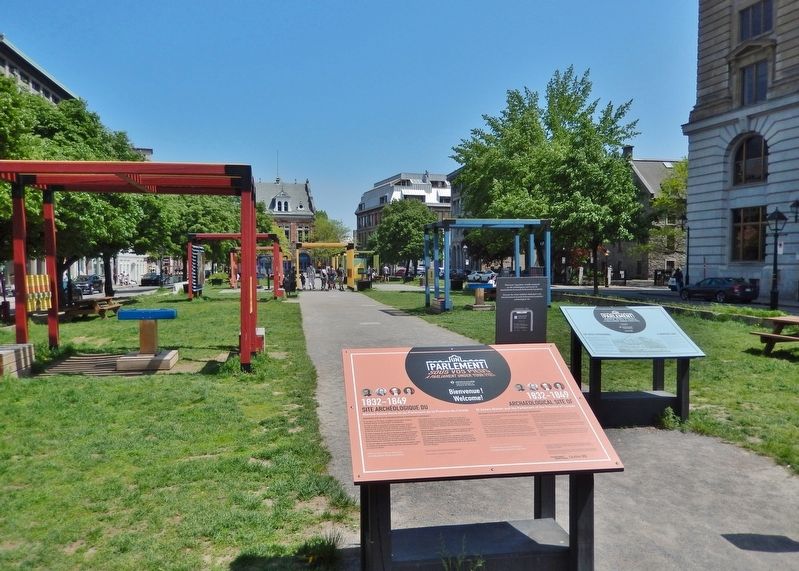
Looking north from Rue McGill across Youville Square.
In 1844, the building was given a new vocation as the seat of Parliament for the Province of Canada. Within its walls, politicians made critical decisions to advance Canadian democracy, marking the advent of a shift towards self-governance from the British Empire.
Set ablaze by rioters on April 25, 1849, the Parliament was reduced to ashes and demolished. Later, a new market was built on the site.
From 2010 to 2017, Pointe-à-Callière carried out one of Canada's most extensive urban archaeological excavations here. Extending more than 100 metres long and 5 metres wide, the remains of the Parliament of the Province of Canada were unearthed, along with some 350,000 historical artifacts.
Pointe-à-Callière now aims to preserve and showcase Old Montreal’s last major archaeological and historical site — a jewel of our cultural heritage!
A Parliament Under Your Feet consists of seven stations located over the building's remains. Explore artifacts discovered during the digs and meet leading figures in Canadian politics and everyday life at the time.
Visit this unique site and discover a Parliament under your feet!
Pointe-à-Callière is funded by Ville de Montréal.
This project was made possible thanks to financial support from Tourism Montreal’s Strategic Tourism Assets Maintenance Fund with the financial participation of the Government of Quebec.
Erected by Tourism Montréal and the Government of Québec.
Topics. This historical marker is listed in these topic lists: Anthropology & Archaeology • Architecture • Government & Politics • Industry & Commerce. A significant historical year for this entry is 1832.
Location. 45° 30.007′ N, 73° 33.379′ W. Marker is in Montréal, Québec. It is in Old Montreal. It can be reached from the intersection of Place d'Youville and Rue McGill. The marker is in the St Anne's Market and Parliament of the Province of Canada archaeological site at Youville Square. Touch for map. Marker is at or near this postal address: 406 Place d'Youville, Montréal QC H2Y 2B6, Canada. Touch for directions.

Regionally, this marker is in Central Canada. Globally, it is in North America, the Western Hemisphere, and the Western World. Historically, it finds itself in what was once a British colony, the Viceroyalty of New France, the Haudenosaunee (Iroquois) Confederacy, and Rupert’s Land.
Other nearby markers. At least 8 other markers are within walking distance of this marker: Un Joyau Patrimonial / A Heritage Gem (here, next to this marker); Savais-tu que... / Did you know... (within shouting distance of this marker); Bienvenue aux parlementaires ! / Welcoming the Members of Parliament! (within shouting distance of this marker); Un lieu désigné pour accueillir le Parlement : Le Marché Sainte-Anne (within shouting distance of this marker); À l'heure des réformes / A Time of Reforms (within shouting distance of this marker); L'Acte d'Union — 1840 / Montréal devient capitale de la province du Canada — 1843 (within shouting distance of this marker); Sous vos pieds se trouvent les vestiges de la bibliothèque de l'Assemblée législative (within shouting distance of this marker); Maison de Mère d'Youville (about 90 meters away, measured in a direct line). Touch for a list and map of all markers in Montréal.
Related markers. Click here for a list of markers that are related to this marker. St Anne's Market and Parliament of the Province of Canada Archaeological Site
Also see . . . St. Anne's Market (Wikipedia).
Excerpt: St. Anne's Market was a public auction house located at Place d'Youville in Old Montreal. From 1844 to 1849, it served as the home of the Legislative Council and Assembly during the pre-Confederation era. On April 25, 1849, the building was burned down by Loyalist rioters.(Submitted on November 14, 2026, by Cosmos Mariner of Cape Canaveral, Florida.)
The original St. Anne's Market was built in 1832 to accommodate produce stalls in Old Montreal. Merchants sold fruit, vegetables, grains, meat, and fish in approximately 60 stalls. The two-storey, 100-metre-long Georgian building was designed by John Wells and Francis Thompson and was built atop a section of the Little River.
The market was acquired by the municipal government in 1842, and became the first permanent provincial seat of government after the parliament was moved in 1844 from Kingston to Montreal; the first legislative session at the St. Anne's Market site was held on November 28, 1844.
The passage of the Rebellion Losses Bill on the night of April 25, 1849, led to the sacking and arson of the St. Anne's Market parliamentary building. The fire, set by Loyalist rioters attempting to disrupt an ongoing Assembly session, spread to nearby building and burned rapidly. Firefighters sent to respond to the fire at St. Anne's Market were slowed by mobs of rioters, leading to the building's total destruction within two hours.
Since 2010, the parking lot has been the site of an archaeological excavation by the Pointe-à-Callière Museum, unearthing artifacts lost during the 1849 fire.
Credits. This page was last revised on November 20, 2026. It was originally submitted on November 14, 2026, by Cosmos Mariner of Cape Canaveral, Florida. This page has been viewed 11 times since then. Photos: 1, 2. submitted on November 14, 2026, by Cosmos Mariner of Cape Canaveral, Florida.
