
Gay Village in Manchester in Greater Manchester, England, United Kingdom — Northwestern Europe (the British Isles)
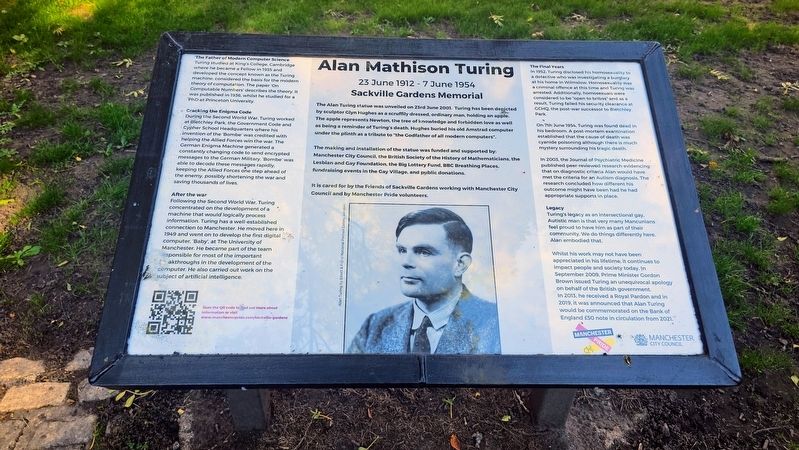
Alan Mathison Turing
23 June 1912 – 7 June 1954
Photographed by Ian Lefkowitz, September 14, 2026
1. Alan Mathison Turing Marker
Sackville Gardens Memorial
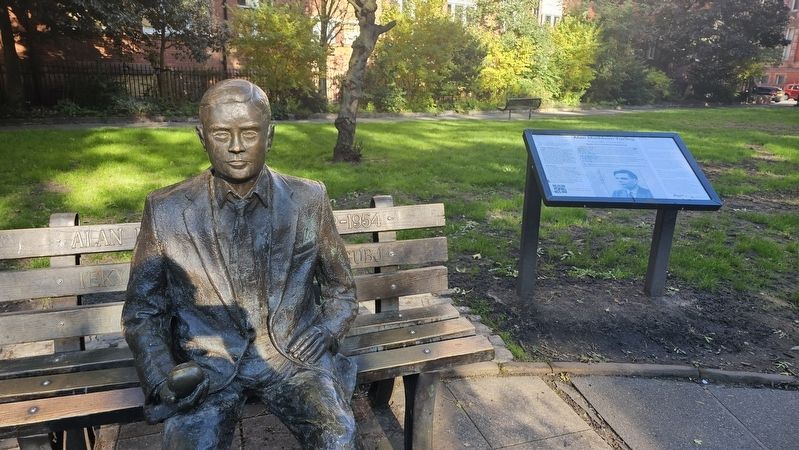
The Alan Turing statue was unveiled on 23rd June 2001. Turing has been depicted by sculptor Glyn Hughes as a scruffily dressed, ordinary man, holding an apple. The apple represents Newton, the tree of knowledge and forbidden love as well as being a reminder of Turing’s death. Hughes buried his old Amstrad computer under the plinth as a tribute to “the Godfather of all modern computers”.
The making and installation of the statue was funded and supported by: Manchester City Council, the British Society of the History of Mathematicians, the Lesbian and Gay Foundation, the Big Lottery Fund, BBC Breathing Places, fundraising events in the Gay Village, and public donations.
It is cared for by the Friends of Sackville Gardens working with Manchester City Council and by Manchester Pride volunteers.
The Father of Modern Computer Science
Turing studied at King’s College, Cambridge where he became a Fellow in 1935 and developed the concept known as the Turing machine, considered the basis for the modern theory of computation. The paper ‘On Computable Numbers’ describes the theory. It was published in 1936, whilst
this page online
Cracking the Enigma Code
During the Second World War, Turing worked at Bletchley Park, the Government Code and Cypher School Headquarters where his invention of the ‘Bombe’ was credited with helping the Allied Forces win the war. The German Enigma Machine generated a constantly changing code to send encrypted messages to the German Military. ‘Bombe’ was able to decode these messages rapidly, keeping the Allied Forces one step ahead of the enemy, possibly shortening the war and saving thousands of lives.
After the war
Following the Second World War, Turing concentrated on the development of a machine that would logically process information. Turing has a well-established connection to Manchester. He moved here in 1949 and went on to develop the first digital computer, ‘Baby’, at The University of Manchester. He became part of the team responsible for most of the important breakthroughs in the development of the computer. He also carried out work on the subject of artificial intelligence.
The Final Years
In 1952, Turing disclosed his homosexuality to a detective who was investigating a burglary
Photographed by Ian Lefkowitz, September 14, 2026
2. Alan Turing Memorial, by Glyn Hughes
This sculpture in Sackville Gardens depicts Alan Turing sitting on a park bench holding an apple. This marker is located next to the sculpture.
On 7th June 1954, Turing was found dead in his bedroom. A post mortem examination established that the cause of death was cyanide poisoning although there is much mystery surrounding his tragic death.
In 2003, the Journal of Psychiatric Medicine published peer-reviewed research evidencing that on diagnostic criteria Alan would have met the criteria for an Autism diagnosis. The research concluded how different his outcome might have been had he had appropriate supports in place.
Legacy
Turing’s legacy as an intersectional gay, Autistic man is that very many Mancunians feel proud to have him as part of their community. We do things differently here. Alan embodied that.
Whilst his work may not have been appreciated in his lifetime, it continues to impact people and society today. In September 2009, Prime Minister Gordon Brown issued Turing an unequivocal apology on behalf of
Photographed by Ian Lefkowitz, September 14, 2026
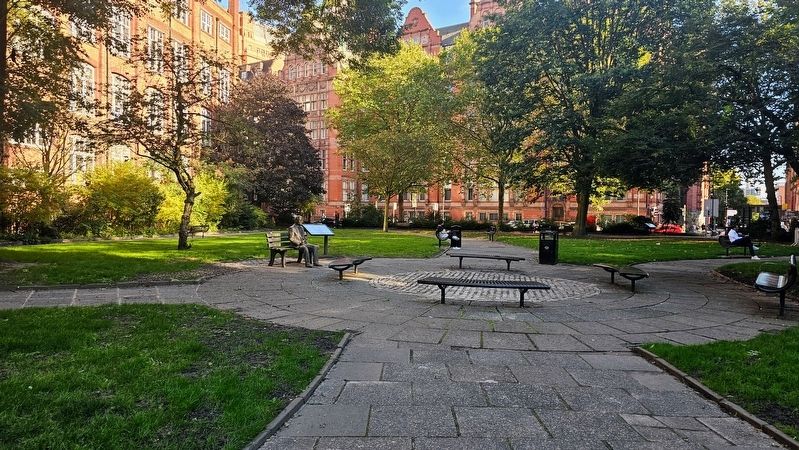
3. Alan Mathison Turing Marker
The marker is located in Sackville Gardens in Manchester's Gay Village.
(Captions)
Alan Turing by Elliott & Fry, National Portrait Gallery, London
Erected by Manchester Pride and Manchester City Council.
Topics. This historical marker is listed in these topic lists: Science & Medicine • War, World II. A significant historical date for this entry is June 7, 1954.
Location. 53° 28.603′ N, 2° 14.157′ W. Marker is in Manchester, England, in Greater Manchester. It is in Gay Village. It can be reached from Sackville Street west of Whitworth Street, on the left when traveling west. Touch for map. Marker is at or near this postal address: 46 Sackville Street, Manchester, England M1 3WA, United Kingdom. Touch for directions.

Regionally, this marker is in North West England. Globally, it is on the Atlantic Ocean, in the North Atlantic Region, in Europe, in Atlantic Europe, on one of the British Isles, in the Western World, and in the Anglosphere. Historically, it finds itself in what was once the Roman Empire.
Other nearby markers. At least 8 other markers are within walking distance of this marker: A different marker also named Alan Mathison Turing (here, next to this marker); The Beacon of Hope (within shouting distance of this marker); a different marker also named The Beacon of Hope (within shouting distance of this marker); Former Manchester Gay Centre (about 150 meters away, measured in a direct line); New York New York (about 150 meters away); Co-operative Insurance Company (about 210 meters away); Trades Union Congress (about 240 meters away); Les Dawson (approx. 0.4 kilometers away). Touch for a list and map of all markers in Manchester.
Also see . . . Alan Turing Memorial (Wikipedia).
Turing is depicted sitting on a bench situated in a central position in the park, holding an apple. On Turing's left is the former Sackville Street Building of the University of Manchester, and on his right is Canal Street. Sculptor Glyn Hughes said the park was chosen as the location for the statue because "it's got the university science buildings...on one side, and it's got all the gay bars on the other side, where apparently he spent most of his evenings."(Submitted on November 14, 2026, by Ian Lefkowitz of New York, New York.)
Additional keywords. LGBT; LGBTQ; 🏳️🌈
Credits. This page was last revised on November 14, 2026. It was originally submitted on November 14, 2026, by Ian Lefkowitz of New York, New York. This page has been viewed 11 times since then. Photos: 1, 2, 3. submitted on November 14, 2026, by Ian Lefkowitz of New York, New York. • Andrew Ruppenstein was the editor who published this page.
