
Old Montreal in Montréal, Québec — Central Canada (French-Canadian)
Un Joyau Patrimonial
⎯⎯⎯
A Heritage Gem
Photographed by Cosmos Mariner, May 20, 2024
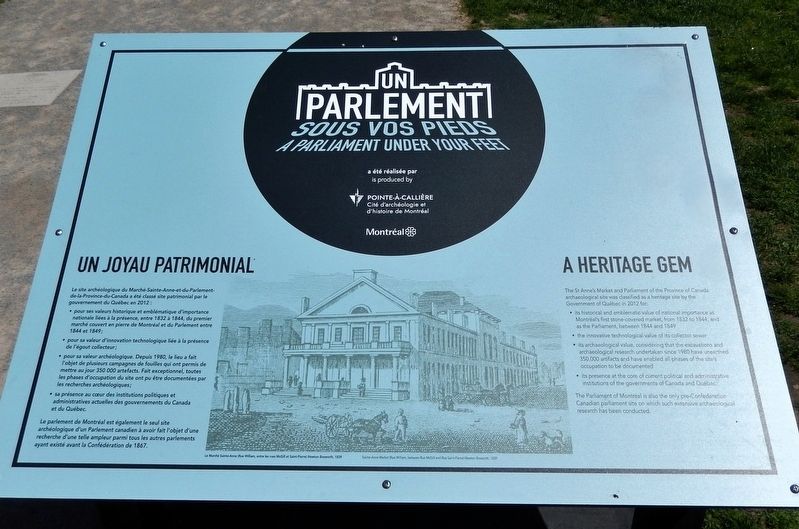
1. Un Joyau Patrimonial / A Heritage Gem Marker

Un Joyau Patrimonial
Le site archéologique du Marché-Sainte-Anne-et-du-Parlement-de-la-Province-du-Canada a été classé site patrimonial par le gouvernement du Québec en 2012 :
• pour ses valeurs historique et emblématique d'importance nationale liées à la présence, entre 1832 à 1844, du premier marché couvert en pierre de Montréal et du Parlement entre 1844 et 1849;
• pour sa valeur d'innovation technologique liée à la présence de l'égout collecteur;
• pour sa valeur archéologique. Depuis 1980, le lieu a fait l'objet de plusieurs campagnes de fouilles qui ont permis de mettre au jour 350 000 artefacts. Fait exceptionnel, toutes les phases d'occupation du site ont pu être documentées par les recherches archéologiques;
• sa présence au cœur des institutions politiques et administratives actuelles des gouvernements du Canada et du Québec.
Le parlement de Montréal est également le seul site archéologique d'un Parlement canadien à avoir fait l'objet d'une recherche d'une telle ampleur parmi tous les autres parlements ayant existé avant la Confédération de 1867.
A Heritage Gem
The St Anne's Market and
this page online
• its historical and emblematic value of national importance as Montreal's first stone-covered market, from 1832 to 1844, and as the Parliament, between 1844 and 1849
• the innovative technological value of its collector sewer
• its archaeological value, considering that the excavations and archaeological research undertaken since 1980 have unearthed 350,000 artifacts and have enabled all phases of the site's occupation to be documented
• its presence at the core of current political and administrative institutions of the governments of Canada and Quebec.
The Parliament of Montreal is also the only pre-Confederation Canadian parliament site on which such extensive archaeological research has been conducted.
Erected by Tourism Montréal and the Government of Québec.
Topics. This historical marker is listed in these topic lists: Anthropology & Archaeology • Government & Politics. A significant historical year for this entry is 2012.
Location. 45° 30.008′ N, 73° 33.376′ W. Marker is in Montréal, Québec.
Courtesy Newton Bosworth, 1839
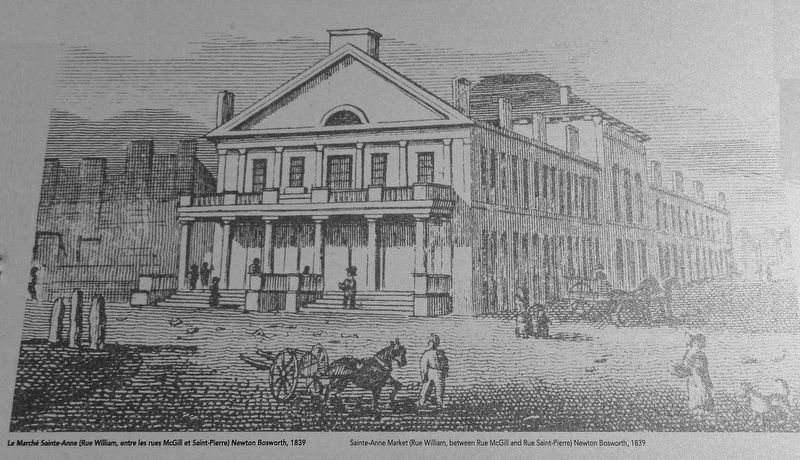
2. Marker detail: Le Marché Sainte-Anne / Sainte-Anne Market

Regionally, this marker is in Central Canada. Globally, it is in North America, the Western Hemisphere, and the Western World. Historically, it finds itself in what was once a British colony, the Viceroyalty of New France, the Haudenosaunee (Iroquois) Confederacy, and Rupert’s Land.
Other nearby markers. At least 8 other markers are within walking distance of this marker: Site archéologique du Marché-Sainte-Anne-et-du-Parlement-de-la-province-du-Canada (here, next to this marker); Savais-tu que... / Did you know... (within shouting distance of this marker); Bienvenue aux parlementaires ! / Welcoming the Members of Parliament! (within shouting distance of this marker); Un lieu désigné pour accueillir le Parlement : Le Marché Sainte-Anne (within shouting distance of this marker);
Photographed by Cosmos Mariner, May 20, 2024
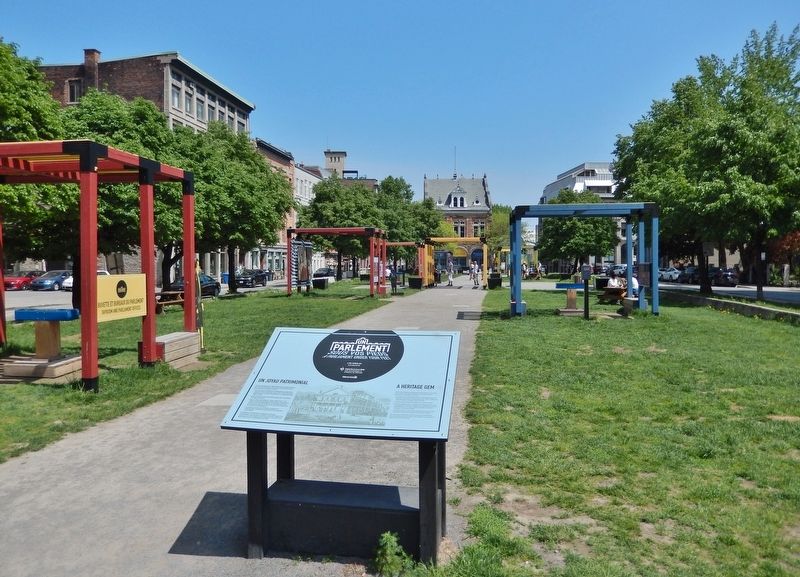
3. Un Joyau Patrimonial / A Heritage Gem Marker
Looking north from Rue McGill across Youville Square.
Related markers. Click here for a list of markers that are related to this marker. St Anne's Market and Parliament of the Province of Canada Archaeological Site
Also see . . . Secrets of the Ruins: Excavation of Parliament of the Province of Canada (Canada's History).
(By François Gignac, Louise Pothier, and Hendrik Van Gijseghem — Posted September 13, 2022) Excerpt: In the aftermath of the rebellions in Lower Canada and Upper Canada, Britain merged both colonies into a single Province of Canada in 1841 and instituted responsible government as a concession to Reformers’ demands. As of 1844, the Parliament of the Province of Canada met in Montreal in a stately building that had previously housed St. Anne’s Market, near a point of land known as Pointe-à-Callière.(Submitted on November 15, 2026, by Cosmos Mariner of Cape Canaveral, Florida.)
In the spring of 1849, the Reform government led by Louis-Hippolyte Lafontaine and Robert Baldwin passed the Rebellion Losses Bill, which compensated the inhabitants of Lower Canada (renamed Canada East) for losses arising from “the total or partial unjust, unnecessary, or wanton destruction of the dwellings, buildings, property, and effects of the said inhabitants.” The Tories vehemently opposed the bill, believing that it rewarded the habitants who had sympathized with the rebels and that it represented a loss of anglophone influence in favour of francophones.
The Tories petitioned Governor General Lord Elgin to veto the bill. He refused, instead upholding the democratic will of Parliament. Incensed, the Tories rioted. On the evening of April 25, 1849, a torch-wielding mob invaded Parliament — which was still in session — and burned the building to the ground.
In 2010, the museum and historic site Pointe-à-Callière, Montreal Archaeology and History Complex, initiated a major research program to study and preserve the building’s remains, breathing new life into ruins that had lain dormant for more than 150 years. Part of Montréal’s Birthplace National Historic Site of Canada, and recognized as a heritage site by the Ministère de la Culture et des Communications du Québec, Pointe-à-Callière provides a prime example of the preservation of Canadian archaeological heritage.
Credits. This page was last revised on November 20, 2026. It was originally submitted on November 14, 2026, by Cosmos Mariner of Cape Canaveral, Florida. This page has been viewed 12 times since then. Photos: 1. submitted on November 14, 2026, by Cosmos Mariner of Cape Canaveral, Florida. 2, 3. submitted on November 15, 2026, by Cosmos Mariner of Cape Canaveral, Florida.
