
Halesworth in Suffolk, England, United Kingdom — Northwestern Europe (the British Isles)
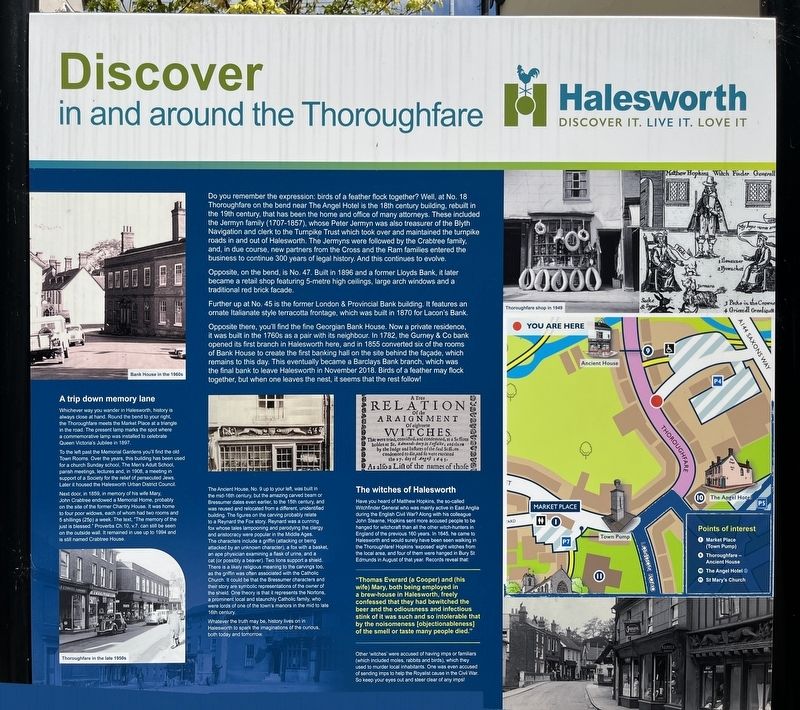
Discover in and around the Thoroughfare
Photographed by Ray Gurganus, April 20, 2026
1. Discover in and around the Thoroughfare Marker
Opposite, on the bend, is No. 47. Built in 1896 and a former Lloyds Bank, it later became a retail shop featuring 5-metre high ceilings, large arch windows and a traditional red brick facade.
Further up at No. 45 is the former London & Provincial Bank building. It features an ornate Italianate style terracotta frontage, which was built in 1870 for Lacon's Bank.
Opposite there, you'll find the fine Georgian Bank House. Now a private residence, it
this page online
A trip down memory lane
Whichever way you wander in Halesworth, history is always close at hand. Round the bend to your right, the Thoroughfare meets the Market Place at a triangle in the road. The present lamp marks the spot where a commemorative lamp was installed to celebrate Queen Victoria's Jubilee in 1897.
To the left past the Memorial Gardens you'll find the old Town Rooms. Over the years, this building has been used for a church Sunday school, The Men's Adult School, parish meetings, lectures and, in 1908, a meeting in support of a Society for the relief of persecuted Jews. Later it housed the Halesworth Urban District Council.
Next door, in 1859, in memory of his wife Mary, John Crabtree endowed a Memorial Home, probably on the site of the former Chantry House. It was home to four poor widows, each of whom had two rooms and 5 shillings (25p) a week. The text, "The memory of the just is blessed." Proverbs Ch. 10, v.7. can still be seen on the outside wall. It remained in use up to 1994 and is still named Crabtree House.
The Ancient House, No. 9 up to your left, was built in the mid-16th century, but the amazing carved beam or Bressumer dates even earlier, to the 15th century, and was reused and relocated from a different, unidentified building. The figures on the carving probably relate to a Reynard the Fox story. Reynard was a cunning fox whose tales lampooning and parodying the clergy and aristocracy were popular in the Middle Ages. The characters include a griffin (attacking or being attacked by an unknown character), a fox with a basket, an ape physician examining a flask of urine, and a cat (or possibly a beaver). Two lions support a shield. There is a likely religious meaning to the carvings too, as the griffin was often associated with the Catholic Church. It could be that the Bressumer characters and their story are symbolic representations of the owner of the shield. One theory is that it represents the Nortons, a prominent local and staunchly Catholic family, who were lords of one of the town's manors in the mid to late 16th century.
Whatever the truth may be, history lives on in Halesworth to spark the imaginations of the curious, both today and tomorrow.
The witches of Halesworth
Have you heard of Matthew Hopkins, the so-called Witchfinder General who was mainly active in East Anglia during the English Civil War? Along with his colleague John Stearne, Hopkins sent more accused people to be hanged for witchcraft than all the other witch-hunters in England of the previous 160 years. In 1645, he came to Halesworth and would surely have been seen walking in the Thoroughfare! Hopkins 'exposed' eight witches from the local area, and four of them were hanged in Bury St Edmunds in August of that year. Records reveal that:
"Thomas Everard (a Cooper) and (his wife) Mary, both being employed in a brew-house in Halesworth, freely confessed that they had bewitched the beer and the odiousness and infectious stink of it was such and so intolerable that by the noisomeness [objectionableness] of the smell or taste many people died."
Other 'witches' were accused of having imps or familiars (which included moles, rabbits and birds), which they used to murder local inhabitants. One was even accused of sending imps to help the Royalist cause in the Civil War. So keep your eyes out and steer clear of any imps!
Topics. This historical marker is listed in this topic list: Law Enforcement.
Location. 52° 20.631′ N, 1° 30.135′ E. Marker is in Halesworth, England, in Suffolk. It is on Thoroughfare. Touch for map. Marker is at or near this postal address: 12 Thoroughfare, Halesworth, England IP19 8AH, United Kingdom. Touch for directions.

Regionally, this marker is in East Anglia. Globally, it is on the Atlantic Ocean, in the North Atlantic Region, in Europe, in Atlantic Europe, on one of the British Isles, in the Western World, and in the Anglosphere. Historically, it finds itself in what was once the Roman Empire.
Other nearby markers. At least 8 other markers are within walking distance of this marker: Over the Centuries (within shouting distance of this marker); Discover our historic market town (about 90 meters away, measured in a direct line); The Angel Yard Maltings (about 90 meters away); Discover two ways to explore the town (about 120 meters away); The Old Rectory; Land Girls (about 120 meters away); Discover in and around the Market Place (about 150 meters away); Church of St Mary the Virgin (about 150 meters away); Discover what used to be here (about 180 meters away). Touch for a list and map of all markers in Halesworth.
Credits. This page was last revised on November 19, 2026. It was originally submitted on November 14, 2026, by Ray Gurganus of Washington, District of Columbia. This page has been viewed 5 times since then. Photo 1. submitted on November 14, 2026, by Ray Gurganus of Washington, District of Columbia. • Andrew Ruppenstein was the editor who published this page.
Editor’s want-list for this marker. photo of the marker within its surroundings • Can you help?
