
Government Center in Boston in Suffolk County, Massachusetts — The American Northeast (New England)
William Curser
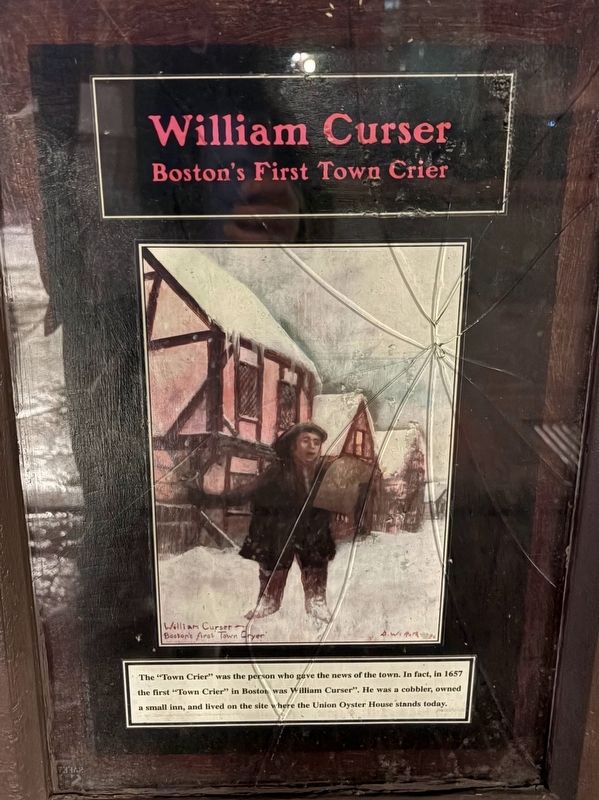
Photographed by Sean P. Flynn, November 6, 2026
1. William Curser Marker
Topics. This historical marker is listed in these topic lists: Colonial Era • Industry & Commerce. A significant historical year for this entry is 1657.
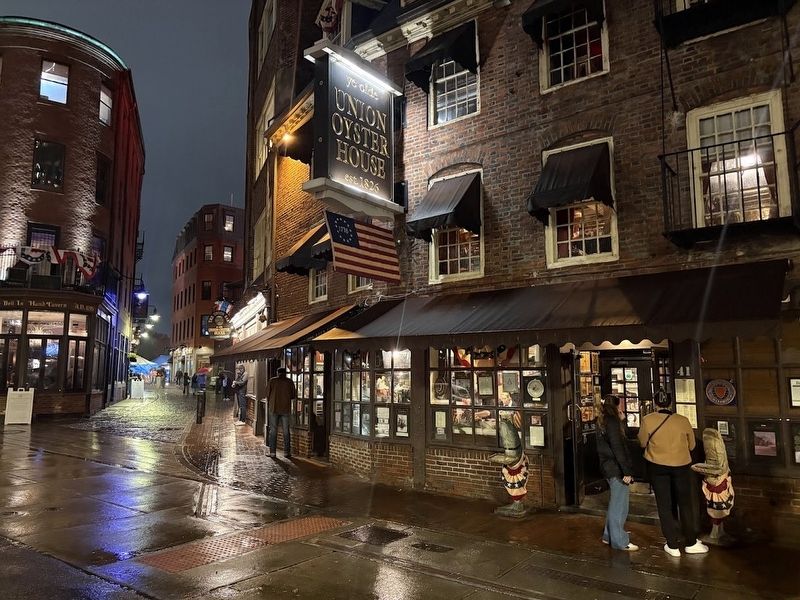
Location. 42° 21.677′ N, 71° 3.42′ W. Marker is in Boston, Massachusetts, in Suffolk County. It is in Government Center. It is at the intersection of Union Street and Marshall Street, on the right when traveling north on Union Street. This marker is in the window of the Union Oyster House. Touch for map. Marker is at or near this postal address: 41 Union Street, Boston MA 02108, United States of America. Touch for directions.

Regionally, this marker is in Historic Boston. It is also in the American Northeast, in New England, and on the Eastern Seaboard. Globally, it is in the North Atlantic Region, North America, the Western Hemisphere, the Western World, and the Anglosphere. Historically, it finds itself in what was once one of
this page online
Other nearby markers. At least 8 other markers are within walking distance of this marker: Daniel Webster (here, next to this marker); Union Oyster House (here, next to this marker); "The Sign of the Cornfields" (here, next to this marker); Benjamin Thompson (here, next to this marker); a different marker also named Union Oyster House (here, next to this marker); A Background of Union Street (here, next to this marker); How Did Ye Olde Oyster House Change Over the Years? (here, next to this marker); The History of Ye Olde Union Oyster House (here, next to this marker). Touch for a list and map of all markers in Boston.
More about this marker. This is one of several framed markers in the windows of the Union Oyster House that discuss the history of colonial Boston.
Also see . . . A history of the town crier. From the Historic UK website.
Excerpt: “‘Oyez’ (pronounced ‘oh yay’) comes from the French ouïr (‘to listen’) and means 'Hear ye'. The town crier would begin his cry with these words, accompanied by the ringing of a large hand bell to attract attention. It was the job of the crier(Submitted on November 16, 2026, by Sean P. Flynn of Oak Park, Illinois.)or bellman to inform the townspeople of the latest news, proclamations, bylaws and any other important information, as at this time most folk were illiterate and could not read.”Photographed by Sean P. Flynn, November 6, 20262. Union Oyster House
Credits. This page was last revised on November 17, 2026. It was originally submitted on November 16, 2026, by Sean P. Flynn of Oak Park, Illinois. This page has been viewed 7 times since then. Photos: 1, 2. submitted on November 16, 2026, by Sean P. Flynn of Oak Park, Illinois.
