
Old Montreal in Montréal, Québec — Central Canada (French-Canadian)
Sous vos pieds se trouvent les vestiges de la bibliothèque de l'Assemblée législative
Beneath Your Feet Are the Remains of the Legislative Library
Photographed by Cosmos Mariner, May 20, 2024
1. Sous vos pieds se trouvent les vestiges de la bibliothèque de l'Assemblée législative Marker
Beneath Your Feet Are the Remains of the Legislative Library.

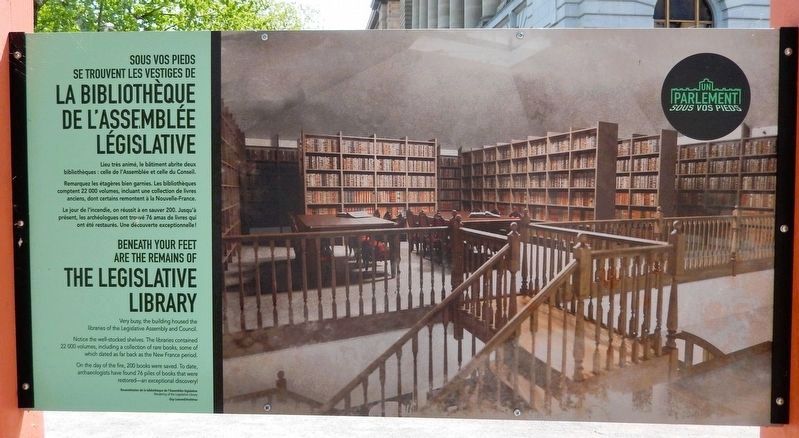
Lieu très animé, le bâtiment abrite deux bibliothèques : celle de l'Assemblée et celle du Conseil.
Remarquez les étagères bien garnies. Les bibliothèques comptent 22 000 volumes, incluant une collection de livres anciens, dont certains remontent à la Nouvelle-France.
Le jour de l'incendie, on réussit à en sauver 200. Jusqu'à présent, les archéologues ont trouvé 76 amas de livres qui ont été restaurés. Une découverte exceptionnelle!
[légende] Reconstitution de la bibliothèque de l'Assemblée.
Guy Lessand, Architruc
Very busy, the building housed the libraries of the Legislative Assembly and Council.
Notice the well-stocked shelves. The libraries contained 22,000 volumes, including a collection of rare books, some of which dated as far back as the New France period.
On the day of the fire, 200 books were saved. To date, archaeologists have found 76 piles of books that were restored — an exceptional discovery!
[caption] A computerized rendering of the library of the Legislative Assembly.
Guy Lessand, Architruc
Topics. This historical marker is listed in these topic lists: Anthropology & Archaeology
this page online
Location. 45° 30.028′ N, 73° 33.36′ W. Marker is in Montréal, Québec. It is in Old Montreal. It is at the intersection of Place d'Youville and Rue Normand, on the left when traveling south on Place d'Youville. The marker is in the St Anne's Market and Parliament of the Province of Canada archaeological site at Youville Square. Touch for map. Marker is at or near this postal address: 406 Place d'Youville, Montréal QC H2Y 2E9, Canada. Touch for directions.

Regionally, this marker is in Central Canada. Globally, it is in North America, the Western Hemisphere, and the Western World. Historically, it finds itself in what was once a British colony, the Viceroyalty of New France, the Haudenosaunee (Iroquois) Confederacy, and Rupert’s Land.
Other nearby markers. At least 8 other markers are within walking distance of this marker: À l'heure des réformes / A Time of Reforms (here, next to this marker); L'Acte d'Union — 1840 / Montréal devient capitale de la province du Canada — 1843 (here, next to this marker); Un lieu désigné pour accueillir le Parlement : Le Marché Sainte-Anne
Photographed by Cosmos Mariner, May 20, 2024
2. Sous vos pieds se trouvent les vestiges de la bibliothèque de l'Assemblée législative Marker
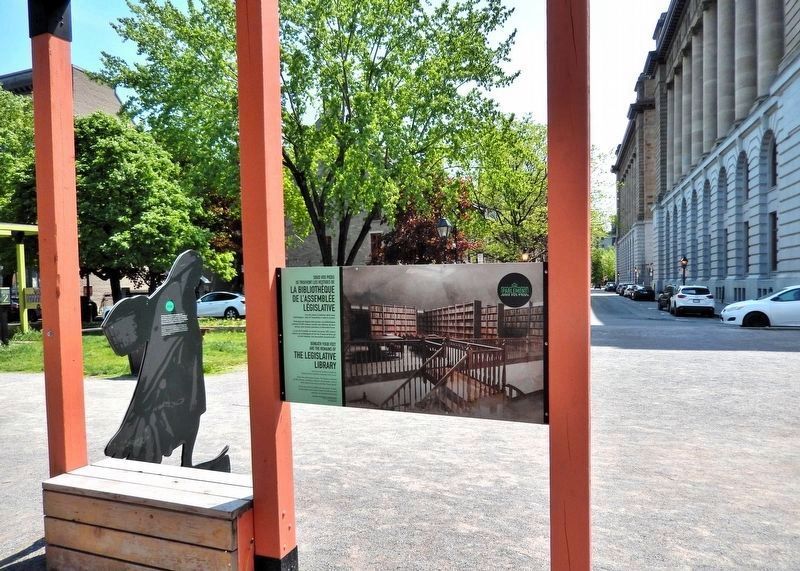
Looking east across Youville Square. Rue Normand is in the background.
Related markers. Click here for a list of markers that are related to this marker. St Anne's Market and Parliament of the Province of Canada Archaeological Site
Also see . . . Secrets of the Ruins: Excavation of Parliament of the Province of Canada (Canada's History).
(By François Gignac, Louise Pothier, and Hendrik Van Gijseghem — Posted September 13, 2022) Excerpt: In 2010, the museum and historic site Pointe-à-Callière, Montreal Archaeology and History Complex, initiated a major research program to study and preserve the building’s remains, breathing new life into ruins that had lain dormant for more than 150 years. During excavations carried out from 2010 to 2017, archaeologists scrutinized these important ruins, seeking clues that would allow for a virtual reconstruction of the building’s interior and exterior. The many material traces bear witness to a site whose history had remained in the shadows for more than one and a half centuries, revealing clues to this overlooked chapter in Canada’s political history.(Submitted on November 20, 2026, by Cosmos Mariner of Cape Canaveral, Florida.)
The legislative library was housed in the building’s central bay, where a new storey was added for this purpose and outfitted with a skylight to let in natural light. The building and its contents, including more than twenty-two thousand volumes held in its two libraries, were almost entirely destroyed by fire during the Tory riot. St. Anne’s Market was rebuilt over the ruins in 1851. In 1901 the market building was demolished; about two decades later the site was paved over as a parking lot, burying all traces of its earlier occupations.
Two clusters of charred books — one in the east wing and the other in the central bay — corresponded to the locations of the libraries of the legislative council and the legislative assembly respectively.
Credits. This page was last revised on November 20, 2026. It was originally submitted on November 18, 2026, by Cosmos Mariner of Cape Canaveral, Florida. This page has been viewed 4 times since then. Photos: 1, 2. submitted on November 20, 2026, by Cosmos Mariner of Cape Canaveral, Florida.
