
Mistley in Essex, England, United Kingdom — Northwestern Europe (the British Isles)
The History of Mistley
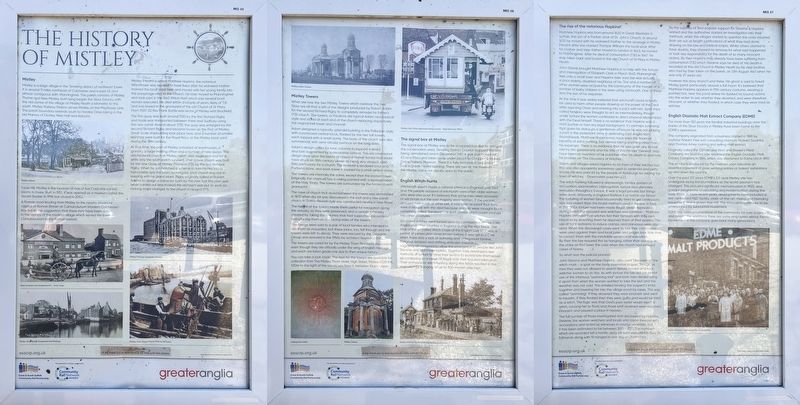
Photographed by Ray Gurganus
1. The History of Mistley Marker
Mistley
Mistley is a large village in the Tendring district of northeast Essex. It is around 11 miles northeast of Colchester and is east of, and almost contiguous with, Manningtree. The parish consists of Mistley Thorne and New Mistley, both lying beside the Stour Estuary with the old centre of the village at Mistley Heath a kilometre to the south. Mistley Railway Station serves Mistley on the Mayflower Line. The parish boundary extends south to Horsley Cross taking in the old Manors of Dickley, New Hall and Abbotts.
Furze Hill, Mistley is the location of one of five Cold War control rooms in Essex. Built in 1951, it was opened as a museum called the Secret Bunker in 1996 but closed in 2002.
A Roman road leading from Mistley to the nearby provincial capital of Roman Britain at Camulodunum (modern Colchester) has led to the suggestion that there may have been a port in the vicinity of the modern village which served the town Camulodunum in the Roman period.
Mistley (Heath) is where Matthew Hopkins, the notorious Witchfinder was reputed to have lived after his widowed mother married the local Vicar here and moved
this page online
The first quay was built around 1720 by the first Richard Rigby and trade was transported between there and Sudbury using the new canal. Around about 1770, the quay was enlarged by the second Richard Rigby and became known as the Port of Mistley. Small-scale shipbuilding took place here, and a number of smaller warships were built for the Royal Navy at the Mistley boat yard during the 18th century.
At that time, the port of Mistley consisted of warehouses, a granary, a large malting office and a number of new quays. The old medieval church at Mistley Heath was neglected and for a while only the south porch survived, after a new church was built by the new Quay at Mistley Thorne in 1735 by the first Richard Rigby. When his son hatched a scheme to turn Mistley into a fashionable spa this
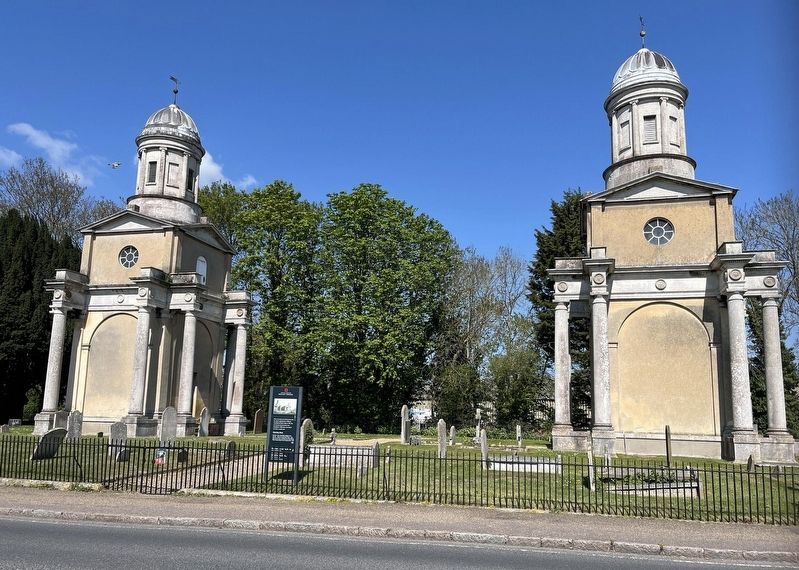
Photographed by Ray Gurganus, April 21, 2026
2. Mistley Towers
Mistley Towers
What are now the two Mistley Towers which overlook the river Stour are all that is left of the designs produced by Robert Adam for the second Richard Rigby to completely remodel his father's 1735 church. The towers, or Pavilions are typical Adam neoclassical style and stood at each end of the church replacing respectively the original bell tower and chancel.
Adam designed a typically splendid building in the Palladian style, with a porticoed central block, flanked by the two tall towers, each topped with a small dome. The body of the church was also symmetrical, with semi-circular porticos on the long sides.
Adam's design called for ionic columns to support a tiered structure augmented by a decorative cornice. This unconventional design drew upon the layout of classical Roman tombs and would have struck an 18th-century viewer as being very unusual, even odd particularly for a church. The material is rendered brick and Portland stone, and each tower is topped by a small lantern dome.
The towers are internally the same, except that the eastern tower (originally the chancel) has a ceiling painted with a representation of the Holy Trinity. The towers are surrounded by the former church graveyard.
The nave of church that stood between the towers was demolished in 1870 when dry rot was discovered in the roof and a new parish church in Gothic Revival style was constructed nearby in New Road.
The height of the towers made them useful for navigation along the estuary, so they were preserved, and a certain symmetry created by taking the columns that had supported the porticos and placing them on the facing sides of the towers.
The towers were sold to a pair of local families who intended to use them as mausolea, but these plans, too, fell through and the towers were left to decay. They were rescued by the Georgian Group and restored in the 1950s by architect Raymond Erith.
The towers are cared for by the Mistley Thorn Residents Association, even though they are officially under the wing of English Heritage and each are listed grade one due to their unique history. You can take a look inside. The keys for the towers are available for collection from The Mistley Thorn Hotel, High Street, Mistley CO11 1HE, 100m to the right of the site as you face-it, between 10am - 4pm.
The signal box at Mistley
The signal box at Mistley was to be scrapped but due to being in the conservation area, Tendring District Council stopped the box being demolished and in December 1985 it was purchased for £5 and lifted and taken away under escort to Chappel & Wakes Colne Railway Museum. There it is fully restored, in use and is now a grade 1 listed building. There are two at the museum - the Mistley one is not usually open to the public.
English Witch-hunts
Witchcraft wasn't made a criminal offence in England until 1563 and the people accused of witchcraft were often older women who were also poor. It's believed that some men were accused of witchcraft but the vast majority were women. If the person accused had a cat, or other pet, it was seen as proof that they were in league with the devil because animals were thought to be something called "familiars" a spirit animal which could change into other creatures.
So-called witches were turned upon by communities across East Anglia and other counties in England during the mid 1640s. The time of the so called Witch Craze of the English Civil War was a period of persecution never known before. It was set in a time when there was a lack of authority and widespread famine. Religious tensions and shifting attitudes towards poverty and vagrancy all conspired to allow the emergence of people like John Stearne and Matthew Hopkins. Together they developed new methods of torture to force their victims to incriminate themselves by confessing to a range of illegal acts that required execution. Their enthusiastic witch hunting during the 1640s resulted in the execution by hanging, of up to 300 women and men.
The rise of the notorious Hopkins
Matthew Hopkins, was born around 1620 in Great Wenham in Suffolk, the son of a Puritan vicar of St. John's Church. In around 1635 he moved with his widowed mother to the vicarage in Mistley (Heath) after she married Thomas Witham the local vicar. After his mother and step-father moved to London in 1643, he moved to Manningtree. After he died of consumption (T.B.) in 1647 he was taken back and buried in the old Church of St Mary in Mistley Heath.
John Sterne brought Matthew Hopkins in to help with the torture and interrogation of Elizabeth Clark in March 1645. Manningtree was only a small town and Hopkins later said she was actually a poor elderly, disabled neighbour of his. She and a number of other women were accused by the community of the murder of a number of baby children in the town using witchcraft. One of these was the son of his stepsister.
At the time it was widely believed that witchcraft could actually be used to harm other people drawing on the power of the Devil after rejecting Christ and entering into a pact with him. Spirit imps called familiars were thought to act as intermediatory, though under torture the women confessed to direct physical relationships with the Devil himself. There is no evidence that Hopkins was a strict puritan or had any legal background. It's perhaps surprising that given his status as a gentleman of leisure he was not playing a part in the protestant army in defending East Anglia from Roundheads. Matthew Hopkins may have seen the financial benefits of witch hunting, but denied taking anything other than his expenses. There is no evidence that he was given any formal role by the government and the title of Witchfinder 'General' may have been an invention of his publisher after his death to promote his booklet on 'The Discovery of Witches'.
Towns and villages asked Hopkins to rid them of their witches but this was also apparently sometimes used to settle old and petty scores. He was paid £6 by the people of Aldeburgh for ridding the town of witches - Stowmarket paid him £23.
The witch hunting followed a depressingly familiar pattern of accusation, examination, interrogation, torture and ultimately, execution throughout Europe. It was a legal process but things were done differently in England (believe it or not!) In our favour the torturing of women (and occasionally men) to get confessions was less violent than the brutal methods used in Europe. In fact, in the 600s torture had been made illegal. Sleep deprivation during which the accused was watched was common - Matthew Hopkins believed that witches fed their familiars with their own blood so by watching them he deprived them of their powers. The use of tight restraints to induce cramps, and starvation were also used. When the discovered cases went to trial their confessions were used against them and local juries and judges took little time to convict them with the inevitable sentence of execution. By then the law required this by hanging, rather than burning at the stake as had been the case when the church had pursued cases of heresy.
So what was the judicial process?
John Stearne and Matthew Hopkins, also used "discovering" the witch-mark - a spot on the body insensitive to pain, though as men they were not allowed to search female bodies and took watcher women to do this. As with torture the law did not permit use of the infamous "swimming trial" and both men denied using it apart from when the women wanted to take the test and the weather was not cold. This entailed binding the suspect's limbs together and lowering her into the village pond by ropes. This was called "swimming". If they drowned they were innocent and went to heaven. If they floated then they were guilty and would be tried as a witch. The logic was that God's pure water would reject a witch, causing her to float, and those who drowned were assumed innocent and assured a place in heaven.
The full number of those investigated and discovered by Hopkins, Stearne, the women watchers and locals who came forward with accusations and acted as witnesses in court is uncertain, but it has been estimated to be between 300-400. The numbers which are recorded tell a horrific story. 68 were executed in Bury St Edmunds alone with 19 hanged in one day in Chelmsford.
By the summer of 1646 popular support for Stearne & Hopkins waned and the authorities started an investigation into their methods, whilst the villages started to question the costs incurred. Both set out at length justifications of what they had done, drawing on the law and biblical scripts. Whilst others started to have doubts, they showed no remorse for what had happened or took any responsibility for the death of so many innocent victims. By then Hopkins may already have been suffering from consumption (T.B.) which Stearne says he died of. His death is recorded at the old Church in Mistley Heath by his step brother, who had by then taken on the parish, on 12th August 1647 when he was only 27 years old.
However the story doesn't end there. His ghost is said to haunt Mistley pond, particularly around a full moon. It's believed that Matthew Hopkins appears in 17th century costume, wearing a pointed hat, near the pond where he dunked his bound victims into the water to see whether they drowned, and were therefore innocent, or whether they floated, in which case they were tried as witches.
English Diastatic Malt Extract Company (EDME)
For more than 130 years the familiar industrial buildings near the banks of the Stour Estuary in Mistley have been home to the EDME's operations.
The company originated from a business started in 1881 by maltster Robert Free with consulting chemists Richard Southby and Thomas Amey making and selling malt extract.
Originally called the Condensed Wort and Brewer's Meal Company, the business was renamed the English Diastatic Malt Extract Company in 1884, which was shortened to Edme Ltd in 1897.
The products produced by the business soon became an essential ingredient of prize-winning entries at bakers' exhibitions up and down the country.
Over the past 137 years EDME's 3.5-acre Mistley site has undergone many transformations as the world around it has changed. This included significant mechanisation in 1950, and a major programme of rebuilding and modernisation during the early 1990s. In more recent years, developments have included a test centre and R&D facility, state-of-the-art mixing and blending equipment, and a gluten-free mill. This innovation continues to be underpinned by substantial investment.
EDME has been a cornerstone of the community for over a century, and among the workforce there are some employees whose family involvement in the company goes back many generations.
Topics. This historical marker is listed in these topic lists: Industry & Commerce • Religion & Religious Structures • Women.
Location. 51° 56.621′ N, 1° 4.878′ E. Marker is in Mistley, England, in Essex. It can be reached from High Street, on the right when traveling east. Touch for map. Marker is at or near this postal address: High Street, Mistley, England, United Kingdom. Touch for directions.

Regionally, this marker is in the Greater South East. Globally, it is on the Atlantic Ocean, in the North Atlantic Region, in Europe, in Atlantic Europe, on one of the British Isles, in the Western World, and in the Anglosphere. Historically, it finds itself in what was once the Roman Empire.
Other nearby markers. At least 8 other markers are within 13 kilometers of this marker, measured as the crow flies: Mistley Cobble Wall (about 150 meters away, measured in a direct line); Mistley Towers (approx. 0.4 kilometers away); Manningtree, Mistley, and Lawford (approx. 1.4 kilometers away); The History of Manningtree and the Stour Estuary (approx. 2.5 kilometers away); Walk in Constables Footsteps (approx. 2.6 kilometers away); a different marker also named Manningtree (approx. 2.6 kilometers away); Gipeswic (approx. 12.6 kilometers away); Ipswich (approx. 12.6 kilometers away). Touch for a list and map of all markers in Mistley.
Credits. This page was last revised on November 19, 2026. It was originally submitted on November 19, 2026, by Ray Gurganus of Washington, District of Columbia. This page has been viewed 6 times since then. Photos: 1, 2. submitted on November 19, 2026, by Ray Gurganus of Washington, District of Columbia. • Andrew Ruppenstein was the editor who published this page.
Editor’s want-list for this marker. photo of the marker within its surroundings • Can you help?
