Greensboro in Guilford County, North Carolina — The American South (South Atlantic)
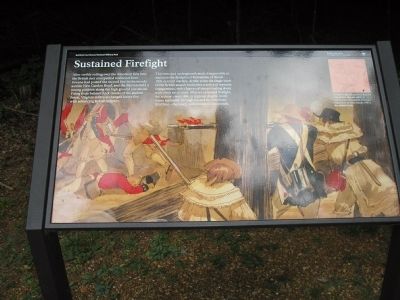
Sustained Firefight
Guilford Courthouse National Military Park
| — | National Park Service, U.S. Department of the Interior | — |
Photographed by Bill Coughlin, August 19, 2006
1. Sustained Firefight Marker

After swiftly rolling over the American first line, the British met unexpected resistance here. Greene had posted the second line in the woods astride New Garden Road, and the Patriots held a strong position along the high ground just ahead. Firing from behind thick trunks of the ancient forest, Virginia militia exchanged heavy fire with advancing British infantry.
The trees and undergrowth made it impossible to maintain the disciplined formations of classic 18th-century warfare. At this point the single wave of the British assault broke into a series of separate engagements, with clusters of troops trading shots with other small units. After an extended firefight, the redcoats were able to regroup despite costly losses and break through toward the American third line – the tough, well-trained Continentals.
Erected by National Park Service, U.S. Department of the Interior.
Topics. This historical marker is listed in these topic lists: Notable Events • Notable Places • War, US Revolutionary.
Location. Marker has been permanently removed. It was located near 36° 7.825′ N,
this page online
We have been informed that this marker is no longer there and will not be replaced. This page is an archival view of what was.
Regionally, this marker was in the Piedmont and specifically in Piedmont Triad. It was also in the American South and specifically in the Upper South. Globally, it was in North America, the Western Hemisphere, the Western World, and the Anglosphere. Historically, it found itself in what was once the territory of the Mississippian Culture, one of the original Thirteen Colonies, one of the Confederate States of America, and the Antebellum South.

Other nearby markers. At least 8 other markers are within walking distance of this location: Second Line Trail (here, next to this marker); Lieut. Col. “Hal.” Dixon

Photographed by Bill Coughlin, August 19, 2006
2. Marker on Guilford Courthouse Battlefield
Two brigades of Virginia militia were waiting here for the British troops that broke through the American First Line of Defense. After a prolonged stand, the line was finally broken and the militia fell back to the third and final line.
More about this marker. The background of the marker features a picture of a Continental soldier and militiamen behind a rail fence firing at advancing British troops. The upper right corner of the marker contains a map with the caption “A British engineer drew this detailed map shortly after the battle. It clearly shows the pattern of the terrain: many acres of dense woods, with a few cleared fields.”
Also see . . .
1. Guilford Courthouse National Military Park. National Park Service. (Submitted on September 18, 2008, by Bill Coughlin of Woodland Park, New Jersey.)
2. The Battle of Guilford Courthouse 1781. An account of the Battle of Guilford Courthouse from a British perspective from BritishBattles.com. (Submitted on September 18, 2008, by Bill Coughlin of Woodland Park, New Jersey.)
Photographed by Bill Coughlin, August 1, 2010
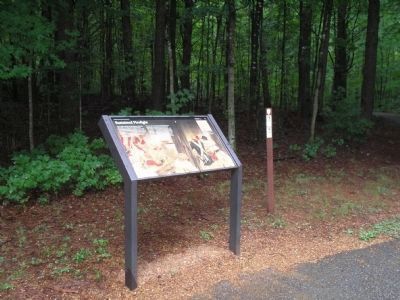
3. Sustained Firefight Marker at Tour Stop #3
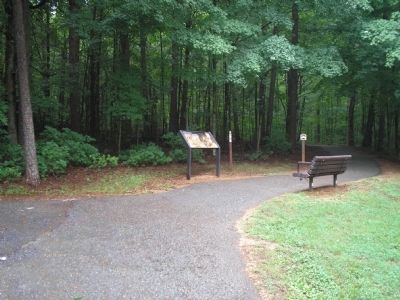
The Sustained Firefight Marker is located at stop # 3 along the auto tour road in Guilford Courthouse National Military Park.
Photographed by Bill Coughlin, August 1, 2010
4. Sustained Firefight Marker
Photographed by Bill Coughlin, August 19, 2006
5. Guilford Courthouse National Military Park
The marker is located on the auto tour road in Guilford Courthouse National Military Park.
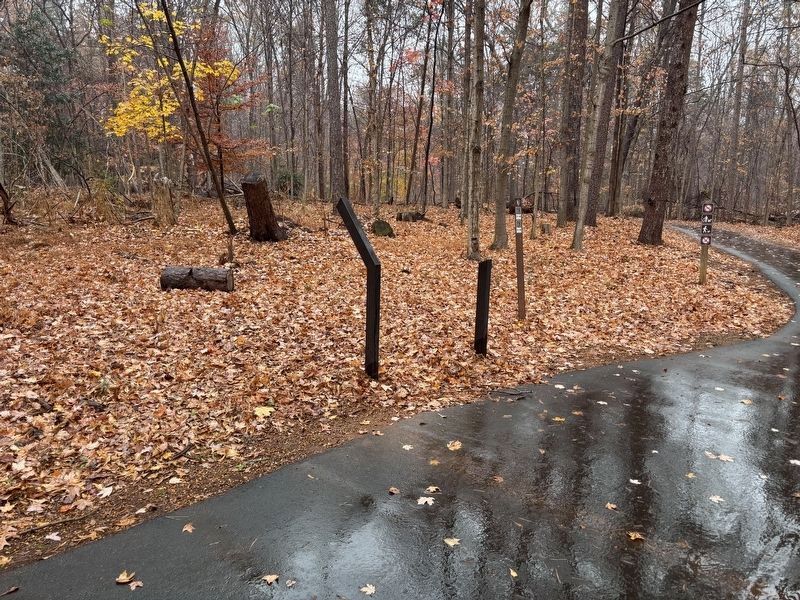
Photographed by Benjamin Rubin, November 22, 2026
6. Location of Sustained Firefight Marker
Credits. This page was last revised on November 23, 2026. It was originally submitted on September 18, 2008, by Bill Coughlin of Woodland Park, New Jersey. This page has been viewed 1,149 times since then and 40 times this year. Last updated on November 22, 2026, by Benjamin Rubin of Columbia, South Carolina. Photos: 1, 2. submitted on September 18, 2008, by Bill Coughlin of Woodland Park, New Jersey. 3, 4. submitted on August 1, 2010, by Bill Coughlin of Woodland Park, New Jersey. 5. submitted on September 18, 2008, by Bill Coughlin of Woodland Park, New Jersey. 6. submitted on November 22, 2026, by Benjamin Rubin of Columbia, South Carolina. • Devry Becker Jones was the editor who published this page.