Soho in City of Westminster in Greater London, England, United Kingdom — Northwestern Europe (the British Isles)
Soho Square
The Garden's History and Layout
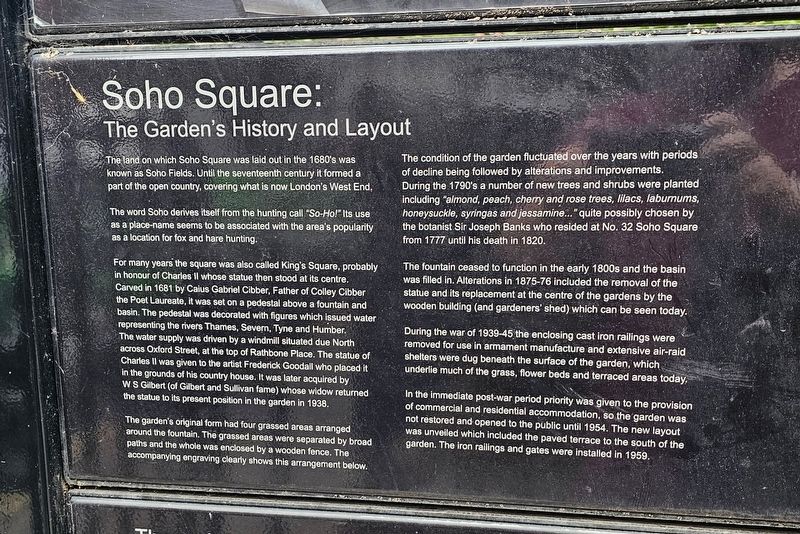
Photographed by Ian Lefkowitz, September 15, 2026
1. Soho Square Marker
 The land on which Soho Square was laid out in the 1680’s was known as Soho Fields. Until the seventeenth century it formed a part of the open country, covering what is now London’s West End.
The word Soho derives itself from the hunting call “So-Ho!” Its use as a place-name seems to be associated with the area’s popularity as a location for fox and hare hunting.
For many years the square was also called King’s Square, probably in honour of Charles II whose statue then stood at its centre. Carved in 1681 by Caius Gabriel Cibber, Father of Colley Cibber the Poet Laureate, it was set on a pedestal above a fountain and basin. The pedestal was decorated with figures which issued water representing the rivers Thames, Severn, Tyne and Humber. The water supply was driven by a windmill situated due North across Oxford Street, at the top of Rathbone Place. The statue of Charles II was given to the artist Frederick Goodall who placed it in the grounds of his country house. It was later acquired by W S Gilbert (of Gilbert and Sullivan fame) whose widow returned the statue to its present position in the garden in 1938.
The garden’s
this page online
The condition of the garden fluctuated over the years with periods of decline being followed by alterations and improvements. During the 1790’s a number of new trees and shrubs were planted including “almond, peach, cherry and rose trees, lilacs, laburnums, honeysuckle, syringas and jessamine…” quite possibly chosen by the botanist Sir Joseph Banks who resided at No. 32 Soho Square from 1777 until his death in 1820.
The fountain ceased to function in the early 1800s and the basin was filled in. Alterations in 1875–76 included the removal of the statue and its replacement at the centre of the gardens by the wooden building (and gardeners’ shed) which can be seen today.
During the war of 1939–45 the enclosing cast iron railings were removed for use in armament manufacture and extensive air-raid shelters were dug beneath the surface of the garden, which underlie much of the grass, flower beds and terraced areas today.
In
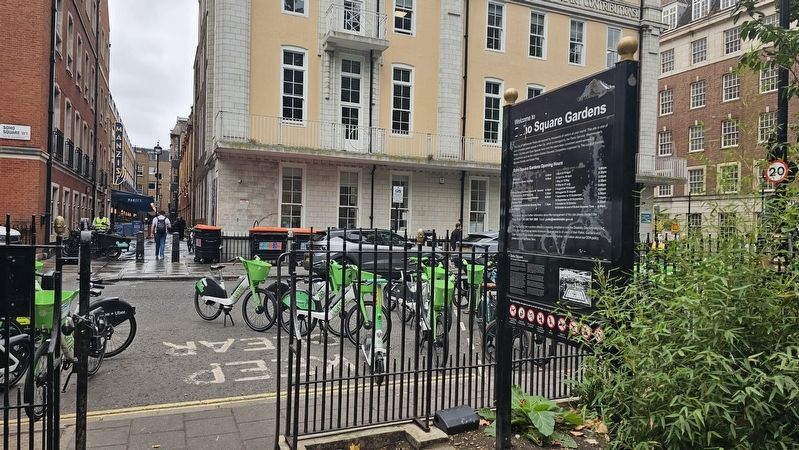
Photographed by Ian Lefkowitz, September 15, 2026
2. Soho Square Marker
This consolidated rules sign is located at the southern entrance to Soho Square Gardens. An identical sign is found at the park's northern entrance.
Erected by City of Westminster.
Topics. This historical marker is listed in this topic list: Parks & Recreational Areas.
Location. 51° 30.901′ N, 0° 7.922′ W. Marker is in City of Westminster, England, in Greater London. It is in Soho. It is at the intersection of Soho Square and Bateman's Buildings, on the right when traveling west on Soho Square. Touch for map. Marker is at or near this postal address: 13456 Soho Square, City of Westminster, England W1D 3QR, United Kingdom. Touch for directions.

Regionally, this marker is in London and in the Greater South East. Globally, it is on the Atlantic Ocean, in the North Atlantic Region, in Europe, in Atlantic Europe, on one of the British Isles, in the Western World, and in the Anglosphere. Historically,
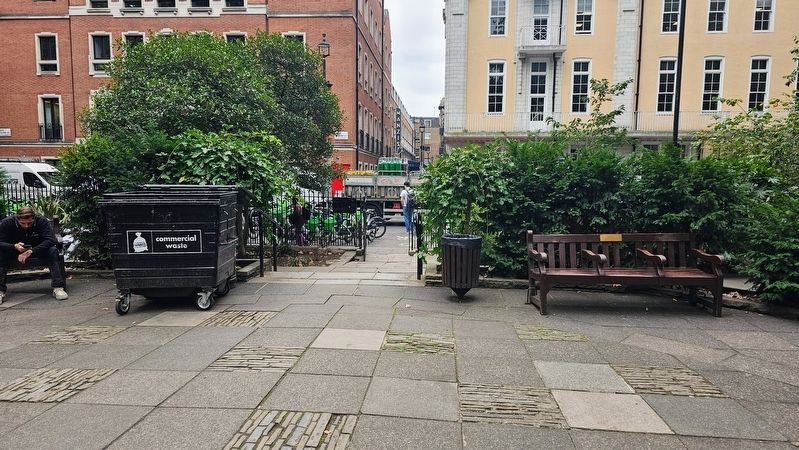
Photographed by Ian Lefkowitz, September 15, 2026
3. Soho Square Marker
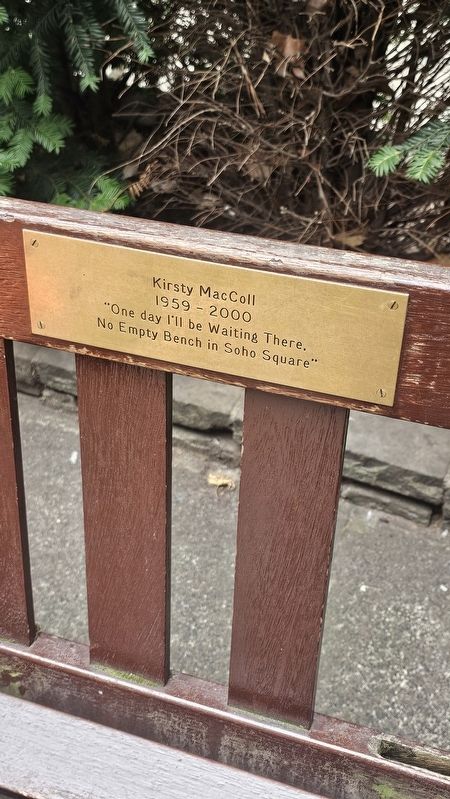
The southern end of Soho Square. The bench on the right of this photo is dedicated to the legendary British singer/songwriter Kirsty MacColl.
Other nearby markers. At least 8 other markers are within walking distance of this marker: A different marker also named Soho Square (within shouting distance of this marker); a different marker also named Soho Square (within shouting distance of this marker); a different marker also named Soho Square (within shouting distance of this marker); Arthur Onslow (within shouting distance of this marker); William Hazlitt (within shouting distance of this marker); Mary Seacole (about 90 meters away, measured in a direct line); Josiah Wedgwood (about 90 meters away); William Nicholson (about 120 meters away). Touch for a list and map of all markers in City of Westminster.
Also see . . . Soho Square - Kirsty MacColl (YouTube). (Submitted on November 24, 2026, by Ian Lefkowitz of New York, New York.)
Photographed by Ian Lefkowitz, September 15, 2026
4. Kirsty MacColl Bench Plaque
Kirsty MacColl
1959–2000
“One day I’ll be waiting there,
No empty bench in Soho Square”
Credits. This page was last revised on November 24, 2026. It was originally submitted on November 24, 2026, by Ian Lefkowitz of New York, New York. This page has been viewed 7 times since then. Photos: 1, 2, 3, 4. submitted on November 24, 2026, by Ian Lefkowitz of New York, New York. • Andrew Ruppenstein was the editor who published this page.