Mill Bluff State Park near Camp Douglas in Monroe County, Wisconsin — The American Midwest (Great Lakes)
Mesas and Buttes
Photographed by Keith L, June 6, 2010
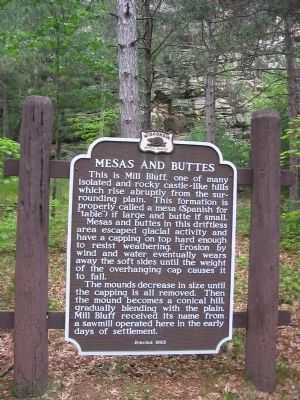
1. Mesas and Buttes Marker
Mesas and buttes in this driftless area escaped glacial activity and have a capping on top hard enough to resist weathering. Erosion by wind and water eventually wears away the soft sides until the weight of the overhanging cap causes it to fall.
The mounds decrease in size until the capping is all removed. Then the mound becomes a conical hill, gradually blending with the plain. Mill Bluff received its name from a sawmill operated here in the early days of settlement.
Erected 1963 by the Wisconsin Historical Society. (Marker Number 124.)
Topics and series. This historical marker is listed in these topic lists: Natural Features • Settlements & Settlers. In addition, it is included in the Wisconsin Historical Society series list.
Location. 43° 56.37′ N, 90° 19.01′ W. Marker is near Camp Douglas, Wisconsin, in Monroe County. It is in Mill Bluff State
this page online

Regionally, this marker is in the American Midwest and in the Corn Belt. Globally, it is in North America, the Western Hemisphere, the Western World, and the Anglosphere. Historically, it finds itself in what was once the territory of the Mississippian Culture and also the Northwest Territory.
Other nearby markers. At least 8 other markers are within walking distance of this marker: Eroding Sandstone Bluffs (within shouting distance of this marker); Volk Field Air Strip (about 300 feet away, measured in a direct line); Ice Age National Scientific Reserve (about 700 feet away); The Big Lake (approx. 0.2 miles away); Long Bluff (approx. 0.2 miles away); Glacial Lake Wisconsin (approx. 0.2 miles away); Welcome to the Islands! (approx. 0.2 miles away); Landmarks for Travelers (approx. ¼ mile away). Touch for a list and map of all
Photographed by Keith L, June 6, 2010
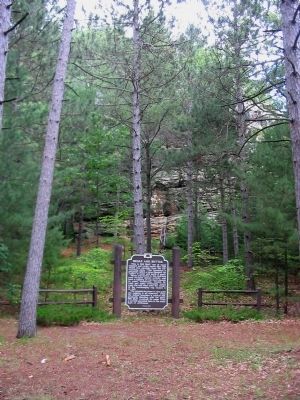
2. Mesas and Buttes Marker
Also see . . . Mill Bluff State Park. Wikipedia entry. "There are 10 named bluffs in the park. Mill Bluff, 120 feet (37 m) high, is between the interstate and U.S. Route 12... Bee Bluff, although smaller and only 60 feet (18 m) high, is the most visible bluff from the interstate, as it stands adjacent to the westbound lanes." (Submitted on June 10, 2010.)
Photographed by Keith L, June 6, 2010
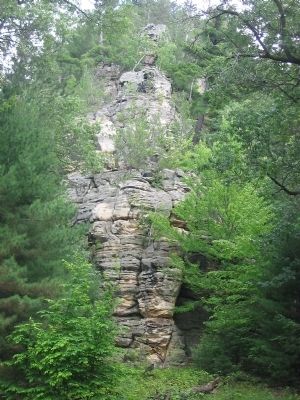
3. Mill Bluff
Photographed by Keith L, June 6, 2010
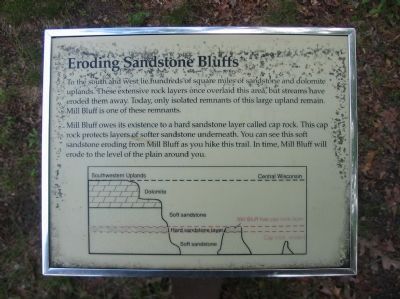
4. Eroding Sandstone Bluffs Sign
To the south and west lie hundreds of square miles of sandstone and dolomite uplands. These extensive rock layers once overlaid this area, but streams have eroded them away. Today, only isolated remnants of this large upland remain. Mill Bluff is one of these remnants.
Mill Bluff owes its existence to a hard sandstone layer called cap rock. This cap rock protects layers of softer sandstone underneath. You can see this soft sandstone eroding from Mill Bluff as you hike this trail. In time, Mill Bluff will erode to the level of the plain around you.
Mill Bluff owes its existence to a hard sandstone layer called cap rock. This cap rock protects layers of softer sandstone underneath. You can see this soft sandstone eroding from Mill Bluff as you hike this trail. In time, Mill Bluff will erode to the level of the plain around you.
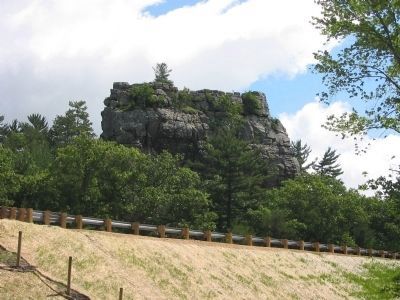
Photographed by Keith L, June 6, 2010
5. Nearby Bee Bluff
Credits. This page was last revised on July 28, 2024. It was originally submitted on June 10, 2010, by Keith L of Wisconsin Rapids, Wisconsin. This page has been viewed 2,046 times since then and 71 times this year. Photos: 1, 2, 3, 4, 5. submitted on June 10, 2010, by Keith L of Wisconsin Rapids, Wisconsin. • Craig Swain was the editor who published this page.
