Araby View near Frederick in Frederick County, Maryland — The American Northeast (Mid-Atlantic)
History of the Monocacy River Valley
Photographed by Devry Becker Jones (CC0), November 6, 2020
1. History of the Monocacy River Valley Marker
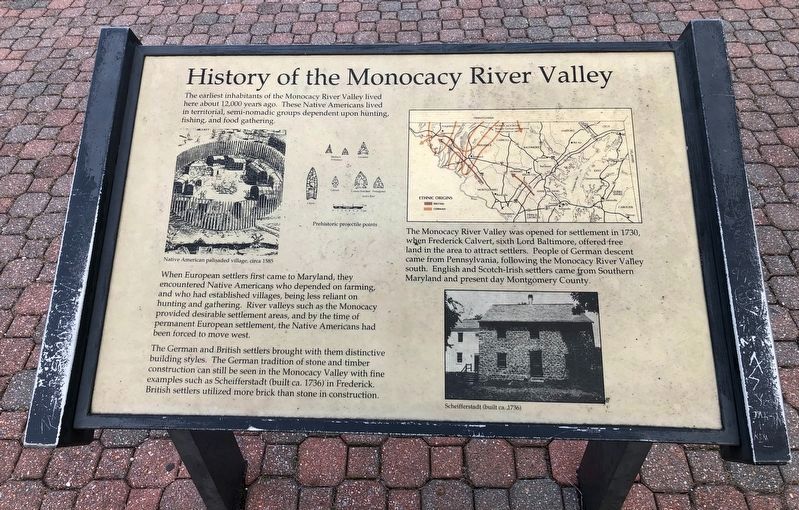
The earliest inhabitants of the Monocacy River Valley lived here about 12,000 years ago. These Native Americans lived in territorial, semi-nomadic groups dependent upon hunting, fishing, and food gathering.
When European settlers first came to Maryland, they encountered Native Americans who depended upon farming and who had established villages, being less reliant on hunting and gathering. River valleys such as the Monocacy provided desirable settlement areas, and by the time of permanent European settlement, the Native Americans had been forced to move west.
The German and British settlers brought with them distinctive building styles. The German tradition of stone and timber construction can still be seen in the Monocacy Valley with fine examples such as Scheifferstadt (built ca. 1736) in Frederick. British settlers utilized more brick than stone in construction.
The Monocacy River Valley was opened for settlement in 1730, when Frederick Calvert, sixth Lord Baltimore, offered free land in the area to attract settlers. People of German descent came from Pennsylvania, following the Monocacy River Valley south. English and
this page online
Topics. This historical marker is listed in these topic lists: Indigenous Peoples and Communities • Settlements & Settlers. A significant historical year for this entry is 1730.
Location. 39° 20.972′ N, 77° 23.39′ W. Marker is near Frederick, Maryland, in Frederick County. It is in Araby View. It can be reached from Interstate 270, on the right when traveling west. Located at a rest stop/scenic overlook loop reached from west bound I-270. Touch for map. Marker is in this post office area: Frederick MD 21704, United States of America. Touch for directions.

Regionally, this marker is in the Washington Metropolitan Area and in Central Maryland. It is also in the American Mid-Atlantic. Globally, it is in North America, the Western Hemisphere, the Western World, and the Anglosphere. Historically, it finds itself in what was once one of the original Thirteen Colonies and also the Antebellum South.
Other nearby markers. At least 8 other markers are within walking distance of this marker: The Battle That Saved Washington (here, next to this marker);
Photographed by Devry Becker Jones (CC0), November 6, 2020
2. Markers at the Rest Stop / Overlook
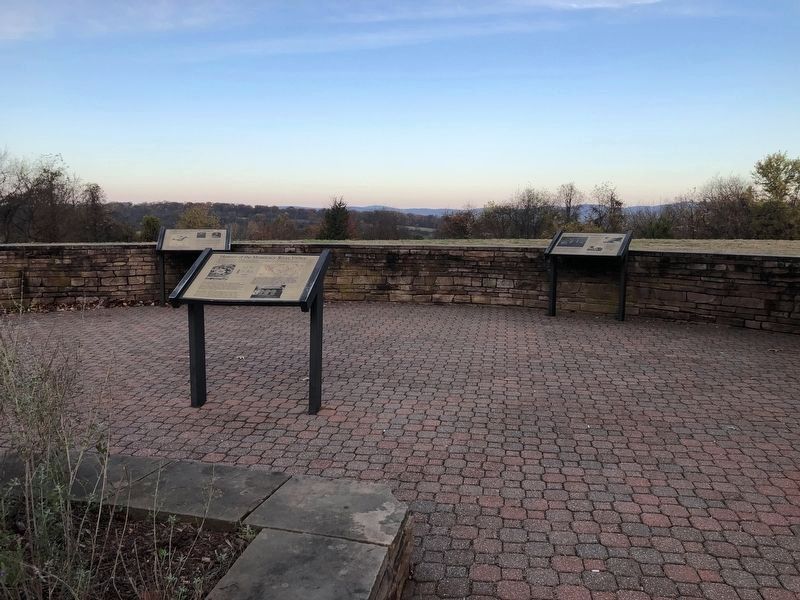
The History of the Monocacy River Valley marker is in the center of the observation walkway behind the center shrubs.
Other markers no longer nearby. Goodloe Edgar Byron (was a few steps from this marker but has been permanently removed); Gordon’s Decisive Attack (was approx. 0.4 miles away but has been confirmed missing); Thick of the Battle (was approx. half a mile away but has been confirmed missing); Thomas Farm (was approx. half a mile away but has been permanently removed); Federal Retreat (was approx. half a mile away but has been permanently removed).
More about this marker. On the left the marker displays a drawing of a "Native American palisaded village, circa 1585." Next to it is a drawing of various prehistoric spear points. A map on the upper right shows the settlement patterns of the valley. On the lower right is a photograph of Scheifferstadt.
Also see . . . Settling the Catoctins. National Park Service website entry (Submitted on November 4, 2007, by Craig Swain of Leesburg, Virginia.)
Credits. This page was last revised on March 15, 2022. It was originally submitted on November 4, 2007, by Craig Swain of Leesburg, Virginia. This page has been viewed 3,626 times since then and 119 times this year. Photos: 1, 2. submitted on November 6, 2020, by Devry Becker Jones of Washington, District of Columbia.
