Near Middletown in Frederick County, Virginia — The American South (Mid-Atlantic)
Union Withdrawal
Photographed by Craig Swain, September 29, 2007
1. Union Withdrawal wayside
A Virtual Tour of the Battle of Cedar Creek by related HMDb markers
Click for more information.
Click for more information.
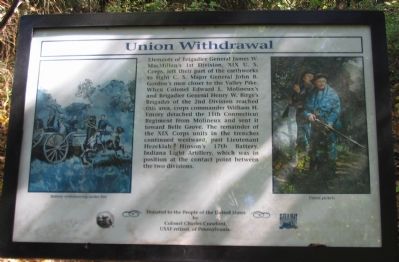
Elements of Brigadier General James W. MacMillan's 1st Division, XIX U.S. Corps, left their part of the earthworks to fight C.S. Major General John B. Gordon's men closer to the Valley Pike. When Colonel Edward L. Molineux's and Brigadier General Henry W. Birge's Brigades of the 2nd Division reached this area, corps commander William H. Emory detached the 11th Connecticut Regiment from Molineux and sent it toward Belle Grove. The remainder of the XIX Corps units in the trenches continued westward, past Lieutenant Hezekiah Hinson's 17th Battery Indiana Light Artillery, which was in position at the contact point between the two divisions
by
Colonel Charles Crawford,
USAF retired, of Pennsylvania
Erected by Blue and Gray Education Society and Cedar Creek Battlefield Foundation.
Topics. This historical marker is listed in this topic list: War, US Civil.
Location. 39° 0.935′ N, 78° 18.746′ W. Marker is near Middletown, Virginia, in Frederick County. It can be reached from Valley Pike (U.S. 11), on the right when traveling south.
this page online

Regionally, this marker is in Virginia’s Shenandoah Valley. It is also in the American South, specifically in the Upper South, and in the Mid-Atlantic. Globally, it is in North America, the Western Hemisphere, the Western World, and the Anglosphere. Historically, it finds itself in what was once the territory of the Mississippian Culture, one of the original Thirteen Colonies, one of the Confederate States of America, and the Antebellum South.
Other nearby markers. At least 8 other markers are within walking distance of this marker: Molineux's 2nd Brigade (within shouting distance of this marker); 1st Maine Battery (approx. 0.2 miles away); Union Trenches (approx. ¼ mile away); South Carolina Troops at Cedar Creek (approx. 0.4 miles away); Plantation Office & Store (approx. half a mile away); Battle of Cedar Creek (approx. half a mile away); The Shenandoah Valley / Battle of Cedar Creek, October 19, 1864
Photographed by Craig Swain, September 29, 2007
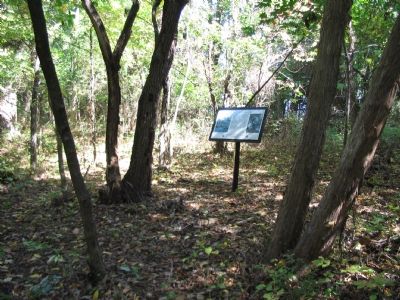
2. Union Withdrawal Trail Stop
Another marker is no longer nearby. Shenandoah At War (was approx. half a mile away but has been permanently removed).
More about this marker. On the left side of the marker is a painting of a "Battery withdrawing under fire." On the right is a painting of "Union pickets."
Regarding Union Withdrawal. The Cedar Creek battlefield is interpreted by several markers. See the Battle of Cedar Creek Virtual Tour by Markers link above.
Also see . . .
1. Cedar Creek Battlefield Foundation. Foundation website homepage (Submitted on November 9, 2007, by Craig Swain of Leesburg, Virginia.)
2. Battle of Cedar Creek Staff Ride. The trail extends from tour stop four on the Center of Military History staff ride of the battle. (Submitted on November 9, 2007, by Craig Swain of Leesburg, Virginia.)
3. Battle of Cedar Creek Summary. The action here is discussed as phase four of the National Parks Service summary of the battle. (Submitted on November 9, 2007, by Craig Swain of Leesburg, Virginia.)
Photographed by Craig Swain, September 29, 2007
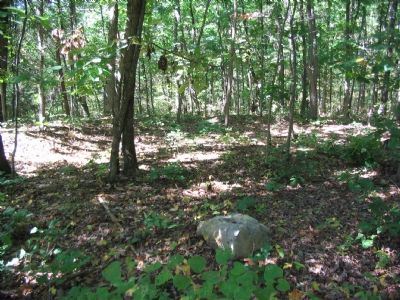
3. Federal Earthworks
A few paces from the marker are the remains of a lunette, still visible as a "V" shaped series of mounds.
Credits. This page was last revised on October 21, 2024. It was originally submitted on November 9, 2007, by Craig Swain of Leesburg, Virginia. This page has been viewed 1,578 times since then and 22 times this year. Photos: 1, 2, 3. submitted on November 9, 2007, by Craig Swain of Leesburg, Virginia.
