Near Custer in Custer County, South Dakota — The American Midwest (Upper Plains)
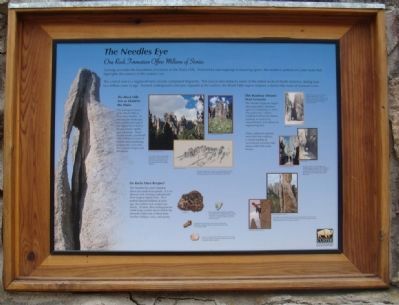
The Needles Eye
One Rock Formation Offers Millions of Stories
Photographed by William J. Toman, August 9, 2010
1. The Needles Eye Marker
Geology provides the foundation of scenery in the Black Hills. From rocky outcroppings to towering spires, the northern portion of Custer State Park highlights the essence of the central core.
The central core is a region of rocks mainly composed of granite. This area is also home to some of the oldest rocks in North America, dating over two billion years in age. Formed underground and now exposed at the surface, the Black Hills region features a dome-like mass of resistant rocks.
The Black Hills Are an Island in the Plains
The geologic history of the Black Hills is long and complex. In viewing the landscape, you would never guess the region had a history of vast oceans, uplifts, and volcanoes. These natural events, combined with millions of years of erosion and weathering, sculpted the rocks into their present shapes and elevations.
This Roadway Attracts Most Everyone
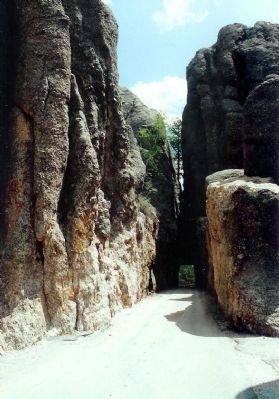
The Needles Highway began attracting public attention upon its completion in 1922. Like past years, visitors continue to drive the narrow roadway to revel in its natural beauty and admire its engineering feat.
Today, sightseers explore more
this page online
Do Rocks Have Recipes?
The Needles Eye and Cathedral Spires are made from granite. It is an igneous rock, forming underground from magma (liquid rock). As it pushed upward millions of years ago, the molten rock cooled very slowly. At times, this cooling process yields large crystals which tend to be minerals within one of these three families: feldspar, mica, and quartz.
[Captions:]
The Cathedral Spires is perhaps the most famous rock formation in the Black Hills. Its name comes from the towering peaks which appear like organ pipes from the Needles Highway.
Kids often observe more than what is expected during a family vacation. Some scenery simply captures their attention and causes them to become more aware of their natural world.
Erected by Custer State Park.
Topics. This historical marker is listed in these topic lists: Natural Features • Roads & Vehicles. A significant historical year for this entry is 1922.
Location. 43° 50.539′ N, 103° 32.744′ W. Marker is near Custer, South Dakota, in Custer County. It is on Peter
Photographed by Mike Stroud, June 1992
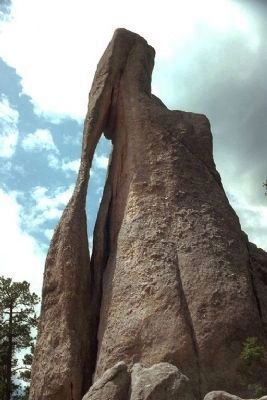
2. The Needles Eye, Custer State Park, in the Black Hills

Regionally, this marker is in West River and in Greater Rapid City. It is also in the American Black Hills, in the Lewis & Clark Corridor, on the prairies, and on the Northern Plains. Globally, it is in North America, the Western Hemisphere, the Western World, and the Anglosphere. Historically, it finds itself in what was once Rupert’s Land and also the Louisiana Purchase.
Other nearby markers. At least 8 other markers are within 5 miles of this marker, measured as the crow flies: Mount Rushmore Inspiration (approx. half a mile away); A Changing Landscape (approx. 0.8 miles away); Harney Peak Lookout (approx. 1.8 miles away); Halfway to where? (approx. 4.2 miles away); Scale Model of Crazy Horse (approx. 4.3 miles away); Death Song (approx. 4.4 miles away); 9-11 Memorial (approx. 4.4 miles away); Profile in Granite (approx. 4.8 miles away). Touch for a list and map of all markers in Custer.
Photographed by William J. Toman, August 9, 2010
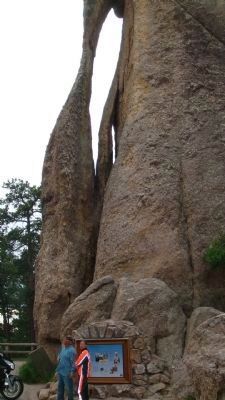
3. The Needles Eye Marker
With the Needles Eye (both of them) above the marker.
Photographed by Mike Stroud, June 1992
4. Custer State Park Tunnel, as mentioned, Needles Highway
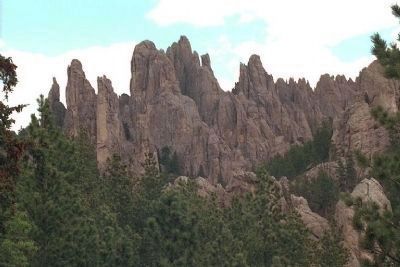
Photographed by Mike Stroud, June 1992
5. Cathedral Spires, as mentioned
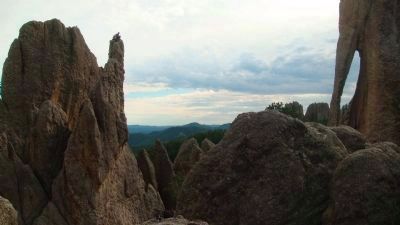
Photographed by William J. Toman, August 9, 2010
6. Rock climbers next to the Needles Eye
The climbers are on the spire on the left.
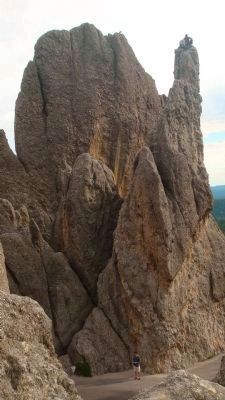
Photographed by William J. Toman, August 9, 2010
7. Closer view of the rock climbers
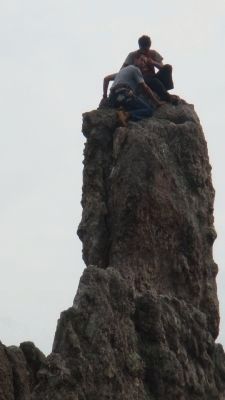
Photographed by William J. Toman, August 9, 2010
8. Even closer view of the rock climbers
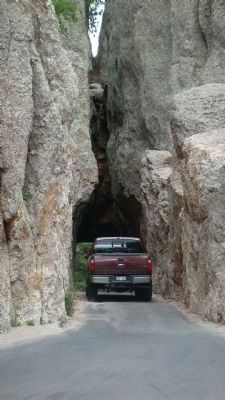
Photographed by William J. Toman, August 9, 2010
9. Tunnel next to the Needles Eye
Photographed by William J. Toman, August 9, 2010
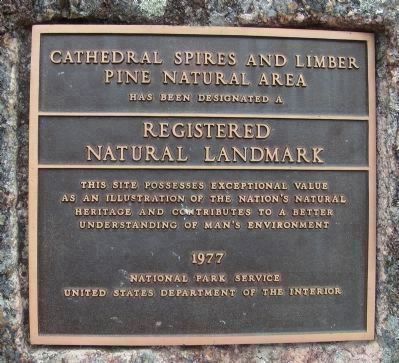
10. Cathedral Spires Marker
The marker reads:
Cathedral Spires and Limber
Pine Natural Area
has been designated a
Registered Natural Landmark
This site possesses exceptional value
as an illustration of the nation's natural
heritage and contributes to a better
understanding of man's environment.
1977
National Park Service
U.S. Department of the Interior
Pine Natural Area
has been designated a
Registered Natural Landmark
This site possesses exceptional value
as an illustration of the nation's natural
heritage and contributes to a better
understanding of man's environment.
1977
National Park Service
U.S. Department of the Interior
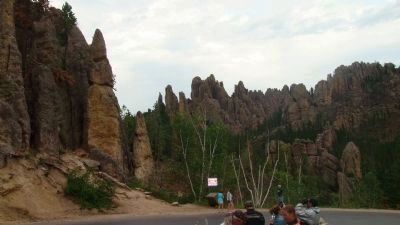
Photographed by William J. Toman, August 9, 2010
11. Cathedral Spires and Marker
The marker is set in the rock at the bottom of the spire on the left.
Credits. This page was last revised on February 15, 2026. It was originally submitted on August 17, 2010, by William J. Toman of Green Lake, Wisconsin. This page has been viewed 3,996 times since then and 154 times this year. Last updated on August 20, 2010, by William J. Toman of Green Lake, Wisconsin. Photos: 1. submitted on August 17, 2010, by William J. Toman of Green Lake, Wisconsin. 2. submitted on August 19, 2010, by Mike Stroud of Bluffton, South Carolina. 3. submitted on August 19, 2010, by William J. Toman of Green Lake, Wisconsin. 4, 5. submitted on August 19, 2010, by Mike Stroud of Bluffton, South Carolina. 6, 7, 8, 9, 10, 11. submitted on August 19, 2010, by William J. Toman of Green Lake, Wisconsin. • Syd Whittle was the editor who published this page.
Editor’s want-list for this marker. A wide shot of the marker in context. • Can you help?
