Near Mechanicsville in Hanover County, Virginia — The American South (Mid-Atlantic)
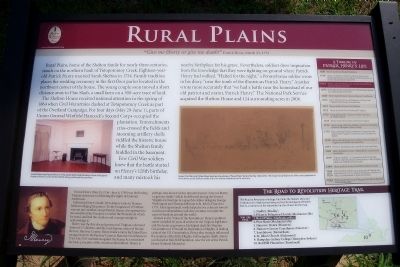
Rural Plains
"Give me liberty or give me death!"
| — | Patrick Henry, March 23, 1775 | — |
Photographed by Bernard Fisher, August 28, 2010
1. Rural Plains Marker
The Shelton House received national attention in the spring of 1864 when Civil War armies clashed at Totopotomoy Creek as part of the Overland Campaign. For four days (May 29-June 1), parts of Union General Winfield Hancock’s Second Corps occupied the plantation. Entrenchments criss-crossed the fields and incoming artillery shells riddled the historic house while the Shelton family huddled in the basement.
Few Civil War soldiers knew that the battle started on Henry’s 128th birthday, and many mistook his nearby birthplace for his grave. Nevertheless, soldiers drew inspiration from the knowledge that they were fighting on ground where Patrick Henry had walked. “Halted for the night,” a Pennsylvania soldier
this page online
(sidebar)
Patrick Henry (May 29, 1736 – June 6, 1799) was the leading Virginia statesman in defending the rights of Colonial America.
Following Henrys death, John Adams wrote to Thomas Jefferson singing his praises: “In the Congress of 1774 there was not one member, except Patrick Henry, who appeared to me sensible of the Precipice or rather the Pinnacle on which he stood, and had the candour and courage enough to acknowledge it.”
Henry was the first elected governor of Virginia, a devoted father of 17 children, and the most famous orator of his day. Born in Hanover County, Henry made a name for himself as a young lawyer in the Parsons’ Cause at Hanover Courthouse in 1763. His 1765 resolutions against the Stamp Act articulated the basic principles of the American Revolution. Henry is perhaps best known for his
August 28, 2010
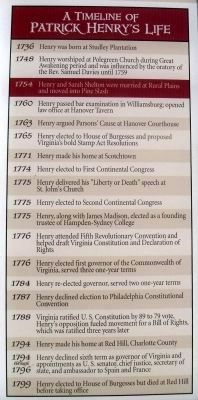
2. A Timeline of Patrick Henry’s Life
1736 Henry was born at Studley Plantation
1748 Henry worshiped at Polegreen Church during Great Awakening period and was influenced by the oratory of the Rev. Samuel Davies until 1759
1754 Henry and Sarah Shelton were married at Rural Plains and moved into Pine Slash
1760 Henry passed bar examination in Williamsburg; opened law office at Hanover Tavern
1763 Henry argued Parsons’ Cause at Hanover Courthouse
1765 Henry elected to House of Burgesses and proposed Virginia’s bold Stamp Act Resolutions
1771 Henry made his home at Scotchtown
1774 Henry elected to First Continental Congress
1775 Henry delivered his “Liberty or Death” speech at St. Johns Church
1775 Henry elected to Second Continental Congress
1775 Henry, along with James Madison, elected as a founding trustee of Hampden-Sydney College
1776 Henry attended Fifth Revolutionary Convention and helped draft Virginia Constitution and Declaration of Rights
1776 Henry elected first governor of the Commonwealth of Virginia, served three one-year terms
1784 Henry re-elected governor, served two one-year terms
1787 Henry declined election to Philadelphia Constitutional Convention
1788 Virginia ratified U.S. Constitution by 89 to 79 vote, Henry’s opposition fueled movement for a Bill of Rights, which was ratified three years later
1794 Henry made his home at Red Hill, Charlotte County
1794 through 1796 Henry declined sixth term as governor of Virginia and appointments as U.S. senator, chief justice, secretary of state, and ambassador to Spain and France
1799 Henry elected to House of Burgesses but died at Red Hill before taking office
1748 Henry worshiped at Polegreen Church during Great Awakening period and was influenced by the oratory of the Rev. Samuel Davies until 1759
1754 Henry and Sarah Shelton were married at Rural Plains and moved into Pine Slash
1760 Henry passed bar examination in Williamsburg; opened law office at Hanover Tavern
1763 Henry argued Parsons’ Cause at Hanover Courthouse
1765 Henry elected to House of Burgesses and proposed Virginia’s bold Stamp Act Resolutions
1771 Henry made his home at Scotchtown
1774 Henry elected to First Continental Congress
1775 Henry delivered his “Liberty or Death” speech at St. Johns Church
1775 Henry elected to Second Continental Congress
1775 Henry, along with James Madison, elected as a founding trustee of Hampden-Sydney College
1776 Henry attended Fifth Revolutionary Convention and helped draft Virginia Constitution and Declaration of Rights
1776 Henry elected first governor of the Commonwealth of Virginia, served three one-year terms
1784 Henry re-elected governor, served two one-year terms
1787 Henry declined election to Philadelphia Constitutional Convention
1788 Virginia ratified U.S. Constitution by 89 to 79 vote, Henry’s opposition fueled movement for a Bill of Rights, which was ratified three years later
1794 Henry made his home at Red Hill, Charlotte County
1794 through 1796 Henry declined sixth term as governor of Virginia and appointments as U.S. senator, chief justice, secretary of state, and ambassador to Spain and France
1799 Henry elected to House of Burgesses but died at Red Hill before taking office
Known as the “Voice of the Revolution,” Henry’s political career included 26 years of service in the Virginia legislature and five terms as governor. He helped draft the Virginia Constitution of 1776 and its Declaration of Rights. A leading critic of the U.S. Constitution, Henry also strongly influenced the creation of the Bill of Rights. Following his death, Henry was buried at Red Hill Plantation, now the site of the Patrick Henry National Memorial.
Erected 2010 by The Road to Revolution Heritage Trail. (Marker Number 3.)
Topics and series. This historical marker is listed in these topic lists: Colonial Era • Patriots & Patriotism • War, US Civil • War, US Revolutionary. In addition, it is included in the Former U.S. Presidents: #02 John Adams,
August 28, 2010
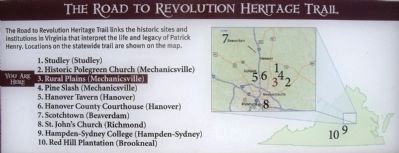
3. The Road to Revolution Heritage Trail
The Road to Revolution Heritage Trail links the historic sites and institutions in Virginia that interpret the life and legacy of Patrick Henry. Locations on the statewide trail are shown on the map.
1. Studley (Studley)
2. Historic Polegreen Church (Mechanicsville)
3. Rural Plains (Mechanicsville)
4. Pine Slash (Mechanicsville)
5. Hanover Tavern (Hanover)
6. Hanover County Courthouse (Hanover)
7. Scotchtown (Beaverdam)
8. St. John’s Church (Richmond)
9. Hampden-Sydney College (Hampden-Sydney)
10. Red Hill Plantation (Brookneal)
1. Studley (Studley)
2. Historic Polegreen Church (Mechanicsville)
3. Rural Plains (Mechanicsville)
4. Pine Slash (Mechanicsville)
5. Hanover Tavern (Hanover)
6. Hanover County Courthouse (Hanover)
7. Scotchtown (Beaverdam)
8. St. John’s Church (Richmond)
9. Hampden-Sydney College (Hampden-Sydney)
10. Red Hill Plantation (Brookneal)
Location. 37° 39.669′ N, 77° 20.779′ W. Marker is near Mechanicsville, Virginia, in Hanover County. It can be reached from Studley Road (Virginia Route 606) 0.1 miles west of Shelton Pointe Drive, on the left when traveling west. Touch for map. Marker is at or near this postal address: 7273 Studley Road, Mechanicsville VA 23116, United States of America. Touch for directions.

Regionally, this marker is in Virginia’s Piedmont, in Central Virginia, and in the Richmond Metropolitan Area. It is also in the American South, specifically in the Upper South, and on the Eastern Seaboard. Globally, it is in the North Atlantic Region, North America, the Western Hemisphere, the Western World, and the Anglosphere. Historically, it finds itself in what was once the territory of the Mississippian Culture, one of the original Thirteen Colonies, one of the Confederate States of America, and the Antebellum South.
Other nearby markers. At least 8 other markers are within walking distance of this marker: Totopotomoy Creek
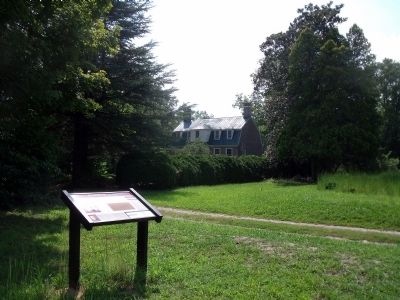
Photographed by Bernard Fisher, August 28, 2010
4. Rural Plains Marker
Another marker is no longer nearby. Shelton House Under Fire (was within shouting distance of this marker but has been replaced with another marker now near it).
More about this marker. On the left is a photo with the caption, "Sarah Shelton wed Patrick Henry in 1754, purportedly while standing in front of the parlor fireplace. Patrick’s uncle, the Rev. Patrick Henry, performed the ceremony."
On the right is a war time sketch with the caption, "Famed Civil War artist Alfred Waud sketched the exterior of “Rural Plains” during the May 1864 battle. The image closely depicts the 18th-century appearance of the home, as the
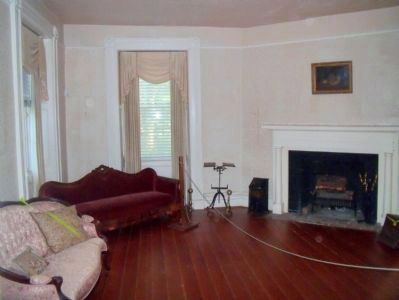
Photographed by Bernard Fisher, July 8, 2009
5. Rural Plains Parlor
Also see . . .
1. The Road to Revolution Heritage Trail. (Submitted on August 28, 2010, by Bernard Fisher of Richmond, Virginia.)
2. Totopotomoy Creek Battlefield at Rural Plains. Richmond National Battlefield Park (Submitted on August 28, 2010, by Bernard Fisher of Richmond, Virginia.)
3. The Battle of Totopotomoy Creek, May 29-31, 1864. Richmond National Battlefield Park (Submitted on August 28, 2010, by Bernard Fisher of Richmond, Virginia.)
4. Rural Plains (pdf file). National Register of Historic Places (Submitted on August 28, 2010, by Bernard Fisher of Richmond, Virginia.)
5. Totopotomoy Creek. CWSAC Battle Summary (Submitted on August 28, 2010, by Bernard Fisher of Richmond, Virginia.)
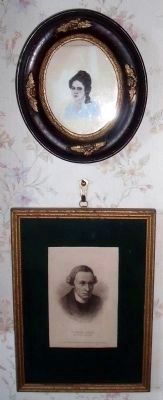
Photographed by Bernard Fisher, July 8, 2009
6. Sarah Shelton and Patrick Henry
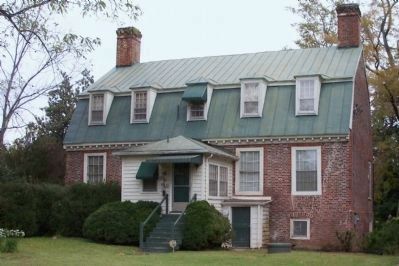
Photographed by Bernard Fisher, October 8, 2006
7. Rural Plains
The Sheltons made very few exterior alterations to the house.
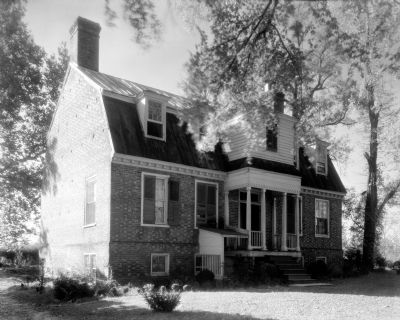
Photographed by Frances Benjamin Johnston, 1935
8. Rural Plains, Mechanicsville Rural Point vic., Hanover County, Virginia
Library of Congress [LC-J7-VA- 1885]
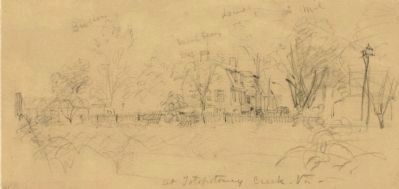
Photographed by Alfred Rudolph Waud, circa May 26, 1864
9. At Totopotomay Creek, Va.
Library of Congress [LC-DIG-ppmsca-21486]
Credits. This page was last revised on July 22, 2023. It was originally submitted on August 28, 2010, by Bernard Fisher of Richmond, Virginia. This page has been viewed 5,166 times since then and 70 times this year. Photos: 1, 2, 3, 4, 5, 6, 7, 8. submitted on August 28, 2010, by Bernard Fisher of Richmond, Virginia. 9. submitted on August 28, 2010.
