
Tremé / Lafitte in New Orleans in Orleans Parish, Louisiana — The American South (West South Central)
Tomb of the Unknown Slave
| — | St. Augustine Catholic Church, New Orleans | — |
Photographed by Richard E. Miller, August 17, 2010
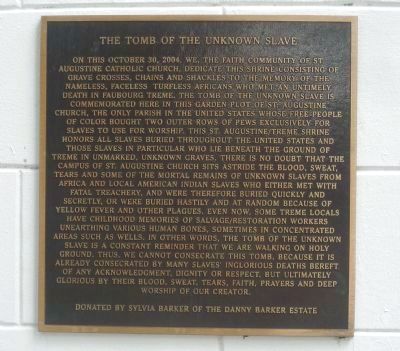
1. Tomb of the Unknown Slave Marker
On this October 30, 2004, we, the faith community of St. Augustine Catholic Church, dedicate this shrine consisting of grave crosses, chains and shackles to the memory of the nameless, faceless turfless Africans who met an untimely death in Faubourg Tremé. The Tomb of the Unknown Slave is commemorated here in this garden plot of St. Augustine Church, the only parish in the United States whose Free People of Color bought two outer rows of pews exclusively for slaves to use for worship. This St. Augustine/Tremé shrine honors all slaves buried throughout the United States and those slaves in particular who lie beneath the ground of Tremé in unmarked, unknown graves. There is no doubt that the campus of St. Augustine Church sits astride the blood, sweat, tears and some of the mortal remains of unknown slaves from Africa and local American Indian slaves who either met with fatal treachery, and were therefore buried quickly and secretly, or were buried hastily and at random because of yellow fever and other plagues. Even now, some Tremé locals have childhood memories of salvage/restoration workers unearthing various human bones,
this page online
Donated by Sylvia Barker of the Danny Barker Estate.
Erected 2004 by The Faith Community of St. Augustine Catholic Church.
Topics. This historical marker is listed in these topic lists: African Americans • Arts, Letters, Music • Indigenous Peoples and Communities • Religion & Religious Structures. A significant historical month for this entry is October 1917.
Location. 29° 57.919′ N, 90° 3.971′ W. Marker is in New Orleans, Louisiana, in Orleans Parish. It is in Tremé / Lafitte. It is on Governor Nicholls Street north of St. Claude Avenue.. Marker is in the Tremé district, on the wall of St. Augustine Church off Gov. Nicholls Street. It is south of I-10, two blocks northeast of Louis Armstrong Park, and one block northwest
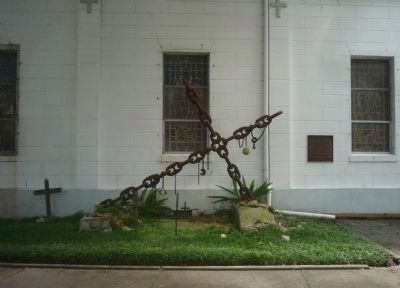
Photographed by Richard E. Miller, August 17, 2010
2. Tomb of the Unknown Slave memorial - marker is visible on wall at right

Regionally, this marker is in one of Louisiana’s River Parishes. It is also in the American South, specifically in the Deep South, on the Gulf Coast, and in the Great River Road Region. Globally, it is in North America, a Gulf of Mexico state, the Western Hemisphere, the Western World, and the Anglosphere. Historically, it finds itself in what was once New Spain, the Viceroyalty of New France, the territory of the Mississippian Culture, the Louisiana Purchase, one of the Confederate States of America, and the Antebellum South.
Other nearby markers. At least 8 other markers are within walking distance of this marker: Saint Augustine Church, New Orleans (within shouting distance of this marker); Dupaquier House (about 500 feet away, measured in a direct line); Carmelite Chapel of St. Joseph and St. Teresa and the Carmelite Monastery (about 600 feet away); Carmelite Monastery (about 600 feet away); St. Aloysius College (approx. 0.2
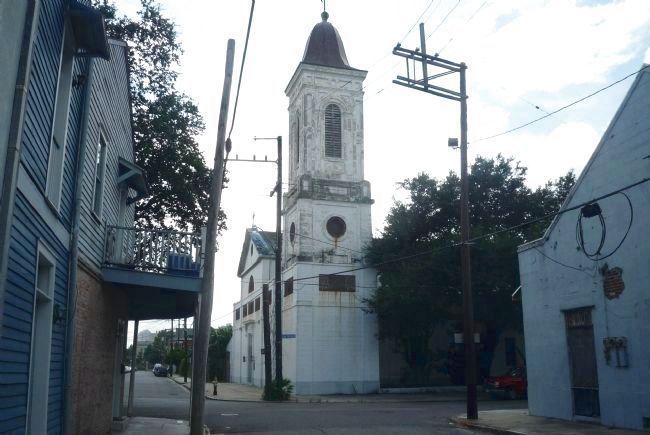
Photographed by Richard E. Miller, August 17, 2010
3. St. Augustine Catholic Church - view from St. Claude Avenue looking southwest
Credits. This page was last revised on February 12, 2023. It was originally submitted on August 29, 2010, by Richard E. Miller of Oxon Hill, Maryland. This page has been viewed 3,960 times since then and 190 times this year. Photos: 1, 2, 3. submitted on August 29, 2010, by Richard E. Miller of Oxon Hill, Maryland. • Bill Pfingsten was the editor who published this page.
