Discovery District in Toronto, Ontario — Central Canada (North America)
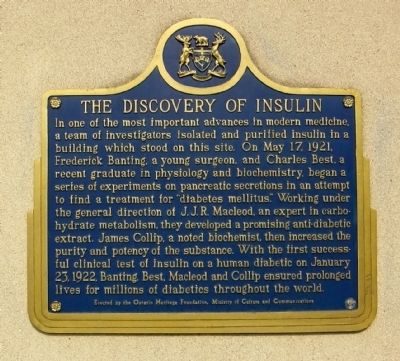
The Discovery of Insulin
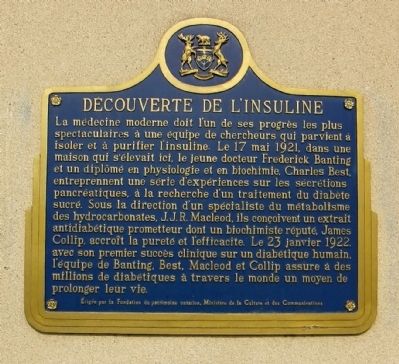
Decouverte De L'Insuline
Photographed by Andrew Ruppenstein, August 19, 2010
1. The Discovery of Insulin Marker

{The marker has a both an English and French version. In English:}
Erected by the Ontario Heritage Foundation, Ministry of Culture and Communications
La médecine moderne doit l’un de ses progrès le plus spectaculaires a une équipe de chercheurs qui parvient à isoler et a purifier l’insulin. Le
this page online
Érigée par la Fondation du patrimoine ontarien, Ministère de la Culture et des Communications
Erected by Ontario Heritage Foundation.
Topics and series. This historical marker is listed in this topic list: Science & Medicine. In addition, it is included in the Canada, Ontario Heritage Trust series list. A significant historical month for this entry is January 1933.
Location. 43° 39.677′ N, 79° 23.621′ W. Marker is in Toronto, Ontario. It is in the Discovery
Photographed by Andrew Ruppenstein, August 19, 2010
2. Decouverte de L'Insuline Marker

Regionally, this marker is in Greater Toronto and on the Golden Horseshoe. It is also in Central Canada. Globally, it is in North America, on the Great Lakes, in the Western Hemisphere, in the Western World, and in the Anglosphere. Historically, it finds itself in what was once a British colony, the Viceroyalty of New France, the Haudenosaunee (Iroquois) Confederacy, and Rupert’s Land.
Other nearby markers. At least 8 other markers are within walking distance of this marker: Charles William Jefferys (within shouting distance of this marker); Sir Oliver Mowat (about 150 meters away, measured in a direct line); The Royal Tour of 1939 / Le Voyage Royal de 1939 (about 150 meters away); William Lyon Mackenzie (about 150 meters away); The Mackenzie-Papineau Battalion/Le Bataillon Mackenzie-Papineau (about 150 meters away); Hon. George Brown (about 180
Photographed by Andrew Ruppenstein, August 19, 2010
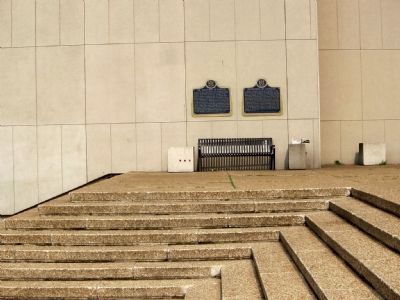
3. The Discovery of Insulin Marker - Wide View
The English version is on the left, the French version on the right.
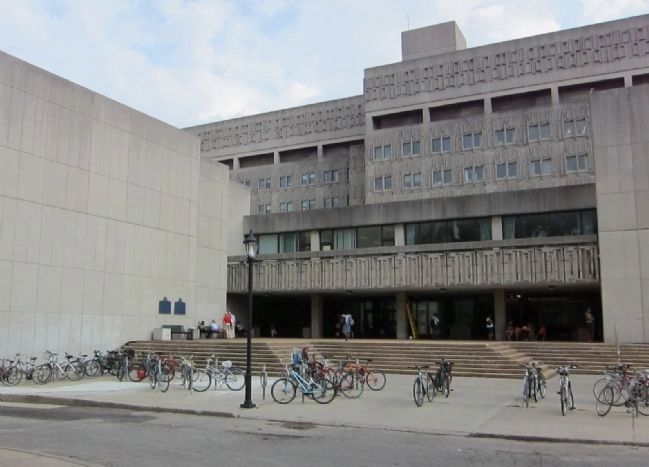
More about this marker. The marker can be found mounted on the outside wall to the left of the main entrance to the Medical Sciences Building on the campus of the University of Toronto.
Related marker. Click here for another marker that is related to this marker.
Also see . . . August Krogh and the Nobel Prize to Banting and Mcleod. The Nobel Prize Foundation's article on the role played by August Krogh in the awarding of the Nobel Prize for Medicine to Frederick Banting and John Mcleod in 1923. (Submitted on September 27, 2010.)
Additional keywords. Nobel Prize
Photographed by Andrew Ruppenstein, August 19, 2010
4. The Discovery of Insulin Markers - Wider View
The markers are visible here to the left of the entrance of the Medical Sciences Building on the University of Toronto Campus.
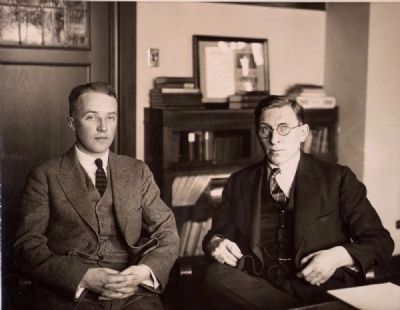
From the University of Toronto via Wikimedia Commons, circa 1924
5. C. H. Best and F. G. Banting
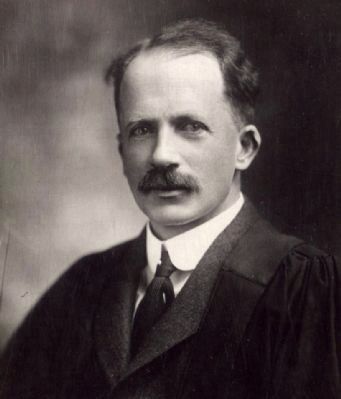
From the University of Toronto via Wikimedia Commons, circa 1928
6. J.J.R. Macleod
Credits. This page was last revised on September 12, 2025. It was originally submitted on September 26, 2010, by Andrew Ruppenstein of Lamorinda, California. This page has been viewed 2,722 times since then and 40 times this year. It was the Marker of the Week July 27, 2014. Photos: 1, 2, 3, 4. submitted on September 26, 2010, by Andrew Ruppenstein of Lamorinda, California. 5, 6. submitted on July 26, 2014. • Bill Pfingsten was the editor who published this page.
