Near Osceola in Mississippi County, Arkansas — The American South (West South Central)
Mark Twain's Plum Point Landing & Overlook
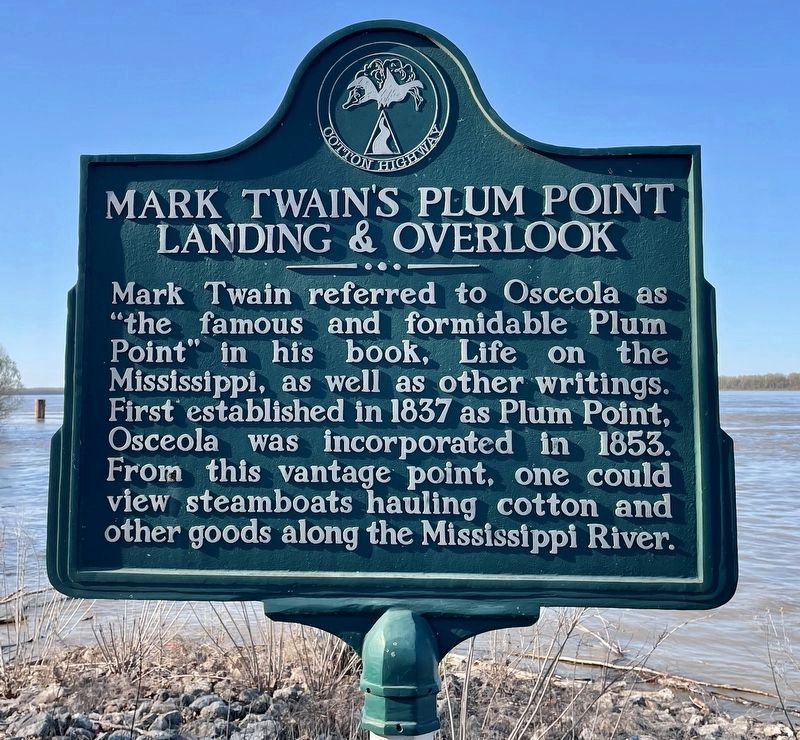
Photographed by Mark Hilton, April 2, 2021
1. Mark Twain's Plum Point Landing & Overlook Marker
Topics. This historical marker is listed in these topic lists: Government & Politics • Waterways & Vessels. A significant historical year for this entry is 1837.
Location. 35° 39.312′ N, 89° 55.543′ W. Marker is near Osceola, Arkansas, in Mississippi County. It is on State Highway 198, on the left when traveling west. Located at the Sans Souci Landing park. Touch for map. Marker is in this post office area: Osceola AR 72370, United States of America. Touch for directions.

Regionally, this marker is in the Arkansas Delta, in Crowley’s Ridge, and in the Mississippi Alluvial Plain. It is also in the American South, specifically in the Upper South, in the Mississippi Delta, and in the Great River Road Region. Globally, it is in North America, the Western Hemisphere, the Western World, and the
this page online
Other nearby markers. At least 8 other markers are within 4 miles of this marker, measured as the crow flies: Sans Souci (a few steps from this marker); Battle of Plum Run Bend (within shouting distance of this marker); Fighting Near Osceola (within shouting distance of this marker); Osceola Hornets (within shouting distance of this marker); Mississippi River Levee (about 300 feet away, measured in a direct line); Calvary Episcopal Church (approx. 4 miles away); Planters Bank Building (approx. 4 miles away); Bank of Osceola (approx. 4 miles away). Touch for a list and map of all markers in Osceola.
Photographed by Craig Swain, August 31, 2010
2. Mark Twain's Plum Point Landing & Overlook Marker
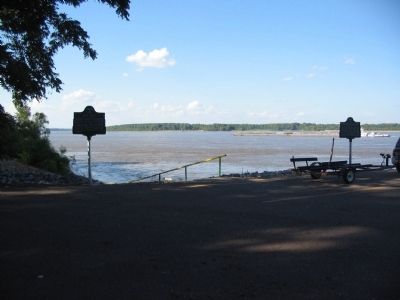
Photographed by Craig Swain
3. Markers Sans Souci Landing
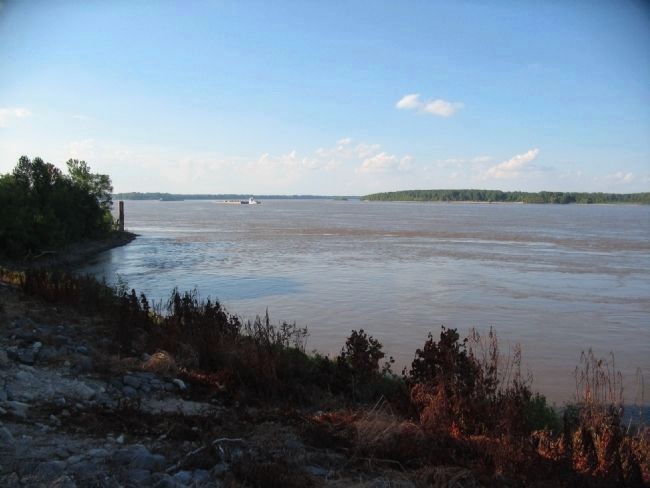
Photographed by Craig Swain, August 31, 2010
4. Modern Day Riverboat Traffic
In Twain's day, steamboats traveled the river. Today diesel engined tow boats push barges. In 1913, while towing a large number of coal barges, the steam powered towboat Sprague collided with stone dikes just north of the Sans Souci landing (likely near one of the chutes to the distant left). Thousands of tons of coal dumped into the river. This deposit was later washed downstream when the river shifted courses.
Credits. This page was last revised on April 4, 2021. It was originally submitted on September 29, 2010, by Craig Swain of Leesburg, Virginia. This page has been viewed 2,953 times since then and 109 times this year. Photos: 1. submitted on April 2, 2021, by Mark Hilton of Montgomery, Alabama. 2, 3, 4. submitted on September 29, 2010, by Craig Swain of Leesburg, Virginia.
