Bennett Place in Durham in Durham County, North Carolina — The American South (South Atlantic)
Bennett Place
The End of War
| — | Carolinas Campaign | — |
Photographed by Bill Coughlin, August 18, 2006
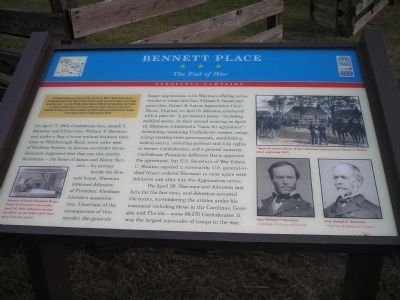
1. Bennet Place - The End of the War
The Carolinas Campaign began on February 1, 1865, when Union Gen. William T. Sherman led his army north from Savannah, Georgia, after the “March to the Sea.” Sherman’s objective was to join Gen. Ulysses S. Grant in Virginia to crush Gen. Robert E. Lee’s Army of Northern Virginia. Scattered Confederate forces consolidated in North Carolina, the Confederacy’s logistical lifeline, where Sherman defeated Gen. Joseph E. Johnston’s last-ditch attack at Bentonville. After Sherman was reinforced at Goldsboro late March, Johnston saw the futility of further resistance and surrendered on April 26, essentially ending the Civil War.
On April 17, 1865, Confederate Gen. Joseph E. Johnston and Union Gen. William T. Sherman met under a flag of truce midway between their lines on Hillsborough Road, seven miles west of Durham Station, to discuss surrender terms. Johnston suggested that they use this nearby farmhouse—the home of James and Nancy Bennett—for privacy.
Inside the Bennett house, Sherman informed Johnson of President Abraham Lincoln’s assassination. Uncertain of the consequences of this murder, the generals began negotiations,
this page online
On April 26, Sherman and Johnston met here for the last time, and Johnston accepted the terms, surrendering the armies under his command including those in the Carolinas, Georgia, and Florida—some 89,270 Confederates. It was the largest surrender of troops in the war.
Erected by North Carolina Civil War Trails.
Topics and series. This historical marker is listed in this topic list: War, US Civil.
Photographed by Michael Buckner, November 17, 2022
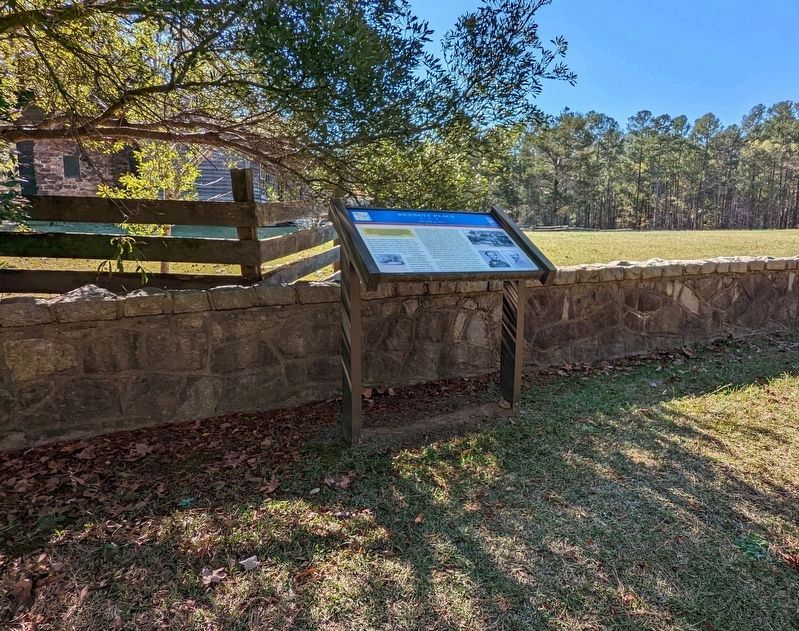
2. Bennett Place Marker
Location. 36° 1.767′ N, 78° 58.439′ W. Marker is in Durham, North Carolina, in Durham County. It is in Bennett Place. It can be reached from the intersection of Bennett Memorial Road and Near Road. Touch for map. Marker is at or near this postal address: 4409 Bennett Memorial Road, Durham NC 27705, United States of America. Touch for directions.

Regionally, this marker is in the Piedmont and in the Research Triangle. It is also in the American South and specifically in the Upper South. Globally, it is in North America, the Western Hemisphere, the Western World, and the Anglosphere. Historically, it finds itself in what was once the territory of the Mississippian Culture, one of the original Thirteen Colonies, one of the Confederate States of America, and the Antebellum South.
Other nearby markers. At least 8 other markers are within 3 miles of this marker, measured as the crow flies: The Original Chimney of the Bennett House (a few steps from this marker); a different marker also named Bennett Place
Photographed by Bill Coughlin, August 18, 2006
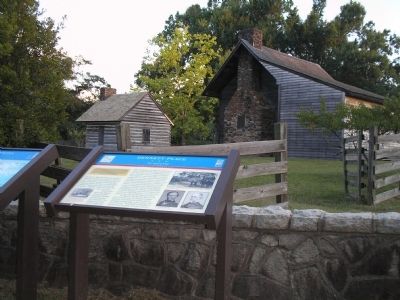
3. Bennet Place - Civil War Trails Marker
Another marker is no longer nearby. North Carolina (was here, next to this marker but has been permanently removed).
Photographed by Bill Coughlin, August 11, 2012
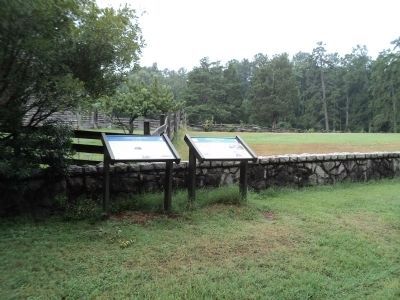
4. Civil War Trails Markers
Two Civil War Trails markers are found at this location. The Bennett Place marker is seen here on the right.
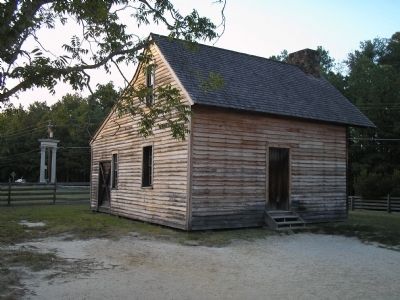
Photographed by Bill Coughlin, August 18, 2006
5. Bennett House
In this house, on April 26, 1965, Confederate Gen. Joseph E. Johnston, surrendered to Union Gen. William T. Sherman, effectively ending the Civil War.
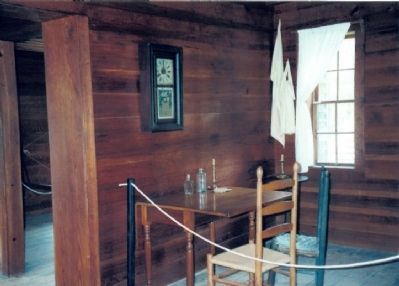
Photographed by Bill Coughlin, August 18, 2006
6. Inside Bennett House
This is where Gen Joseph E. Johnston surrendered his troops to Gen. William T. Sherman.
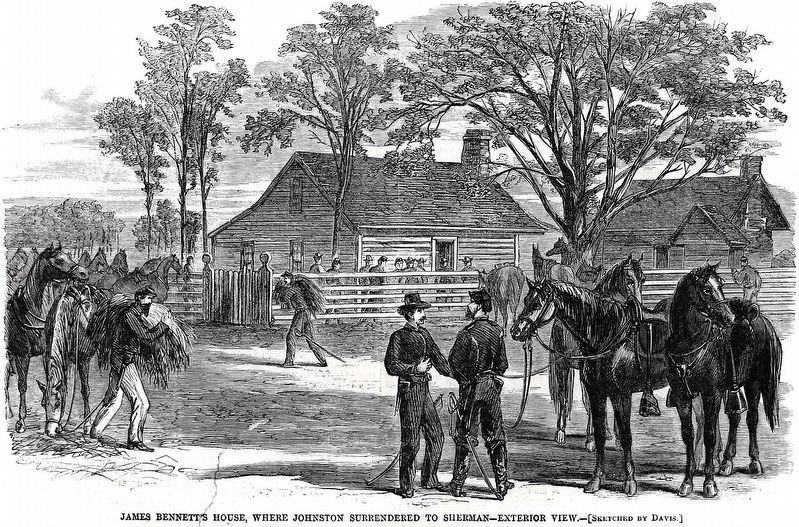
Internet Archive
7. James Bennett's House
Where Johnston Surrendered to Sherman
Where Johnston Surrendered to Sherman
Sketched by Davis. Harper's Weekly, May 27, 1865.
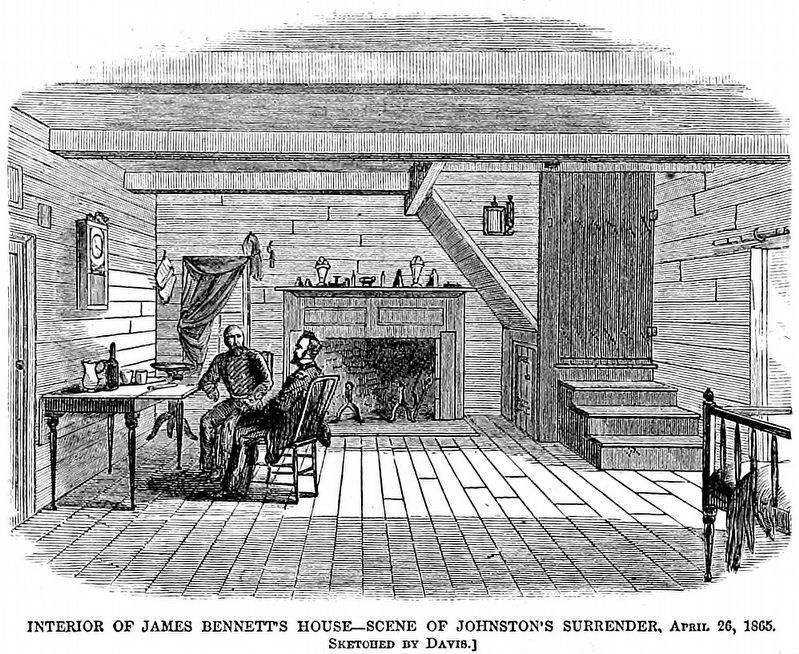
Internet Archive
8. Interior of James Bennett's House
Scene of Johnston's Surrender
April 26, 1865.
Scene of Johnston's Surrender
April 26, 1865.
(Johnston resting his elbow on the table while Sherman faces the clock.)
Sketched by Davis. Harper's Weekly, May 27, 1865.
Sketched by Davis. Harper's Weekly, May 27, 1865.
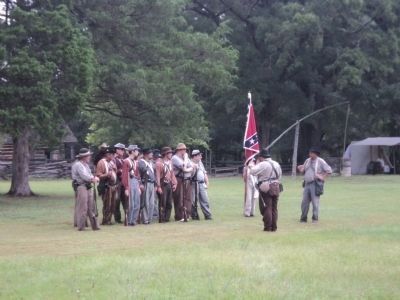
Photographed by Bill Coughlin, August 11, 2012
9. Confederate Soldiers Drill near Bennett House
Credits. This page was last revised on December 25, 2025. It was originally submitted on November 18, 2007, by Bill Coughlin of Woodland Park, New Jersey. This page has been viewed 2,709 times since then and 88 times this year. Photos: 1. submitted on November 16, 2007, by Bill Coughlin of Woodland Park, New Jersey. 2. submitted on November 19, 2022, by Michael Buckner of Durham, North Carolina. 3. submitted on November 16, 2007, by Bill Coughlin of Woodland Park, New Jersey. 4. submitted on August 11, 2012, by Bill Coughlin of Woodland Park, New Jersey. 5. submitted on November 19, 2007, by Bill Coughlin of Woodland Park, New Jersey. 6. submitted on July 27, 2009, by Bill Coughlin of Woodland Park, New Jersey. 7, 8. submitted on December 1, 2023, by Allen C. Browne of Silver Spring, Maryland. 9. submitted on August 13, 2012, by Bill Coughlin of Woodland Park, New Jersey. • J. J. Prats was the editor who published this page.
