
Spotsylvania Courthouse in Spotsylvania County, Virginia — The American South (Mid-Atlantic)
Stubbs School
Photographed by Kevin W., November 18, 2007
1. Stubbs School Marker
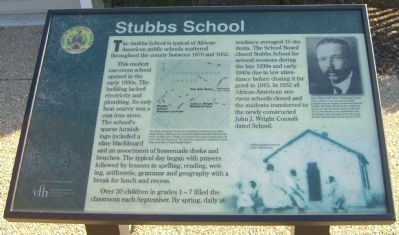
The Stubbs School is typical of African-American public schools scattered throughout the county between 1870 and 1952.
This modest one-room school opened in the early 1930s. The building lacked electricity and plumbing. Its only heat source was a cast iron stove. The school’s sparse furnishings included a slate blackboard and an assortment of homemade desks and benches. The typical day began with prayers followed by lessons in spelling, reading, writing, arithmetic, grammar and geography with a break for lunch and recess.
Over 30 children in grades 1 – 7 filled the classroom each September. By spring, daily attendance averaged 15 students. The School Board closed Stubbs School for several sessions during the late 1930s and early 1940s due to low attendance before closing it for good in 1943. In 1952 all African-American one-room schools closed and the students transferred to the newly constructed John J. Wright Consolidated School.
Caption of map): The Stubbs School was relocated to Spotsylvania Courthouse from Stubbs bridge Road in 1999
this page online
Caption of portrait, upper right): John J. Wright (1863 – 1931), a Spotsylvania County native, attended a one-room school and later graduated from the Virginia Normal and Industrial Institute. Mr. Wright devoted his life to improving educational opportunities for African-Americans. He was instrumental in the establishment of the first African-American high school in the county, the Snell Training School which opened in 1913.
Caption of lower left picture): Children playing in front of a school at Massaponax.
Erected by Virginia Foundation for the Humanities and the County of Spotsylvania.
Topics. This historical marker is listed in these topic lists: African Americans • Civil Rights • Education. A significant historical year for this entry is 1870.
Location. 38° 11.716′ N, 77° 35.225′ W. Marker
Photographed by Kevin W., November 18, 2007
2. Stubbs School and Marker

Regionally, this marker is in the Washington Metropolitan Area, in Northern Virginia, and in the Piedmont. It is also in the American South, specifically in the Upper South, in the Mid-Atlantic, and on the Eastern Seaboard. Globally, it is in the North Atlantic Region, North America, the Western Hemisphere, the Western World, and the Anglosphere. Historically, it finds itself in what was once the territory of the Mississippian Culture, one of the original Thirteen Colonies, one of the Confederate States of America, and the Antebellum South.
Other nearby markers. At least 8 other markers are within walking distance of this marker: Education in Spotsylvania County (here, next to this marker); The Good Hope Colored School (here, next to this marker); Forever young, Forever in our hearts
Photographed by Kevin W., November 18, 2007
3. Stubbs School Interior
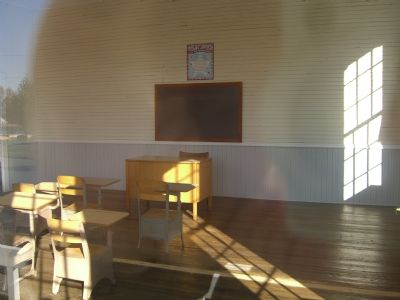
The school’s sparse furnishings included a slate blackboard and an assortment of homemade desks and benches.
Photo is taken through the front window.
Photo is taken through the front window.
Other markers no longer nearby. Slave Entrance (was about 500 feet away but has been replaced with another marker now near it); a different marker also named Pastor's Office (was about 500 feet away but has been replaced with another marker now near it); Civil War Veterans at rest in Zion's Cemetery (was about 500 feet away but has been replaced with another marker now near it).
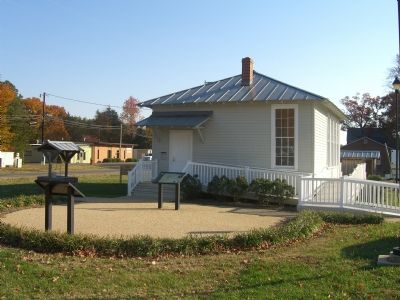
Regarding Stubbs School. The building remains largely unchanged since its days as a school for African-American children. It consists of an entry vestibule, a small cloakroom, and single classroom where children in grades 1-7 studied together. The building had no plumbing or electricity,
Photographed by Kevin W., November 18, 2007
4. Stubbs School Interior
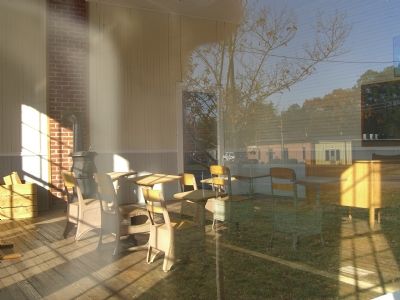
The building lacked electricity and plumbing. Its only heat source was a cast iron stove.
Photo is taken through the side window.
Photo is taken through the side window.
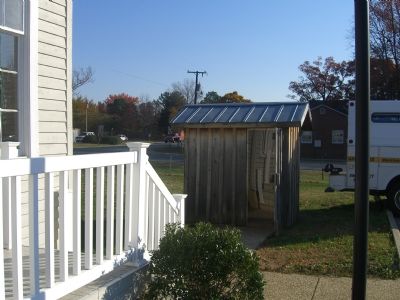
Photographed by Kevin W., November 18, 2007
5. Stubbs School Outhouse
In its original rural setting, the schoolyard included an outhouse and a dusty play lot.
Credits. This page was last revised on September 6, 2022. It was originally submitted on November 20, 2007, by Kevin W. of Stafford, Virginia. This page has been viewed 3,574 times since then and 60 times this year. Photos: 1, 2, 3, 4, 5. submitted on November 20, 2007, by Kevin W. of Stafford, Virginia.
