Near Dunn in Harnett County, North Carolina — The American South (South Atlantic)
Battle of Averasboro
Third Confederate Defensive Line
| — | Carolinas Campaign | — |

The Carolinas Campaign began on February 1, 1865, when Union Gen. William T. Sherman led his army north from Savannah, Georgia, after the “March to the Sea.”
Sherman's objective was to join Gen. Ulysses S. Grant in Virginia to crush Gen. Robert E. Lee's Army of Northern Virginia. Scattered Confederate forces consolidated in North Carolina, the Confederacy's logistical lifeline, where Sherman defeated Gen. Joseph E. Johnston's last-ditch attack at Bentonville. After Sherman was reinforced at Goldsboro late in March, Johnston saw the futility of further resistance and surrendered on April 26, essentially ending the Civil War.
As Gen. William T. Sherman marched north from Fayetteville, Gen. Joseph E. Johnston positioned his army near Smithfield, uncertain whether Sherman's destination was Raleigh or Goldsboro. On March 15, 1865, the head of Sherman's Left Wing struck Confederate Gen. William J. Hardee's skirmishers guarding the road just south of Averasboro. Hardee struck back, and the fight began.
By the afternoon of Mar 16, 1865, Confederate Gen. William J. Hardee’s men had retreated from their first and second defensive
this page online
Of about 12,000 Union troops engaged, 682 were reported killed, wounded, or missing, while the approximately 7,000 Confederates lost about 500. Hardee had delayed the Union advance for a day, buying precious time for Confederate Gen. Joseph E. Johnston, who was skillfully uniting his scattered forces for a more substantial attempt to stop Sherman’s progress.

Photographed by Bill Coughlin, August 18, 2006
2. Battle of Averasboro - Third Confederate Defensive Line
This is a previous iteration of the marker. While the inscription is identical, there are minor differences in formatting from the present version.
“The infirmary was here and – oh! It makes me shudder to think of the awful sights I witnessed that morning. ….I just felt like my heart would break when I would see our brave men rushing into battle and then coming back so mangled. …We could hear the commands and the groans and shrieks of the wounded … about four o’clock the Yankees came charging, yelling and howling. I stood on the piazza [porch] and saw the charge made. …The palings [fences] did not hinder them at all. They just knocked them down like so many mad cattle.”
- Jane “Janie” Smith, 18-year-old daughter of Farquhard Smith, at Smith House on the map.
Erected by North Carolina Civil War Trails.
Topics and series. This historical marker is listed in this topic list: War, US Civil. In addition, it is included in the North Carolina Civil War Trails series list. A significant historical date for this entry is February 1, 1865.
Location. 35° 15.99′ N, 78° 40.316′ W. Marker is near Dunn, North Carolina, in Harnett County. It is on McLellon Road (State Highway 82) south of Arrowhead Road, on the right when traveling south. Marker is near


Regionally, this marker is in North Carolina’s Coastal Plain and in the Piedmont. It is also in the American South and specifically in the Upper South. Globally, it is in North America, the Western Hemisphere, the Western World, and the Anglosphere. Historically, it finds itself in what was once the territory of the Mississippian Culture, one of the original Thirteen Colonies, one of the Confederate States of America, and the Antebellum South.
Other nearby markers. At least 8 other markers are within walking distance of this marker: North Carolina (here, next to this marker); Averasboro Battlefield Museum (a few steps from this marker); Confederate Commanders at Averasboro / Union Commanders at Averasboro (a few steps from this marker); Underground Barn Quilt Trail (within shouting distance of this marker); Confederate Women's Home (within shouting distance of this marker); Model 1841 6-pounder Gun (within shouting
Photographed by Bill Coughlin, August 3, 2010
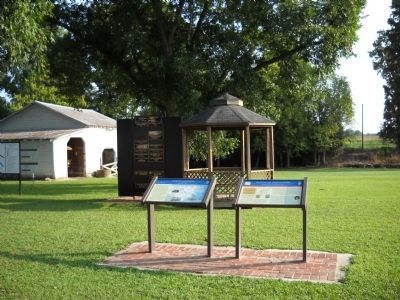
4. Markers on the Averasboro Battlefield
There are several markers at the Averasboro Battlefield Museum. The Third Confederate Defensive Line marker is seen here on the right.
Another marker is no longer nearby. North Carolina (was here, next to this marker but has been replaced with another marker now near it).
More about this marker. The marker features portraits of Gens. Hardee and Kilpatrick, along with Jane Smith. A map illustrating the maneuvers described in the text is in the upper center.
Also see . . . Averasboro Battlefield Commission. (Submitted on December 1, 2007, by Craig Swain of Leesburg, Virginia.)
Photographed by Bill Coughlin, August 3, 2010
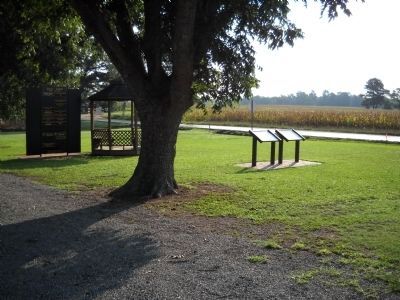
5. Battle of Averasboro Markers
Photographed by Bill Coughlin, August 18, 2006
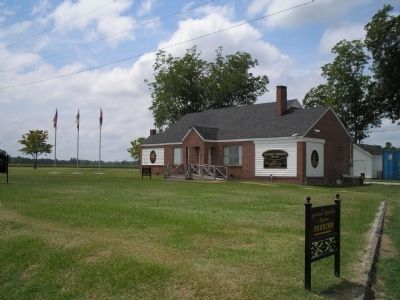
6. Battle of Averasboro Museum
The Battle of Averasboro marker is located beside the museum.
Credits. This page was last revised on June 1, 2026. It was originally submitted on November 27, 2007, by Bill Coughlin of Woodland Park, New Jersey. This page has been viewed 5,080 times since then and 61 times this year. Photos: 1. submitted on June 1, 2026, by Devry Becker Jones of Washington, District of Columbia. 2. submitted on November 27, 2007, by Bill Coughlin of Woodland Park, New Jersey. 3. submitted on June 1, 2026, by Devry Becker Jones of Washington, District of Columbia. 4, 5. submitted on August 3, 2010, by Bill Coughlin of Woodland Park, New Jersey. 6. submitted on November 27, 2007, by Bill Coughlin of Woodland Park, New Jersey. • Craig Swain was the editor who published this page.
