Stadium Area in Baltimore, Maryland — The American Northeast (Mid-Atlantic)
Baltimore Regional Trail
A House Divided
| — | War on the Chesapeake Bay | — |
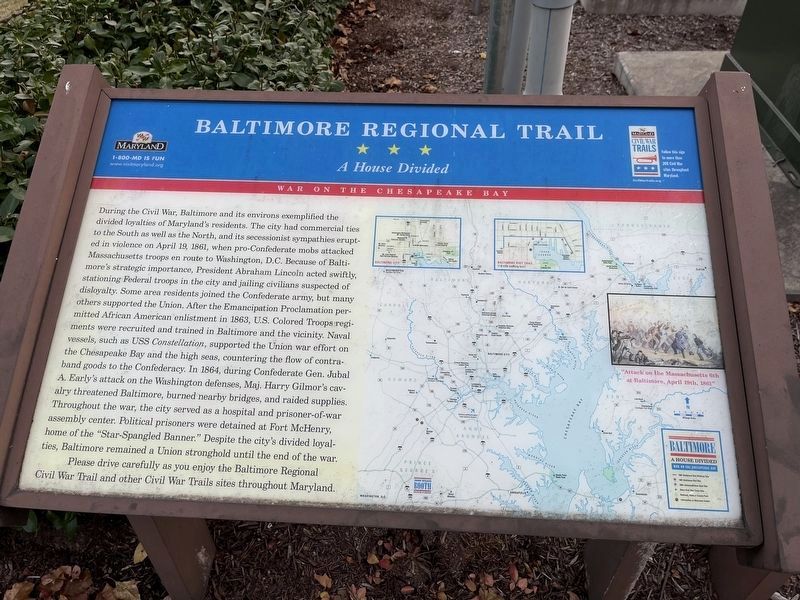
During the Civil War, Baltimore and its environs exemplified the divided loyalties of Maryland's residents. The city had commercial ties to the South as well as the North, and its secessionist sympathies erupted in violence on April 19, 1861, when pro-Confederate mobs attacked Massachusetts troops en route to Washington, D.C. Because of Baltimore's strategic importance, President Abraham Lincoln acted swiftly, stationing Federal troops in the city and jailing civilians suspected of disloyalty. Some area residents joined the Confederate army, but many others supported the Union. After the Emancipation Proclamation permitted African-American enlistment in 1863, U.S. Colored Troops regiments were recruited and trained in Baltimore and the vicinity. Naval vessels, such as USS Constellation, supported the Union war effort on the Chesapeake Bay and the high seas, countering the flow of contraband goods to the Confederacy. In 1863, during Confederate Gen. Jubal A. Early's attack on the Washington defenses, Maj. Harry Gilmor's cavalry threatened Baltimore, burned nearby bridges, and raided supplies. Throughout the war, the city
this page online
Please drive carefully as you enjoy the Baltimore Regional Civil War Trail and other Civil War Trail sites throughout Maryland.
Erected by Maryland Civil War Trails.
Topics and series. This historical marker is listed in this topic list: War, US Civil. In addition, it is included in the Maryland Civil War Trails series list. A significant historical month for this entry is April 1976.
Location. This marker has been replaced by another marker nearby. It was located near 39° 17.094′ N, 76° 37.182′ W. Marker was in Baltimore, Maryland. It was in the Stadium Area. It could be reached from West Camden Street near South Howard Street. The marker stood on the grounds of the Camden Street Station, now a museum. Touch for map. Marker was at or near this postal address: 315 W Camden St, Baltimore MD 21201, United States of America. Touch for directions.

Regionally, this marker was in Central Maryland.
Photographed by Tom Fuchs, November 6, 2006
2. Baltimore Regional Trail Marker
This is a previous iteration of the marker. While the information is identical, the formatting is slightly different.
Other nearby markers. At least 8 other markers are within walking distance of this location: A different marker also named Baltimore Riot Trail (a few steps from this marker); a different marker also named Baltimore Regional Trail (a few steps from this marker); Great Railroad Strike of 1877 (a few steps from this marker); On to Yorktown (within shouting distance of this marker); Carl A.J. Wright (within shouting distance of this marker); Babe’s Dream (about 300 feet away, measured in a direct line); 30 Dennis Martinez, RHP (about 300 feet away); 30 Gregg Olson, RHP (about 300 feet away). Touch for a list and map of all markers in Baltimore.
Another marker is no longer nearby. Baltimore Riot Trail (was here, next to this marker but has been replaced with another marker now near
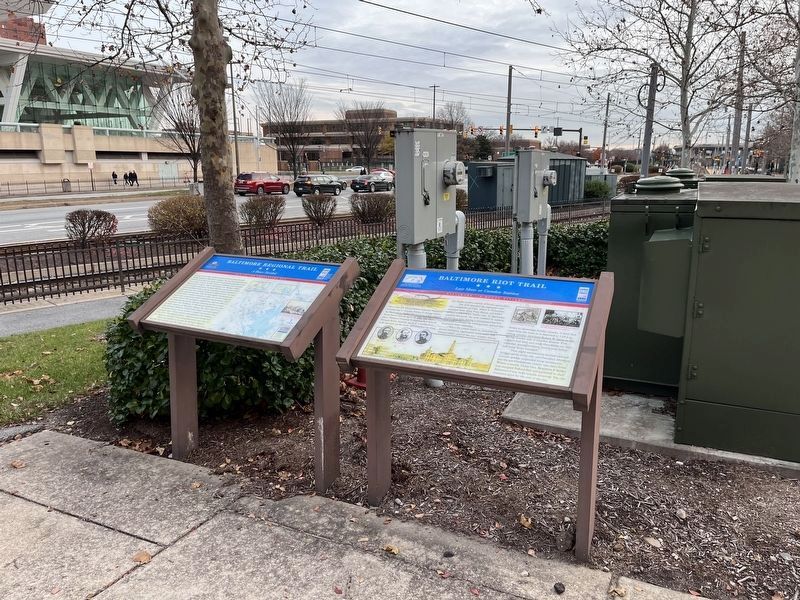
Related marker. Click here for another marker that is related to this marker. This marker has been replaced with the linked marker, which has a different inscription.
Credits. This page was last revised on May 24, 2024. It was originally submitted on November 24, 2006, by Tom Fuchs of Greenbelt, Maryland. This page has been viewed 3,633 times since then and 23 times this year. Last updated on November 4, 2010, by Timothy Carr of Birmingham, Alabama. Photos: 1. submitted on December 11, 2022, by Devry Becker Jones of Washington, District of Columbia. 2. submitted on November 24, 2006, by Tom Fuchs of Greenbelt, Maryland. 3. submitted on December 11, 2022, by Devry Becker Jones of Washington, District of Columbia. • Craig Swain was the editor who published this page.
