Duck Creek Hundred in Smyrna in Kent County, Delaware — The American Northeast (Mid-Atlantic)
Site of Green Pottery
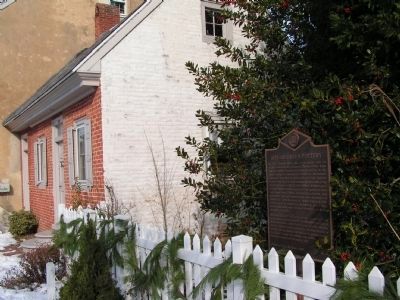
Photographed by Nate Davidson, December 30, 2010
1. Site of Green Pottery Marker
Inscription.
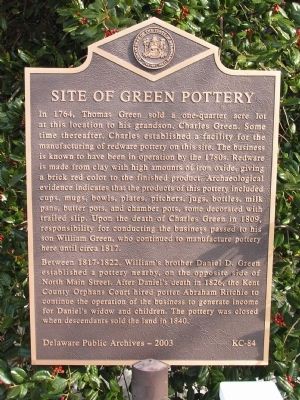
Site of Green Pottery. . In 1764, Thomas Green sold a one-quarter acre lot at this location to his grandson, Charles Green. Some time thereafter, Charles established a facility for the manufacturing of redware pottery on this site. The business is known to have been in operation by the 1780s. Redware is made from clay with high amounts of iron oxide, giving a brick red color to the finished product. Archaeological evidence indicates that the producers of this pottery included cups, mugs, bowls, plates, pitchers, jugs, bottles, milk, pans, butter pots, and chamber pots, some decorated with trailed slip. Upon the death of Charles Green in 1809, responsibility for conducting the business passed to his son William Green, who continued to manufacture pottery here until circa 1817. Between 1817-1822, William's brother Daniel D. Green established a pottery nearby, on the opposite side of North Main Street. After Daniel's death in 1826, the Kent County Orphans Court hired potter Abraham Ritchie to continue the operation of the business to generate income for Daniel's widow and children. The pottery was closed when descendants sold the land in 1840.
In 1764, Thomas Green sold a one-quarter acre lot at this location to his grandson, Charles Green. Some time thereafter, Charles established a facility for the manufacturing of redware pottery on this site. The business is known to have been in operation by the 1780s. Redware is made from clay with high amounts of iron oxide, giving a brick red color to the finished product. Archaeological evidence indicates that the producers of this pottery included cups, mugs, bowls, plates, pitchers, jugs, bottles, milk, pans, butter pots, and chamber pots, some decorated with trailed slip. Upon the death of Charles Green in 1809, responsibility for conducting the business passed to his son William Green, who continued to manufacture pottery here until circa 1817. Between 1817-1822, William's brother Daniel D. Green established a pottery nearby, on the opposite side of North Main Street. After Daniel's death in 1826, the Kent County Orphans Court hired potter Abraham Ritchie to continue the operation of the business to generate income for Daniel's widow and children. The pottery was closed when descendants sold the land in 1840.
Erected 2003 by Delaware Public Archives. (Marker Number KC-84.)
Topics and series. This historical marker is listed in these topic lists: Colonial Era
Location. 39° 18.1′ N, 75° 36.45′ W. Marker is in Smyrna, Delaware, in Kent County. It is in Duck Creek Hundred. It can be reached from N. Main Street close to Mt. Vernon Street. Touch for map. Marker is in this post office area: Smyrna DE 19977, United States of America. Touch for directions.

Regionally, this marker is in the American Mid-Atlantic and on the Delmarva Peninsula. Globally, it is in the North Atlantic Region, North America, the Western Hemisphere, the Western World, and the Anglosphere. Historically, it finds itself in what was once New Netherland, one of the original Thirteen Colonies, and the Antebellum South.
The site of the pottery was directly next to the John Cummins house, shown on the left of this picture.
Credits. This page was last revised on May 15, 2026. It was originally submitted on January 12, 2011, by Nathan Davidson of Salisbury, Maryland. This page has been viewed 1,367 times since then and 24 times this year. Photos:1, 2. submitted on January 12, 2011, by Nathan Davidson of Salisbury, Maryland. • Bill Pfingsten was the editor who published this page.