Waynesboro, Virginia — The American South (Mid-Atlantic)
Waynesboro
Photographed by J. J. Prats, July 1, 2007
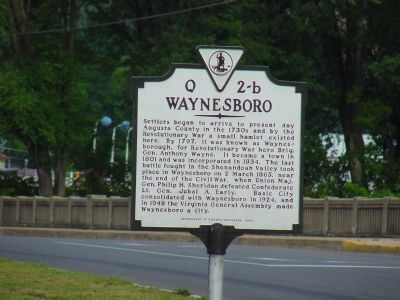
1. Waynesboro Marker
Settlers began to arrive to present day Augusta County in the 1730s and by the Revolutionary War a small hamlet existed here. By 1797, it was known as Waynesborough, for Revolutionary War hero Brig. Gen. Anthony Wayne. It became a town in 1801 and was incorporated in 1834. The last battle fought in the Shenandoah Valley took place in Waynesboro on 2 March 1865, near the end of the Civil War, when Union Maj. Gen. Philip H. Sheridan defeated Confederate Lt. Gen. Jubal A. Early. Basic City consolidated with Waynesboro in 1924, and in 1948 the Virginia General Assembly made Waynesboro a city.
Erected 2000 by Department of Historic Resources. (Marker Number Q-2-b.)
Topics and series. This historical marker is listed in these topic lists: Political Subdivisions • Settlements & Settlers • War, US Civil. In addition, it is included in the Virginia Department of Historic Resources (DHR) series list. A significant historical date for this entry is March 2, 1865.
Location. 38° 4.1′ N, 78° 53.167′ W. Marker is in Waynesboro, Virginia. It is on West Main Street (U.S. 340) east of Arch Avenue, on the left when traveling east. Touch for map.
this page online

Regionally, this marker is in Virginia’s Shenandoah Valley. It is also in the American South and specifically in the Upper South. Globally, it is in North America, the Western Hemisphere, the Western World, and the Anglosphere. Historically, it finds itself in what was once the territory of the Mississippian Culture, one of the original Thirteen Colonies, one of the Confederate States of America, and the Antebellum South.
Other nearby markers. At least 8 other markers are within walking distance of this marker: River Crossings & Bridges (about 400 feet away, measured in a direct line); Ecology of the South River (about 600 feet away); a different marker also named Waynesboro (about 700 feet away); William H. Harman Monument (approx. 0.2 miles away); Settlement of Port Republic Road (approx. 0.2 miles away); Mercury and the South River (approx. 0.2 miles away); Fishburne Military School (approx. 0.2 miles away); Port Republic Road Historic District (approx. half a mile away). Touch for a list and map of all markers
Photographed by J. J. Prats, July 1, 2007
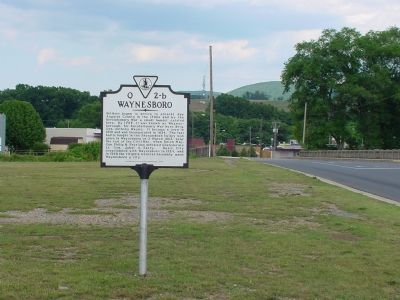
2. Waynesboro Marker
More about this marker. This marker replaced a marker with the same title and number which read, “Here, on one of the first roads west of the Blue Ridge, a hamlet stood in colonial times. The Walker exploring expedition started from this vicinity in 1748. Here, in June, 1781, the Augusta militia assembled to join Lafayette in the East. A town was founded in 1797. It was established by law in 1801 and named for General Anthony Wayne.”
Also see . . .
1. Waynesboro, Virginia. Wikipedia entry (Submitted on August 30, 2023, by Larry Gertner of New York, New York.)
2. Basic City, Virginia. Wikipedia entry:
Became one of the “lost towns” of Virginia when it consolidated with Waynesboro in 1924. (Submitted on December 7, 2007.)
Photographed by J. J. Prats, July 1, 2007
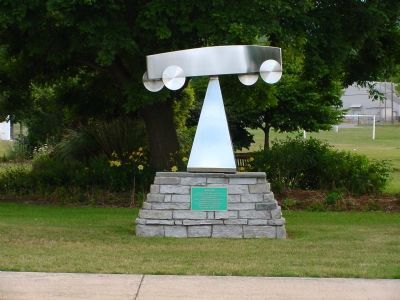
3. Blue Ridge Soap Box Classic Monument
Monument is across the street from the marker. Plaque reads, “June 1999. Dedicated in recognition of volunteers and participants who make the Blue Ridge Soap Box Classic a community event committed to promoting friendly competition, fair play and fun.”
Credits. This page was last revised on August 30, 2023. It was originally submitted on December 7, 2007, by J. J. Prats of Powell, Ohio. This page has been viewed 2,308 times since then and 70 times this year. Photos: 1, 2, 3. submitted on December 7, 2007, by J. J. Prats of Powell, Ohio.
