Albany in Dougherty County, Georgia — The American South (South Atlantic)
The Bridge House
Photographed by David Seibert, January 23, 2011
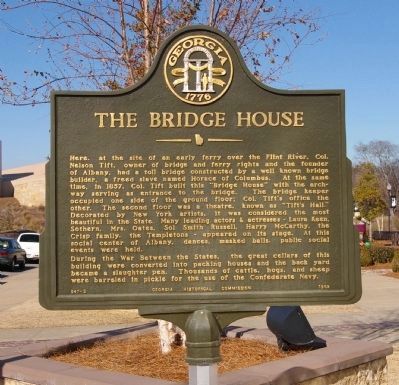
1. The Bridge House Marker
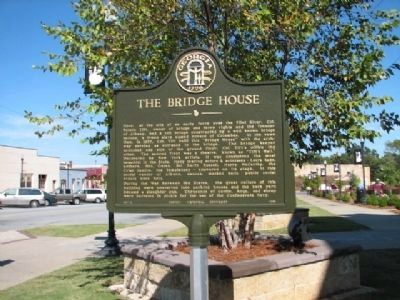
Here, at the site of an early ferry over the Flint River, Col. Nelson Tift, owner of bridge and ferry rights and the founder of Albany, had a toll bridge constructed by a well known bridge builder, a freed slave named Horace of Columbus. At the same time, in 1857, Col. Tift built this “Bridge House” with the archway serving as entrance to the bridge. The bridge keeper occupied one side of the ground floor; Col. Tift’s office the other. The second floor was a theater, known as “Tift’s Hall.” Decorated by New York artists, it was considered the most beautiful in the State. Many leading actors & actresses -- Laura Keene, Sothern, Mrs. Oates, Sol Smith Russell, Harry McCarthy, the Crisp family, the Templeton’s ~ appeared on its stage. At this social center of Albany, dances, masked balls, public socials events were held.
During the War Between the States, the great cellars of this building were converted into packing houses and the back yard became a slaughter pen. Thousands of cattle, hogs, and sheep were barreled in pickle for the use of the Confederate Navy.
Erected 1958 by Georgia Historical Commission. (Marker
this page online
Topics and series. This historical marker is listed in these topic lists: Notable Places • War, US Civil. In addition, it is included in the Georgia Historical Society series list. A significant historical year for this entry is 1857.
Location. 31° 34.65′ N, 84° 8.938′ W. Marker is in Albany, Georgia, in Dougherty County. It is on North Front Street 0 miles north of East Broad Street. Touch for map. Marker is at or near this postal address: 112 North Front Street, Albany GA 31701, United States of America. Touch for directions.

Regionally, this marker is on the Coastal Plain. It is also in the American South and specifically in the Deep South. Globally, it is in North America, the Western Hemisphere, the Western World, and the Anglosphere. Historically, it finds itself in what was once the territory of the Mississippian Culture, one of the original Thirteen Colonies, one of the Confederate States of America, and the Antebellum South.
Other nearby markers. At least 8 other markers are within walking distance of this marker: Nelson Tift (a few steps from this marker); Flint River Bridge World War I Memorial
Photographed by Sandra Hughes, October 25, 2008
2. Bridge House Marker
Also see . . .
1. Nelson Tift. Wikipedia biography:
Nelson Tift (July 23, 1810 – November 21, 1891) was an American jurist, businessman, soldier and politician from the state of Georgia. (Submitted on March 18, 2010, by Sandra Hughes Tidwell of Killen, Alabama, USA.)
2. Colonel Nelson Tift historical marker. Digital Library of Georgia website entry:
Located at Albany-Dougherty County Judicial Building, Albany, Ga. (Submitted on March 18, 2010, by Sandra Hughes Tidwell of Killen, Alabama, USA.)
3. Laura Keene. Wikipedia biography:
Laura Keene (July 20, 1826 – November 4, 1873) was an American actress and manager, whose real name was Mary Frances Moss. (Submitted on March 18, 2010, by Sandra Hughes Tidwell of Killen, Alabama, USA.)
4. Sol Smith Russell.
Photographed by David Seibert, January 23, 2011
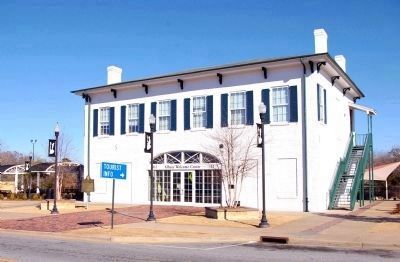
3. The Bridge House and Marker
The marker can just be seen at the far left of the building.
Sol Smith Russell (1848-1902) was an American stage actor, born at Brunswick, Missouri. He served as a drummer boy in the Union army. In 1862 he became connected with a theatre at Cairo, Ill. (Submitted on March 18, 2010, by Sandra Hughes Tidwell of Killen, Alabama, USA.)
5. Harry McCarthy. Wikipedia website entry:
Harry McCarthy (1804-1874[1]) was a songwriter from Ulster, where he became a variety entertainer and comedian in the mid 19th century. In 1861 he wrote the song "The Bonnie Blue Flag," about the unofficial first Confederate flag, using the tune from "The Irish Jaunting Car." The song was extremely popular, rivaling "Dixie" as a Confederate anthem. The song lost some of its popularity when, late in the war, McCarthy left the South for Philadelphia, Pennsylvania. (Submitted on March 18, 2010, by Sandra Hughes Tidwell of Killen, Alabama, USA.)
Photographed by Sandra Hughes, October 25, 2008
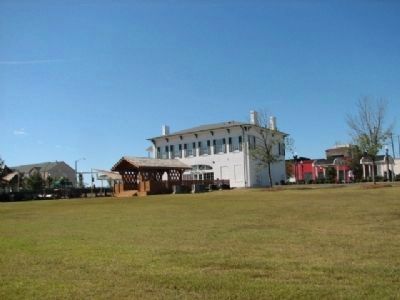
4. The Bridge House
The Historic Bridge House, now home to the Albany Welcome Center, has been fully and beautifully restored. In 1858, Albany founder Nelson Tift hired African American bridge builder Horace King to build a covered bridge and bridge house to span the Flint River. King’s 150-year-old brick bridge house still stands today and is the place for visitors to stop for brochures and information, as well as Albany souvenirs, including stuffed turtles (the signature painted turtle statues are found throughout downtown Albany) and kitchen and cooking items inspired by Albany native and queen of southern cuisine, Paula Deen.
Photographed by David Seibert, January 23, 2011
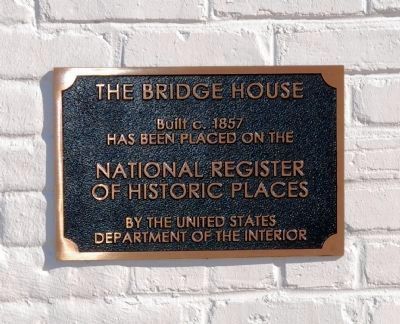
5. The Bridge House Plaque
This plaque, mounted to the right of the door, confirms that the Bridge House is on the National Register of Historic Places.
via Wikipedia, unknown
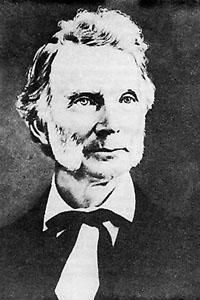
6. Nelson Tift
Credits. This page was last revised on October 13, 2023. It was originally submitted on March 18, 2010, by Sandra Hughes Tidwell of Killen, Alabama, USA. This page has been viewed 2,107 times since then and 68 times this year. Last updated on March 10, 2011, by David Seibert of Sandy Springs, Georgia. Photos: 1. submitted on March 10, 2011, by David Seibert of Sandy Springs, Georgia. 2. submitted on March 18, 2010, by Sandra Hughes Tidwell of Killen, Alabama, USA. 3. submitted on February 8, 2011, by David Seibert of Sandy Springs, Georgia. 4. submitted on March 18, 2010, by Sandra Hughes Tidwell of Killen, Alabama, USA. 5. submitted on February 8, 2011, by David Seibert of Sandy Springs, Georgia. 6. submitted on July 10, 2021, by Larry Gertner of New York, New York. • Bill Pfingsten was the editor who published this page.
