Downtown Detroit in Wayne County, Michigan — The American Midwest (Great Lakes)
Finney Barn
⎯⎯⎯
William Dolarson

Photographed by Mike Wintermantel, March 26, 2011
1. Finney Barn Marker Side
Finney Barn. Seymour Finney conducted one of the principal passenger depots of the underground railroad in the Detroit area. Finney, a tailor by trade, later became a hotel-keeper, and it was in this capacity that he assisted fugitive slaves in the era prior to 1861. In 1850 he purchased a site where in later years stood the Finney Hotel, and also erected a large barn which he operated along with his tavern. Strongly sympathetic to the abolitionist cause, Finney employed every means to assist escaping slaves across the river into Canada. Detroit was one of the most important "stations" en route to Canada; if a fugitive reached this city, he was comparatively safe. Finney Barn served as a hiding-place for runaways until they could reach the river bank and freedom.
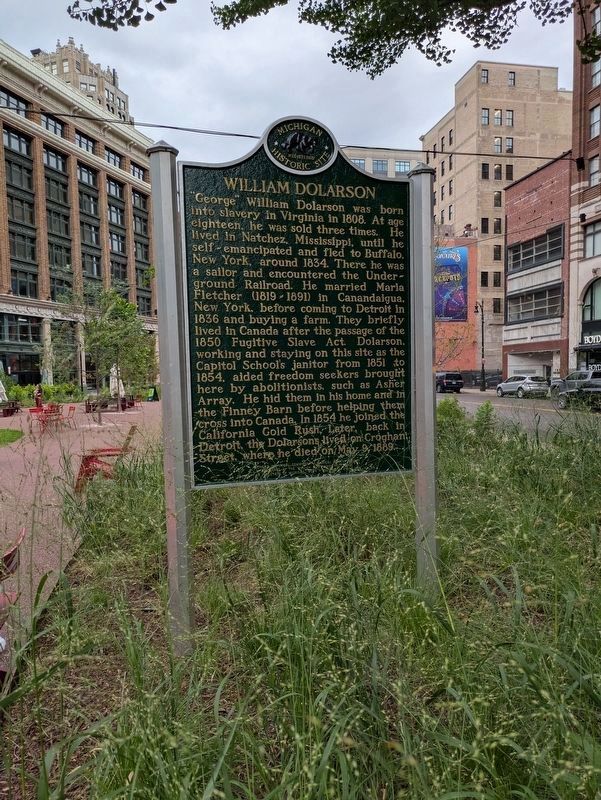
William Dolarson. "George" William Dolarson was born into slavery in Virginia in 1808. At age eighteen, he was sold three times. He lived in Natchez, Mississippi, until he self-emancipated and fled to Buffalo, New York, around 1834. There he was a sailor and encountered the Under-ground Railroad. He 1narried Maria Fletcher (1819-1891) in Canandaigua, New York, before coming to Detroit in 1836 and buying a farm. They briefly lived in Canada after the passage of the 1850 Fugitive Slave Act. Dolarson, working and staying on this site as the Capitol School's janitor from 1851 to 1854, aided freedo1n seekers brought here by abolitionists, such as Asher Array. He hid them in his home and in the Finney Barn before helping the1n cross into Canada. In 1854 he joined the California Gold Rush. Later, back in Detroit, the Dolarsons lived on Croghan Street, where he died on May 9, 1889.
Erected 1980 by Michigan History Division, Department of State. (Marker Number S0069.)
Topics and series. This historical marker is listed in these topic lists:
this page online
Location. 42° 19.974′ N, 83° 2.958′ W. Marker is in Detroit, Michigan, in Wayne County. It is in Downtown Detroit. It is at the intersection of Griswold Street and State Street, on the right when traveling south on Griswold Street. Touch for map. Marker is at or near this postal address: 150 State St, Detroit MI 48226, United States of America. Touch for directions.

Regionally, this marker is in Southeast Michigan. It is also in the American Midwest. Globally, it is in North America, on the Great Lakes, in the Western Hemisphere, in the Western World, and in the Anglosphere. Historically, it finds itself in what was once the Viceroyalty of New France and also the Northwest Territory.
Other nearby markers. At least 8 other markers are within walking distance of this marker: Michigan's First Capitol / Capitol Union School (a few steps from this marker); The First Capitol Building in Michigan (a few steps from this marker); Detroit's Underground Railway Station
Photographed by Bruce InCharlotte, August 19, 2025
2. William Dolarson Marker Side
Photographed by Mike Wintermantel, March 26, 2011
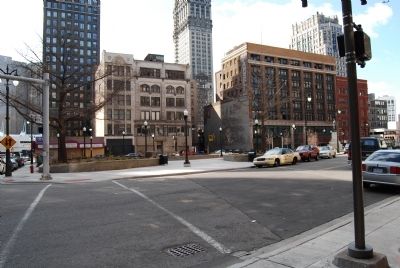
3. Finney Barn / William Dolarson Marker
Credits. This page was last revised on January 11, 2026. It was originally submitted on March 27, 2011, by Mike Wintermantel of Pittsburgh, Pennsylvania. This page has been viewed 3,899 times since then and 264 times this year. Photos: 1. submitted on March 27, 2011, by Mike Wintermantel of Pittsburgh, Pennsylvania. 2. submitted on September 13, 2025, by Bruce InCharlotte of Charlotte, North Carolina. 3. submitted on March 27, 2011, by Mike Wintermantel of Pittsburgh, Pennsylvania. • Bill Pfingsten was the editor who published this page.
