Sedalia in Guilford County, North Carolina — The American South (South Atlantic)
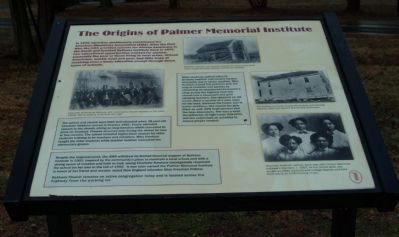
The Origins of Palmer Memorial Institute
Photographed by Paul Jordan, January 1, 2011
1. The Origins of Palmer Memorial Institute Marker
In 1846, Christian abolitionists established the American Missionary Association (AMA). After the Civil War, the AMA provided schools for African Americans in the South and founded Bethany Institute here in 1870. Few educational opportunities existed for anyone, especially the poor or those living in rural areas. African Americans, mostly rural and poor, had little hope of receiving even a basic education except through these types of schools.
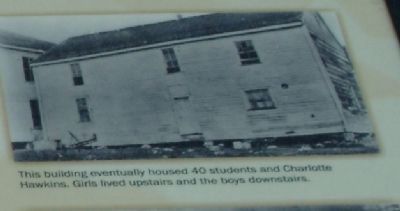
Many students walked miles to Bethany Institute and missed classes frequently due to winter weather. Miss Hawkins solved this problem with the help of students and parents by converting an abandoned blacksmith’s shop across the highway from the church into a classroom and girls’ sleeping quarters. She obtained an old house about a quarter of a mile away for the boys. Because the house was in better condition, she moved the girls there as well. Girls lived upstairs and the boys downstairs. She was a strict disciplinarian of high moral character, and she supervised all activities to ensure proper conduct.
The school and church were both well-attended when 18-year-old Charlotte Hawkins
this page online
Despite the improvements, the AMA withdrew its limited financial support of Bethany Institute in 1902. Inspired by the community’s pleas to maintain a local school and with a strong sense of mission and faith in God, young Charlotte courageously reopened the school on her own in the fall of 1902. It was later named the Palmer Memorial Institute in honor of her friend and mentor, noted New England educator Alice Freeman Palmer.
Bethany Church remains an active congregation today and is located across the highway from the parking lot.
Erected by Division of State Historic Sites and Properties.
Topics and series. This historical marker is listed in these topic lists: Abolition & Underground RR • African Americans • Education • Religion & Religious Structures.
Photographed by Paul Jordan, January 1, 2011
2. The Origins of Palmer Memorial Institute Marker
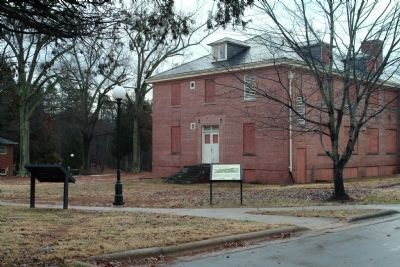
The marker is to the left of the sidewalk.
Location. This marker has been replaced by another marker nearby. It was located near 36° 4.088′ N, 79° 37.487′ W. Marker was in Sedalia, North Carolina, in Guilford County. It was on Burlington Road (U.S. 70) west of Palmer Farm Road, on the right when traveling east. Touch for map. Marker was at or near this postal address: 6136 Burlington Road, Sedalia NC 27342, United States of America. Touch for directions.

Regionally, this marker was in the Piedmont and specifically in Piedmont Triad. It was also in the American South and specifically in the Upper South. Globally, it was in North America, the Western Hemisphere, the Western World, and the Anglosphere. Historically, it found itself in what was once the territory of the Mississippian Culture, one of the original Thirteen Colonies, one of the Confederate States of America, and the Antebellum South.
Other nearby markers. At least 8 other markers are within walking distance of this location: Introduction & Welcome (here, next to
Photographed by Paul Jordan, January 1, 2011
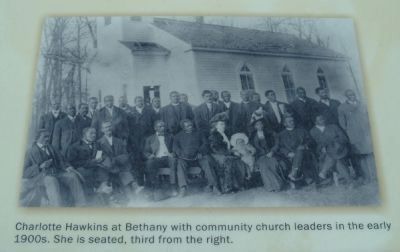
3. Charlotte Hawkins at Bethany
with community church leaders in the early 1900s. She is seated, third from the right.
Other markers no longer nearby. Charlotte Hawkins Brown Museum (was here, next to this marker but has been replaced with another marker now near it); Charles W. Eliot Hall (was within shouting distance of this marker but has been replaced with another marker now near it).
Photographed by Paul Jordan, January 1, 2011
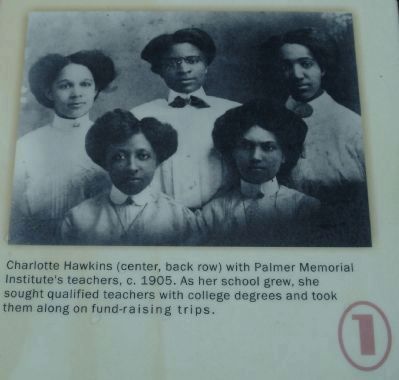
4. Charlotte Hawkins
Charlotte Hawkins (center, back row) with Palmer Memorial Institute's teachers, c. 1905. As her school grew, she sought qualified teachers with college degrees and took them along on fund-raising trips.
Photographed by Paul Jordan, January 1, 2011
5. The Boy's Dormitory
This building eventually housed 40 students and Charlotte Hawkins. The girls lived upstairs and the boys downstairs.
Credits. This page was last revised on January 26, 2026. It was originally submitted on April 16, 2011, by Paul Jordan of Burlington, N. C., U. S. A.. This page has been viewed 899 times since then and 39 times this year. Photos: 1, 2, 3, 4, 5. submitted on April 16, 2011, by Paul Jordan of Burlington, N. C., U. S. A.. • Bill Pfingsten was the editor who published this page.
