East Canaan in North Canaan in Northwest Hills Region, Connecticut — The American Northeast (New England)
Birth of an Industry
The Iron Works of The 1700's
| — | Beckley Furnace Industrial Monument | — |

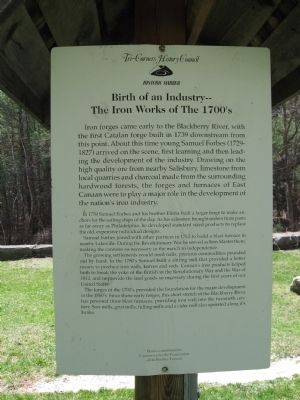
Iron forges came early to the Blackberry River, with the first Catalan forge built in 1739 downstream from this point. About this time young Samuel Forbes (1729-1827) arrived on the scene, first learning and then leading the development of the industry. Drawing on the high quality iron ore from nearby Salisbury, limestone from local quarries and charcoal made from the surrounding hardwood forests, the forges and furnaces of East Canaan were to play a major role in the nation's iron industry.
In 1759 Samuel Forbes and his brother Elisha built a larger forge to make anchors for sailing ships of the day. As his salesmen brought orders from ports as far away as Philadelphia, he developed standard sized products to replace the old, expensive individual designs.
Samuel Forbes joined with other partners in 1762 to build a blast furnace in nearby Lakeville. During the Revolutionary War he served as Iron Master there, making cannons so necessary in the march to independence.
The growing settlements would need nails, precious commodities pounded out by hand. In the 1780's Samuel built a slitting mill that provided a better
this page online
The forges of the 1700's provided the foundation for the major development in the 1800's. Since those early forges, this short stretch of the Blackberry River has powered three blast furnaces, providing iron well into the twentieth century. Saw mills, grist mills, fulling mills and a cider mill also operated along its banks.
Erected by Tri-Corners History Council, Committee for the Preservation of the Beckley Furnace.
Topics. This historical marker is listed in these topic lists: Colonial Era • Industry & Commerce. A significant historical year for this entry is 1739.
Location. 42° 0.66′ N, 73° 17.548′ W. Marker is in North Canaan in Northwest Hills Region, Connecticut. It is in East Canaan. It can be reached from the intersection of Lower Road and Furnace Hill Road, on the left when traveling west. Located on the information kiosk at Beckley Furnace Industrial Monument. Touch for map.
Photographed by Michael Herrick, April 15, 2011
2. Birth of an Industry Marker
This is a photo of the marker in its prior environs.

Regionally, this marker is in Connecticut’s Berkshire Foothills and in the Litchfield Hills. It is also in the American Northeast and in New England. Globally, it is in North America, the Western Hemisphere, the Western World, and the Anglosphere. Historically, it finds itself in what was once Litchfield County and also one of the original Thirteen Colonies.
Other nearby markers. At least 8 other markers are within walking distance of this marker: Beckley Furnace Industrial Monument (here, next to this marker); Salamander (here, next to this marker); Tuyere Arch (a few steps from this marker); What Is This Place? (a few steps from this marker); Casting Arch & Furnace Hearth (a few steps from this marker); What is This Place? (within shouting distance of this marker); Leffel Turbine (within shouting distance of this marker); Hydraulic turbine and blast pump (within shouting distance of this marker). Touch for a list and map of all markers in North Canaan.
Also see . . . Friends of Beckley Furnace.

Photographed by Michael Herrick, April 15, 2011
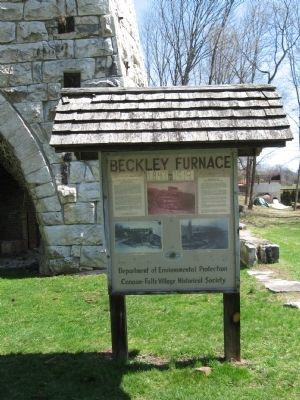
4. Beckley Furnace Information Kiosk
1847 – 1919
Department of Environmental Protection
Canaan - Falls Village Historical Society
Photographed by Michael Herrick, April 15, 2011
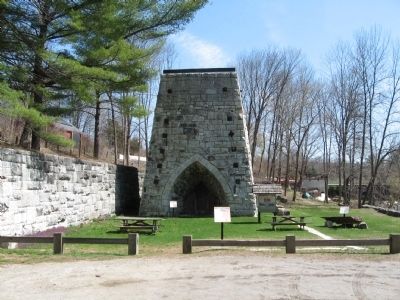
5. Beckley Furnace
Credits. This page was last revised on June 27, 2026. It was originally submitted on April 25, 2011, by Michael Herrick of Southbury, Connecticut. This page has been viewed 934 times since then and 29 times this year. Photos: 1. submitted on June 27, 2026, by Devry Becker Jones of Washington, District of Columbia. 2. submitted on April 25, 2011, by Michael Herrick of Southbury, Connecticut. 3. submitted on June 27, 2026, by Devry Becker Jones of Washington, District of Columbia. 4, 5. submitted on April 25, 2011, by Michael Herrick of Southbury, Connecticut.
