Near Diamond in Newton County, Missouri — The American Midwest (Upper Plains)
The Moses Carver Farm
Photographed by William Fischer, Jr., January 22, 2011
1. The Moses Carver Farm Marker
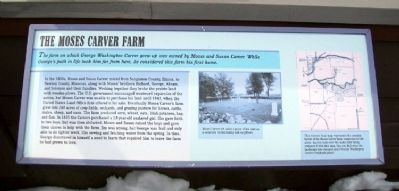
The farm on which George Washington Carver grew up was owned by Moses and Susan Carver. While George’s path in life took him far from here, he considered this farm his first home.
In the 1830s, Moses and Susan Carver moved from Sangamon County, Illinois, to Newton County, Missouri, along with Moses’ brothers Richard, George, Abram, and Solomon and their families. Working together they broke the prairie land with wooden plows. The U.S. government encouraged westward expansion of the nation, but Moses Carver was unable to purchase his land until 1843, when the United States Land Office first offered it for sale. Eventually Moses Carver’s farm grew into 240 acres of crop fields, orchards, and grazing pastures for horses, cattle, mules, sheep, and oxen. The farm produced corn, wheat, oats, Irish potatoes, hay, and flax. In 1855 the Carvers purchased a 13-year old enslaved girl. She gave birth to two boys, but was then abducted. Moses and Susan raised the boys and gave them chores to help with the farm. Jim was strong, but George was frail and only able to do lighter work, like sewing and fetching water from the spring. In
this page online
Erected by National Park Service.
Topics and series. This historical marker is listed in these topic lists: African Americans • Agriculture • Education • Science & Medicine. In addition, it is included in the George Washington Carver series list. A significant historical year for this entry is 1843.
Location. This marker has been replaced by another marker nearby. It was located near 36° 59.17′ N, 94° 21.306′ W. Marker was near Diamond, Missouri, in Newton County. It could be reached from Carver Road. Marker is on the George Washington Carver National Monument Visitor Center viewing porch. Touch for map. Marker was at or near this postal address: 5646 Carver Road, Diamond MO 64840, United States of America. Touch for directions.

Regionally, this marker was in Southwest Missouri. It was also in the American Ozarks, in the Lewis & Clark Corridor, and in the Corn Belt. Globally, it was in North America, the Western Hemisphere, the Western World, and the Anglosphere. Historically, it found itself in
Photographed by William Fischer, Jr., January 22, 2011
2. The Moses Carver Farm Marker
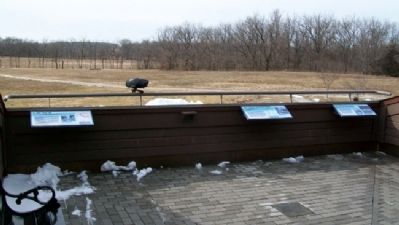
On left
Other nearby markers. At least 8 other markers are within walking distance of this location: A different marker also named The Moses Carver Farm (here, next to this marker); George Washington Carver National Monument (here, next to this marker); a different marker also named George Washington Carver's Birthplace (here, next to this marker); Take a Walk in Carver's Woods (within shouting distance of this marker); Why a National Monument? (within shouting distance of this marker); George Washington Carver's Thoughts (within shouting distance of this marker); "Conservation is One of Our Biggest Problems" - G.W. Carver (within shouting distance of this marker); Birthplace of George Washington Carver (about 300 feet away, measured in a direct line). Touch for a list and map of all markers in Diamond.
Other markers no longer nearby. George Washington Carver National Monument (was here, next to this marker but has been replaced with another marker now near it); George Washington Carver's Birthplace (was here, next to this
Photographed by National Park Service, undated
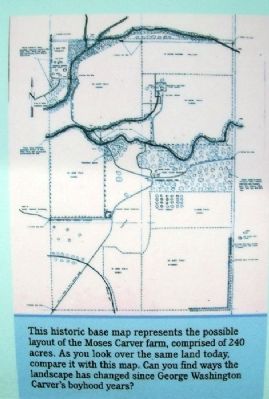
3. Photo on Moses Carver Farm Marker
Also see . . .
1. George Washington Carver National Monument. National Park Service website entry (Submitted on April 26, 2011, by William Fischer, Jr. of Reynoldsburg, Ohio.)
2. George Washington Carver. Famous Missourians website entry (Submitted on April 26, 2011, by William Fischer, Jr. of Reynoldsburg, Ohio.)
3. Tuskegee Institute National Historic Site. National Park Service website entry (Submitted on April 26, 2011, by William Fischer, Jr. of Reynoldsburg, Ohio.)
Credits. This page was last revised on September 25, 2026. It was originally submitted on April 26, 2011, by William Fischer, Jr. of Reynoldsburg, Ohio. This page has been viewed 2,212 times since then and 97 times this year. Photos: 1, 2, 3. submitted on April 26, 2011, by William Fischer, Jr. of Reynoldsburg, Ohio.
