Locust Grove in Orange County, Virginia — The American South (Mid-Atlantic)
The Battle of Payne’s Farm
The Worm Fence
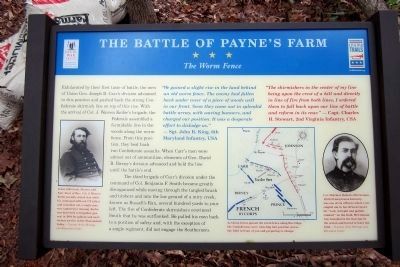
Photographed by Bernard Fisher, June 6, 2011
1. The Battle of Payne’s Farm CWT Marker
This is a previous iteration of the marker. Note that the inscription has the same language as the current version.
Exhilarated by their first taste of battle, the men of Union Gen. Joseph B. Carr’s division advanced to this position and pushed back the strong Confederate skirmish line on top of this rise. With the arrival of Col. J. Warren Keifer’s brigade, the Federals assembled a formidable line in the woods along the worm fence. From this position, they beat back two Confederate assaults. When Carr’s men were almost out of ammunition, elements of Gen. David B. Birney’s division advanced and held the line until the battle’s end.
The third brigade of Carr’s division under the command of Col. Benjamin F. Smith became greatly disorganized while moving through the tangled brush and timbers and into the low ground of a miry creek, known as Russell’s Run, several hundred yards to your left. The fire of Confederate skirmishers convinced Smith that he was outflanked. He pulled his men back to a position of safety and, with the exception of a single regiment, did not engage the Southerners.
“We gained a slight rise in the land behind an old worm fence. The enemy had fallen back under cover of a piece of woods well in our front. Soon they came out in splendid battle array, with waving banners, and charged our position. It was a desperate effort to dislodge us.”— Sgt. John R. King, 6th Maryland Infantry, USA
Click or scan to see
this page online
“The skirmishers in the center of my line being upon the crest of a hill and directly in line of fire from both lines, I ordered them to fall back upon our line of battle and reform in its rear.” — Capt. Charles H. Stewart, 2nd Virginia Infantry, CSA
[Captions:]
In his 1900 book, Slavery and Four Years of War, Col. J. Warren Keifer proudly stated that while his command suffered 172 killed and wounded, not a single man was captured or missing. Keifer was brevetted to brigadier general in 1864 for gallant and meritorious service in the Shenandoah Valley. — Courtesy Army Heritage and Education Center
As Union forces gained the worm fence along this ridge, the Confederates were wheeling into position across the field in front of you and preparing to charge.
Col. Matthew Roberts McClennan, 138th Pennsylvania Infantry, was one of six officers whom Carr singled out in his official report for “cool, intrepid and gallant conduct” on the field. McClennan was wounded in the foot late in the action and forced to leave the field. — Courtesy Army Heritage and Education Center
Erected 2011
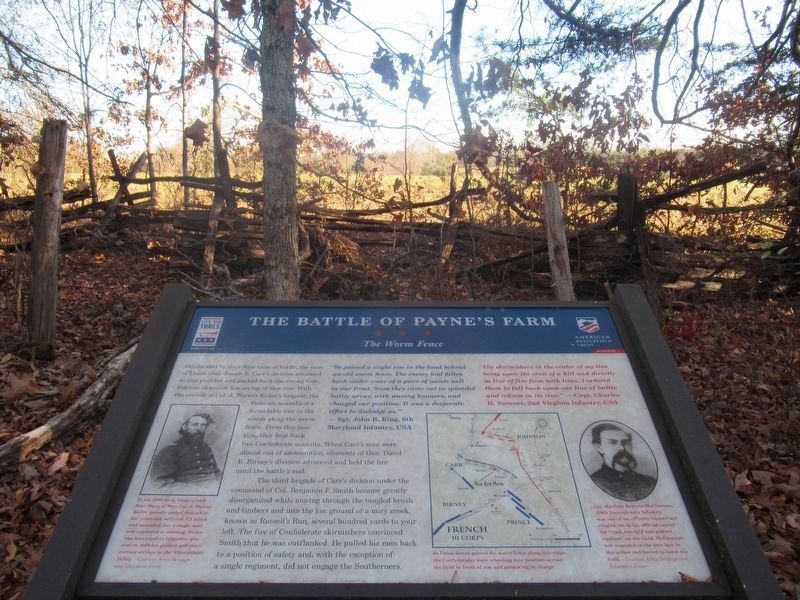
Photographed by Benjamin Harrison Allen, November 26, 2021
2. The Battle of Payne’s Farm Marker
Topics and series. This historical marker is listed in this topic list: War, US Civil. In addition, it is included in the Virginia Civil War Trails series list. A significant historical year for this entry is 1900.
Location. 38° 20.291′ N, 77° 49.455′ W. Marker is in Locust Grove, Virginia, in Orange County. It can be reached from Zoar Road (Virginia Route 611) east of Indiantown Road ( Route 603). Touch for map. Marker is at or near this postal address: 31334 Zoar Road, Locust Grove VA 22508, United States of America. Touch for directions.

Regionally, this marker is in Northern Virginia and in the Piedmont. It is also in the American South and specifically in the Upper South. Globally, it is in North America, the Western Hemisphere, the Western World, and the Anglosphere. Historically, it finds itself in what was once the territory of the Mississippian Culture, one of the original Thirteen Colonies, one of the Confederate States of America, and the Antebellum South.
Other nearby markers. At least 8 other markers are within walking distance of this marker: A different
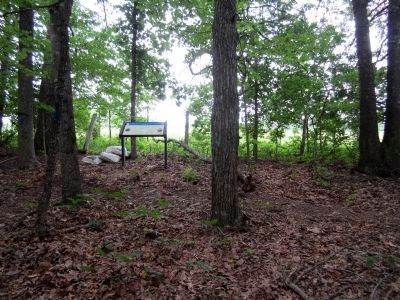
Photographed by Bernard Fisher, June 6, 2011
3. West edge of the open field
Another marker is no longer nearby. The Mine Run Campaign (was approx. half a mile away but has been permanently removed).
Also see . . .
1. Mine Run (Payne's Farm). American Battlefield Trust (Submitted on June 6, 2011.)
2. The Mine Run Campaign by James K. Bryant II. Essential Civil War Curriculum, Virginia Center for Civil War Studies at Virginia Tech (Submitted on June 6, 2011.)
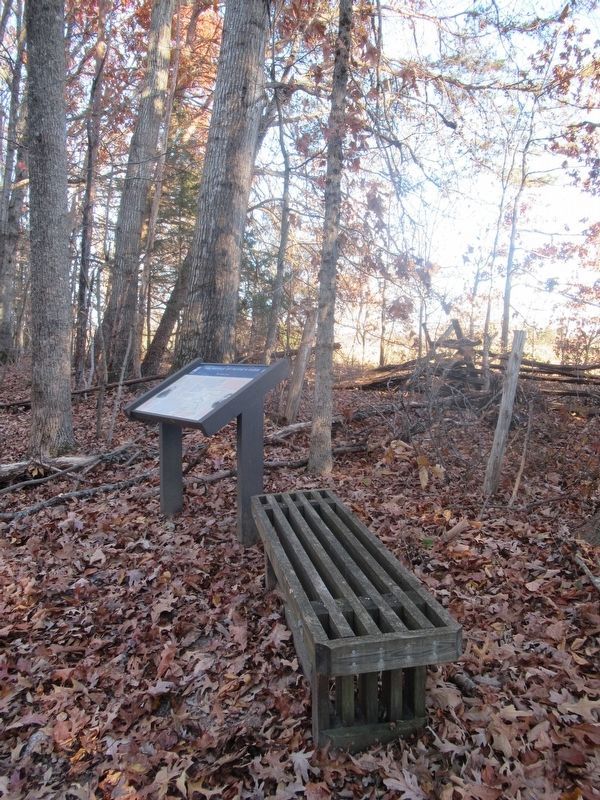
Photographed by Benjamin Harrison Allen, November 26, 2021
4. The Battle of Payne’s Farm Marker
A bench is adjacent to the marker.
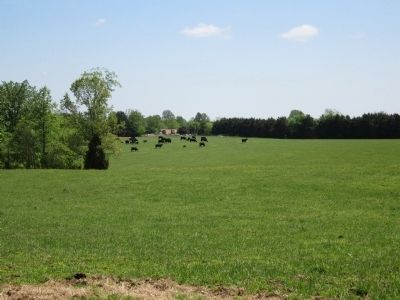
Photographed by Bernard Fisher, April 30, 2011
5. Open fields on Payne's farm
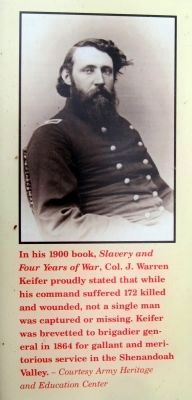
6. Union Col. J. Warren Keifer
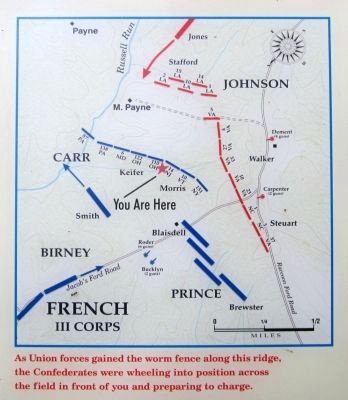
7. Troop alignments across the open fields on Payne's Farm
Credits. This page was last revised on February 24, 2026. It was originally submitted on June 6, 2011, by Bernard Fisher of Richmond, Virginia. This page has been viewed 1,316 times since then and 56 times this year. Last updated on February 24, 2026, by Evan Dwyer of Richmond, Virginia. Photos: 1. submitted on June 6, 2011, by Bernard Fisher of Richmond, Virginia. 2. submitted on February 22, 2022, by Benjamin Harrison Allen of Amissville, Virginia. 3. submitted on June 6, 2011, by Bernard Fisher of Richmond, Virginia. 4. submitted on February 22, 2022, by Benjamin Harrison Allen of Amissville, Virginia. 5, 6, 7. submitted on June 6, 2011, by Bernard Fisher of Richmond, Virginia. • Devry Becker Jones was the editor who published this page.
