Locust Grove in Orange County, Virginia — The American South (Mid-Atlantic)
The Battle of Payne’s Farm
A Fruitless Campaign

Photographed by Evan Dwyer, January 6, 2026
1. The Battle of Payne’s Farm Marker
A new marker, identical in content and layout but with the American Battlefield Trust styling, has been erected.
“In the fight of Johnson’s Division on last Friday I was under as warm a musketry fire as I have experienced for a good while—certainly worse than I have been in since Sharpsburg.” — Lt. Col. Alexander S. “Sandie” Pendleton, CSA
“One of the sharpest & best fought affairs of the war. The musketry was the most terrific any of us had ever heard, and the chances of getting off without a decent wound was about as poor as it possibly could have been.” — Col. Charles T. Collis, 114th Pennsylvania Infantry, USA
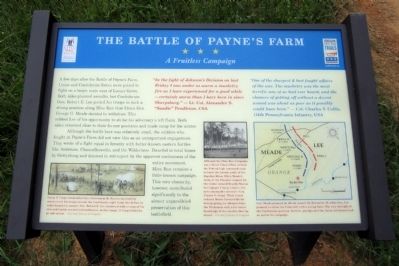
A few days after the Battle of Payne’s Farm, Union and Confederate forces were poised to fight on a larger scale west of Locust Grove. Both sides planned assaults, but Confederate Gen. Robert E. Lee posted his troops in such a strong position along Mine Run that Union Gen. George G. Meade decided to withdraw. This robbed Lee of his opportunity to strike his adversary’s left flank. Both sides returned close to their former positions and made camp for the winter.
Although the battle here was relatively small, the soldiers who fought at Payne’s Farm did not view this as an unimportant engagement. They wrote of a fight
this page online
(captions)
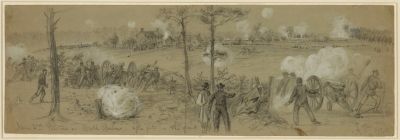
Union II Corps commander, Gen. Gouverneur K. Warren successfully maneuvered his troops around the Confederate right flank, but before he could launch his assault, Gen Robert E. Lee countered with a corps of his own and hastily erected entrenchments. In this image, II Corps batteries go into action. — Courtesy Library of Congress
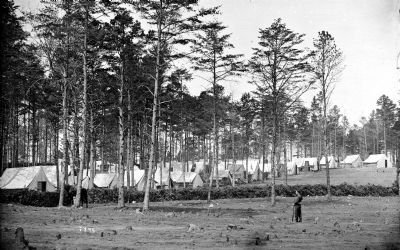
Although the Mine Run Campaign was a failed Union effort, at least the Federal high command came to know the terrain south of the Rapidan River. While Meade’s Army of the Potomac camped for the winter around Brandy Station in Culpeper County (above), his new commander arrived—Gen. Ulysses S. Grant. When Grant ordered Meade forward the following spring, he advanced into the Wilderness with a far better knowledge of the country that lay ahead. — Courtesy Library of Congress
Gen. Meade planned an all-out assault for November 30, while Gen. Lee planned to strike the Union left with a strong force. The very strength of the Confederate position, however, precipitated the Union withdrawal and an end to the campaign.
Erected 2011
Photographed by Bernard Fisher, June 6, 2011
2. The Battle of Payne’s Farm CWT Marker
Topics and series. This historical marker is listed in this topic list: War, US Civil. In addition, it is included in the Virginia Civil War Trails series list. A significant day of the year for for this entry is November 30.
Location. 38° 20.018′ N, 77° 49.482′ W. Marker is in Locust Grove, Virginia, in Orange County. It can be reached from Zoar Road (Virginia Route 611) south of Zoar School Road, on the right when traveling north. Touch for map. Marker is at or near this postal address: 31391 Zoar Rd, Locust Grove VA 22508, United States of America. Touch for directions.

Regionally, this marker is in Northern Virginia and in the Piedmont. It is also in the American South and specifically in the Upper South. Globally, it is in North America, the Western Hemisphere, the Western World, and the Anglosphere. Historically, it finds itself in what was once the territory of the Mississippian Culture, one of the original Thirteen Colonies, one of the Confederate States of America, and the Antebellum South.
Other nearby markers. At least 8 other markers are within walking distance of
Photographed by Alfred R. Waud, 1863
3. View of the rebel position at Mine run--2nd corps batteries in foreground
Library of Congress [LC-DIG-ppmsca-22416]
Another marker is no longer nearby. The Mine Run Campaign (was approx. ¼ mile away but has been permanently removed).
Also see . . .
1. Mine Run (Payne's Farm). American Battlefield Trust (Submitted on June 6, 2011.)
2. The Mine Run Campaign by James K. Bryant II. Essential Civil War Curriculum, Virginia Center for Civil War Studies at Virginia Tech (Submitted on June 6, 2011.)
Photographed by Timothy O'Sullivan, Apr 1864
4. Brandy Station, Virginia. Camp at headquarters, Army of the Potomac
Library of Congress [LC-B817- 7495]
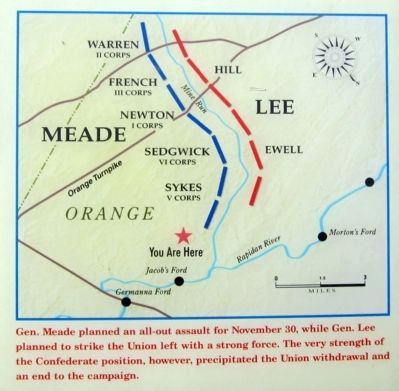
5. Opposing forces at Mine Run
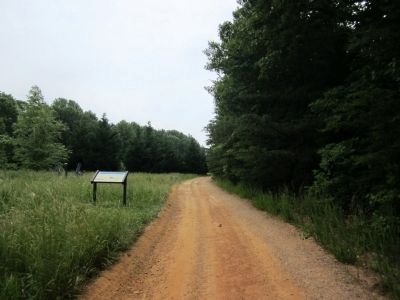
Photographed by Bernard Fisher, June 6, 2011
6. Payne’s Farm Lane
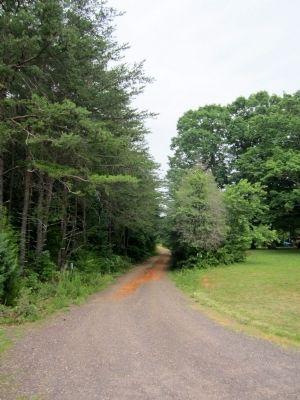
Photographed by Bernard Fisher, June 6, 2011
7. Payne’s Farm Lane from Zoar Church Road
Credits. This page was last revised on February 28, 2026. It was originally submitted on June 6, 2011, by Bernard Fisher of Richmond, Virginia. This page has been viewed 2,356 times since then and 95 times this year. Last updated on January 7, 2026, by Evan Dwyer of Richmond, Virginia. Photos: 1. submitted on February 24, 2026, by Evan Dwyer of Richmond, Virginia. 2, 3, 4, 5, 6, 7. submitted on June 6, 2011, by Bernard Fisher of Richmond, Virginia. • Devry Becker Jones was the editor who published this page.
