Cherokee in Swain County, North Carolina — The American South (South Atlantic)
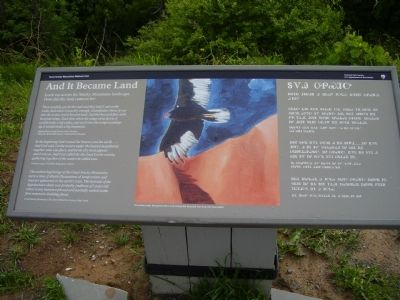
And It Became Land
Photographed by Stanley and Terrie Howard, June 18, 2011
1. And It Became Land Marker
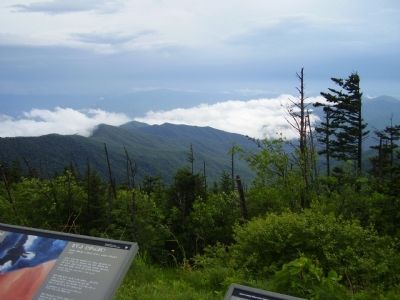
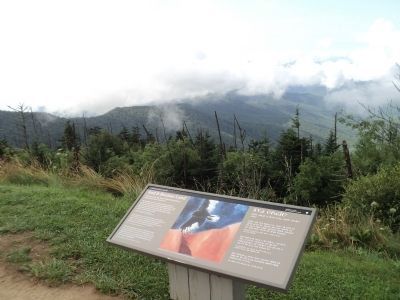
Look out across the Smoky Mountains landscape.
How did this land come to be?
They carefully got all the mud and they laid it out on the rocks. And when it was dry enough, Grandfather threw it out into the water, and it became land. And the buzzard flew with his great wings. Each time when his wings went down, it would make a big valley, and each time the wings would go up,it would make a big mountain.
Adapted from Living Stories of the Cherokee, “How the World Was Made,” Kathi Smith Littlejohn
In the beginning God created the heaven and the earth....And God said, Let the waters under the heaven be gathered together unto one place, and let the dry land appear: and it was so. And God called the dry land Earth; and the gathering together of the waters he called seas.
Genesis I:I,9,10, The Bible, King James Version
The earliest beginnings of the Great Smoky Mountains were a time of drastic fluctuations of temperature and massive upheavals in the earth's crust. The bedrock of the Appalachian chain was probably [millions of] years old when it was metamorphosed and partially melted in the first mountain-building phase.
Great Smoky Mountains: The Story Behind the Scenery,
this page online
Erected by National Park Service, Department of the Interior.
Topics. This historical marker is listed in this topic list: Indigenous Peoples and Communities.
Location. 35° 33.407′ N, 83° 29.777′ W. Marker is in Cherokee, North Carolina, in Swain County. It is on Clingmans Dome Road 7.2 miles west of U.S. 441. Touch for map. Marker is in this post office area: Cherokee NC 28719, United States of America. Touch for directions.

Regionally, this marker is in the Mountains and specifically in the Great Smoky Mountains. It is also in the American South, specifically in the Upper South, in Appalachia, and specifically in Southern Appalachia. Globally, it is in North America, the Western Hemisphere, the Western World, and the Anglosphere. Historically, it finds itself in what was once the original Cherokee Nation, the territory of the Mississippian Culture, one of the original Thirteen Colonies, one of the Confederate States of America, and the Antebellum South.
Other nearby markers. At least 8 other markers are within 5 miles of this marker, measured as the
Photographed by Stanley and Terrie Howard, June 18, 2011
2. And It Became Land Marker
More about this marker. In the center is an illustration with the caption, "Cherokee artist Margaret John Usdi interprets buzzard forming the mountains."
Also see . . . Clingmans Dome. Wikipedia entry (Submitted on July 9, 2024, by Larry Gertner of New York, New York.)
Photographed by Bill Coughlin, August 6, 2012
3. And It Became Land Marker
Credits. This page was last revised on July 9, 2024. It was originally submitted on June 27, 2011, by Stanley and Terrie Howard of Greer, South Carolina. This page has been viewed 857 times since then and 33 times this year. Photos: 1, 2. submitted on June 27, 2011, by Stanley and Terrie Howard of Greer, South Carolina. 3. submitted on August 15, 2012, by Bill Coughlin of Woodland Park, New Jersey. • Bernard Fisher was the editor who published this page.
