Blackwater in Cooper County, Missouri — The American Midwest (Upper Plains)
Osage Chieftain
Photographed by William Fischer, Jr., April 11, 2011
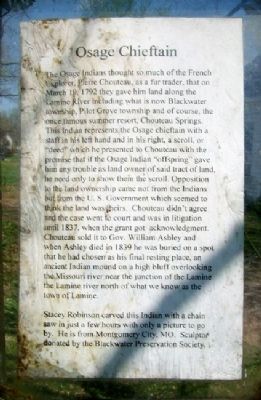
1. Osage Chieftain Marker
The Osage Indians thought so much of the French Explorer, Pierre Chouteau, as a fur trader, that on March 19, 1792 they gave him land along the Lamine River including what is now Blackwater township, Pilot Grove township and of course, the once famous summer resort, Chouteau Springs.
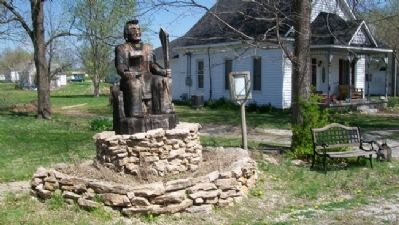
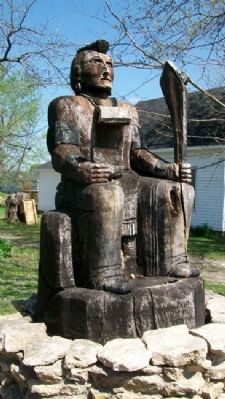
This Indian represents the Osage chieftain with a staff in his left hand and in his right, a scroll, or "deed" which he presented to Chouteau with the promise that if the Osage Indian "offspring" gave him any trouble as land owner of said tract of land, he need only to show them the scroll. Opposition to the land ownership came not from the Indians but from the U.S. Government which seemed to think the land was theirs. Chouteau didn't agree and the case went to court and was in litigation until 1837, when the grant got acknowledgment. Chouteau sold it to Gov. William Ashley and when Ashley died in 1839 he was buried on a spot that he had chosen as his final resting place, an ancient Indian mound on a high bluff overlooking the Missouri river near the junction of the Lamine [sic] river north of what we know as the town of Lamine.
Stacey Robinson carved this Indian with a chain saw in just a few hours with only a picture to go by. He is from Montgomery City, MO. Sculptor donated by the Blackwater Preservation Society.
Erected 2003 by Blackwater Preservation Society.
Topics. This historical marker is listed in these topic lists: Indigenous Peoples and Communities • Settlements & Settlers. A significant historical month for this entry is March 1860.
Location. 38° 58.764′ N, 92° 59.602′ W. Marker is in Blackwater, Missouri, in Cooper County. It is at the intersection of Main Street (Missouri Route K) and Davis Avenue, on the left when traveling east on Main Street. Touch for map. Marker is at or near this postal address: 308 Main
this page online

Regionally, this marker is in the Missouri River Corridor. It is also in the American Midwest, in the Lewis & Clark Corridor, in the Corn Belt, and on the Santa Fe Trail Corridor. Globally, it is in North America, the Western Hemisphere, the Western World, and the Anglosphere. Historically, it finds itself in what was once the territory of the Mississippian Culture, the Louisiana Purchase, and the Antebellum South.
Other nearby markers. At least 8 other markers are within 5 miles of this marker, measured as the crow flies: Blackwater Veterans Memorial (about 300 feet away, measured in a direct line); Sappington Cemetery State Historic Site (approx. 3.8 miles away); a different marker also named Sappington Cemetery State Historic Site (approx. 3.8 miles away); Enslavement to Freedom (approx. 3.9 miles away); Sappington African American Cemetery Burials (approx. 3.9 miles away); Segregation in Life and Death (approx. 3.9 miles away); Sappington Negro Cemetery (approx. 3.9 miles away); "Prairie Park" (approx. 4.3 miles away).
Also see . . .
1. The Osage Nation.
Photographed by William Fischer, Jr., April 11, 2011
2. Osage Chieftain and Marker
2. Pierre Chouteau, Jr. – Merchant and Fur Trader. Legends of America website entry (Submitted on July 3, 2011, by William Fischer, Jr. of Reynoldsburg, Ohio.)
Photographed by William Fischer, Jr., April 11, 2011
3. Osage Chieftain Wood Carving
Photographed by William Fischer, Jr., April 11, 2011
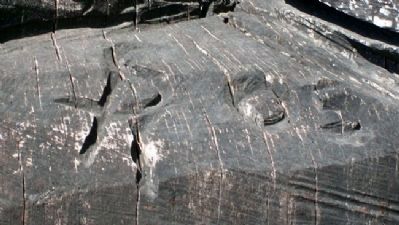
4. Osage Chieftain Scultor's Mark
Credits. This page was last revised on March 1, 2022. It was originally submitted on July 3, 2011, by William Fischer, Jr. of Reynoldsburg, Ohio. This page has been viewed 1,296 times since then and 43 times this year. Photos: 1, 2, 3. submitted on July 3, 2011, by William Fischer, Jr. of Reynoldsburg, Ohio. 4. submitted on July 4, 2011, by William Fischer, Jr. of Reynoldsburg, Ohio.
