Near Rocky Gap in Bland County, Virginia — The American South (Mid-Atlantic)
A Noted Preacher

Photographed by Mark Parker, July 11, 2026
1. Closeup of A Noted Preacher Marker
Erected 1999 by Department of Historic Resources. (Marker Number KC-2.)
Topics and series. This historical marker is listed in these topic lists: Religion & Religious Structures • War, US Civil. In addition, it is included in the Virginia Department of Historic Resources (DHR) series list. A significant historical date for this entry is July 13, 1833.
Location. 37° 12.922′ N, 81° 5.658′ W. Marker is near Rocky Gap, Virginia, in Bland County. It is at the intersection of North Scenic
this page online

Regionally, this marker is in Southwest Virginia and in the Blue Ridge Highlands. It is also in the American South, specifically in the Upper South, in Appalachia, and specifically in Southern Appalachia. Globally, it is in North America, the Western Hemisphere, the Western World, and the Anglosphere. Historically, it finds itself in what was once the territory of the Mississippian Culture, one of the original Thirteen Colonies, one of the Confederate States of America, and the Antebellum South.
Other nearby markers. At least 8 other markers are within 8 miles of this marker, measured as the crow flies: The Crooked Road (approx. 0.8 miles away); James A. Williams, Jr. (approx. 0.8 miles away); Like to Eat? (approx. 0.9 miles away); World's Smallest Railroad (approx. 5.7 miles away in West Virginia); Welcome to West Virginia (approx. 5.7 miles away in West
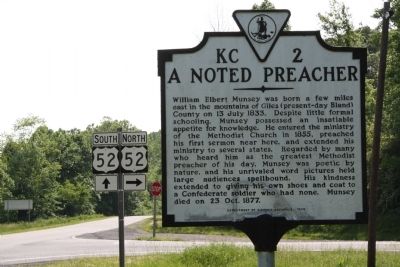
Photographed by J. J. Prats, May 28, 2011
2. A Noted Preacher Marker
Another marker is no longer nearby. Andrew Davidson (was approx. 6.8 miles away in West Virginia but has been permanently removed).
More about this marker. This marker replaces an earlier marker that had gone missing with the same number titled “A Great Preacher” which read, “Some miles to the east was born William Elbert Munsey, July 13, 1833, and near here he preached his first sermon. Ordained to the Methodist ministry in 1855, Munsey was a noted preacher in several States. He died, October 23, 1877.”
Also see . . . Sermons and Lectures by William Elbert Munsey, D.D. From the Introduction: “His methods were the reverse of the rhetorician’s—at the highest point of an extended, highly-wrought passage his words became the most familiar, and his finish was as natural as it was exquisite in the grace of homeliest
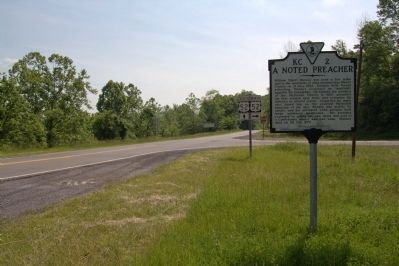
Photographed by J. J. Prats, May 28, 2011
3. A Noted Preacher Marker
“It is questionable to my mind if there lived any greater master of an audience, either in this country or England. Where he had longest preached there the largest crowds thronged to hear him. This must be considered the final test of oratory. At Marion, in Virginia, during the session of the Holston Conference, where he had often preached and was well-known, one might have walked upon the heads of the audience. Flumes were constructed, and ladies were shot by them into the house through its windows; the altar was filled with persons standing, and three individuals had seated themselves for the service, one on each side of the bookboard and one directly under it in front, in a half-bent posture.”
—Excerpt from letter to the editor printed in the New Orleans Christian Advocate on his death.
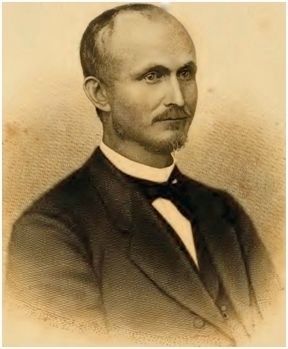
4. William Elbert Munsey (1833–1877)
Illustration on the frontispiece of the 1879 book Sermons and Lectures, Second Edition, by William Elbert Munsey, D.D. “late of the Holston Conference, M. K. Church South,”
Credits. This page was last revised on July 30, 2026. It was originally submitted on July 20, 2011, by J. J. Prats of Powell, Ohio. This page has been viewed 1,211 times since then and 68 times this year. Photos: 1. submitted on July 21, 2026, by Mark Parker of Hickory, North Carolina. 2, 3, 4. submitted on July 20, 2011, by J. J. Prats of Powell, Ohio.
