Holcombe in Chippewa County, Wisconsin — The American Midwest (Great Lakes)
The Holcombe Indian
Photographed by Keith L, July 21, 2011
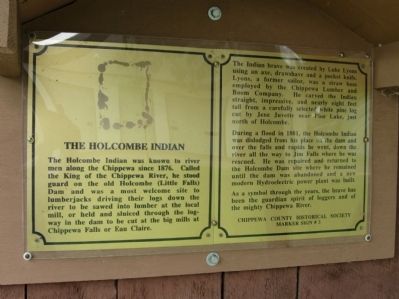
1. The Holcombe Indian Marker
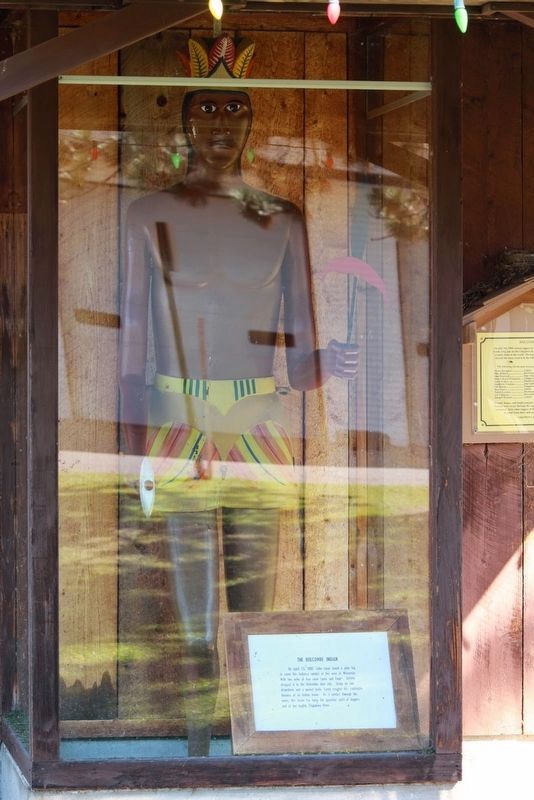
The Holcombe Indian was known to river men along the Chippewa since 1876. Called the King of the Chippewa River, he stood guard on the old Holcombe (Little Falls) Dam and was a most welcome site to lumberjacks driving their logs down the river to be sawed into lumber at the local mill, or held and sluiced through the log-way in the dam to be cut at the big mills at Chippewa Falls or Eau Claire.
The Indian brave was created by Luke Lyons using an axe, drawshave and a pocket knife. Lyons, a former sailor, was a straw boss employed by the Chippewa Lumber and Boom Company. He carved the Indian straight, impressive, and nearly eight feet tall from a carefully selected white pine log cut by Jene Juvette near Pine Lake, just north of Holcombe.
During a flood in 1881, the Holcombe Indian was dislodged from his place on the dam and over the falls and rapids he went, down the river all the way to Jim Falls where he was rescued. He was repaired and returned to the Holcombe Dam site where he remained until the dam was abandoned and a new modern hydroelectric power plant was built.
As a symbol through the years, the brave
this page online
Marker Sign #3
Erected by the Chippewa County Historical Society. (Marker Number 3.)
Topics. This historical marker is listed in these topic lists: Industry & Commerce • Man-Made Features • Waterways & Vessels. A significant historical year for this entry is 1876.
Location. 45° 13.368′ N, 91° 7.07′ W. Marker is in Holcombe, Wisconsin, in Chippewa County. It is on 275th Street (Main Street) near 262nd Avenue (Spooner Avenue), on the left when traveling south. Marker is in Holcombe Town Hall Park. Touch for map. Marker is at or near this postal address: 26179 275th Street, Holcombe WI 54745, United States of America. Touch for directions.

Regionally, this marker is in the American Midwest and in the Corn Belt. Globally, it is in North America, the Western Hemisphere, the Western World, and the Anglosphere. Historically, it finds itself in what was once the territory of the Mississippian Culture and also the Northwest Territory.
Other nearby markers. At least 8 other markers are within 13 miles of this
Photographed by Keith L, July 21, 2011
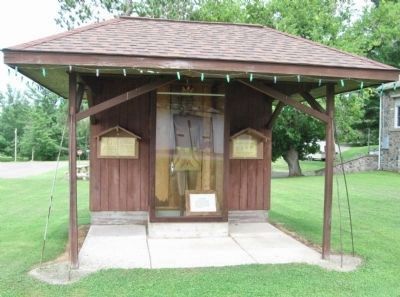
2. The Holcombe Indian and Marker
Photographed by Keith L, July 21, 2011
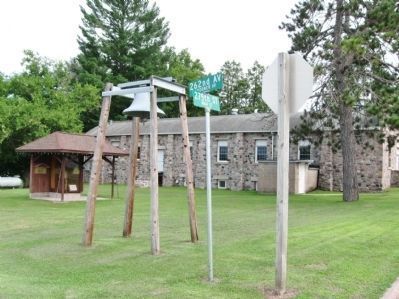
3. The Holcombe Indian Marker
via Wisconsin Historical Markers, unknown
4. The Holcombe Indian
Photographed by Keith L, July 21, 2011
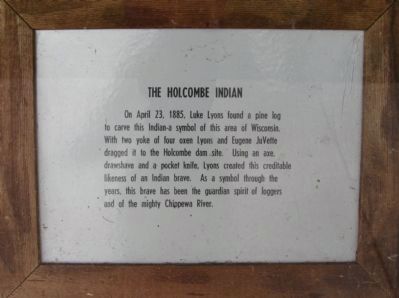
5. The Holcombe Indian Plaque
On April 23, 1885, Luke Lyons found a pine log to carve this Indian - a symbol of this area of Wisconsin. With two yoke of four oxen Lyons and Eugene JuVette dragged it to the Holcombe dam site. Using an axe, drawshave and a pocket knife, Lyons created this creditable likeness of an Indian brave. As a symbol through the years, this brave has been the guardian spirit of loggers and of the Chippewa River.
Credits. This page was last revised on September 4, 2025. It was originally submitted on August 2, 2011, by Keith L of Wisconsin Rapids, Wisconsin. This page has been viewed 1,925 times since then and 73 times this year. Photos: 1, 2, 3. submitted on August 2, 2011, by Keith L of Wisconsin Rapids, Wisconsin. 4. submitted on November 24, 2023, by Larry Gertner of New York, New York. 5. submitted on August 2, 2011, by Keith L of Wisconsin Rapids, Wisconsin.
