Near Tularosa in Otero County, New Mexico — The American Mountains (Southwest)
Three Rivers Petroglyph Site
Photographed by Bill Kirchner, July 25, 2011
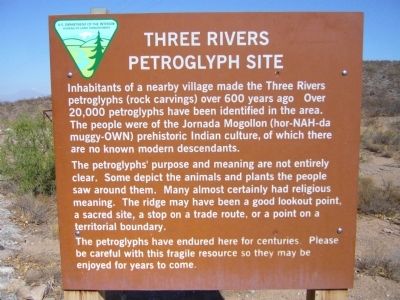
1. Three Rivers Petroglyph Site Marker
The petroglyphs' purpose and meaning are not entirely clear. Some depict the animals and plants the people saw around them. Many almost certainly had religious meaning. The ridge may have been a good lookout point, a sacred site, a stop on a trade route, or a point on a territorial boundary.
The Petroglyphs have endured here for centuries. Please be careful with this fragile resource so they may be enjoyed for years to come.
Erected by U.S. Department of the Interior, Bureau of Land Management.
Topics. This historical marker is listed in these topic lists: Indigenous Peoples and Communities • Notable Places.
Location. 33° 20.688′ N, 106° 0.544′ W. Marker is near Tularosa, New Mexico, in Otero County. It can be reached from County Road B030 4½ miles east of
this page online

Regionally, this marker is in the Pecos Valley. It is also in the American Borderlands and in the Southwest. Globally, it is in North America, the Western Hemisphere, the Western World, and the Anglosphere. Historically, it finds itself in what was once New Spain, the Comanchería, and the Republic of Texas.
Other nearby markers. At least 8 other markers are within walking distance of this marker: The First People (about 300 feet away, measured in a direct line); Prehistoric Village (about 800 feet away); Leave Only Footprints (approx. 0.2 miles away); Sacramento Mountains (approx. 0.2 miles away); Tularosa Basin (approx. 0.2 miles away); Home - 1000 Years Ago (approx. 0.2 miles away); Adobe Surface House (approx. 0.2 miles away); Building of a Later Period (approx. ¼ mile away).
More about this marker. This is a 'use fee area' $2.00 per car.
Photographed by Bill Kirchner, July 25, 2011
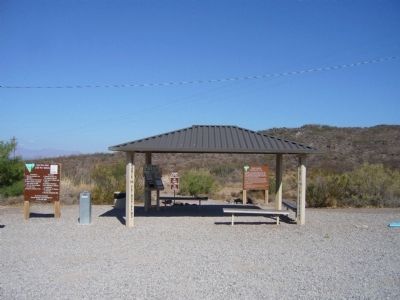
2. Three Rivers Petroglyph Site Marker
The Petroglyph trail starts just behind the marker and goes up the ridge to the right.
Photographed by Bill Kirchner, September 28, 2008
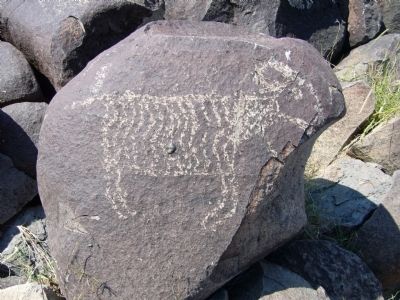
3. Three Rivers Petroglyph
Often, animals are abstract to the point that they are not identifiable, but in Jornada-style rock art, bighorn sheep like this one are usually depicted realistically. The legs are bent as though to represent motion.
Photographed by Bill Kirchner, September 28, 2008
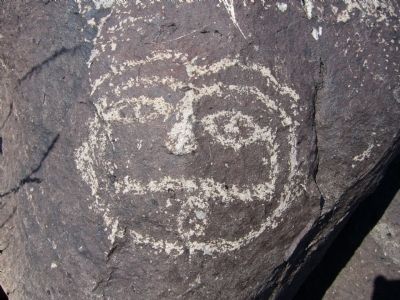
4. Three Rivers Petroglyph
Faces and masks are positioned on rocks is such a way that they are three dimensional. The effect is that the whole boulder has a life-like quality.
Photographed by Bill Kirchner, September 28, 2008
5. Three Rivers Petroglyph
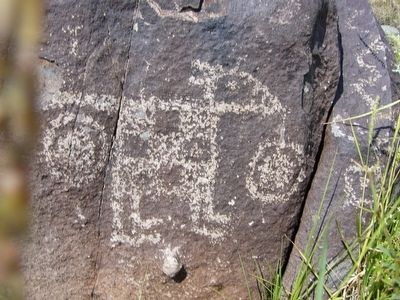
Quadruped images are similar to those found on Mimbres black-on-white pottery. The body is usually filled with geometric designs.
Photographed by Bill Kirchner, September 28, 2008
6. Three Rivers Petroglyph
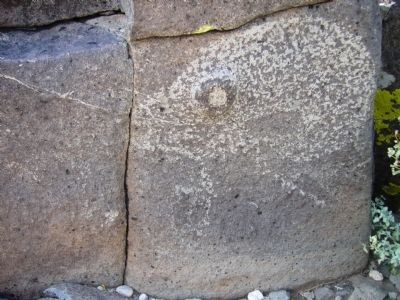
Jornada rock art often incorporated natural rock features into their work. Here, a nodule on the rock is the bighorn sheep's eye.
Credits. This page was last revised on June 16, 2016. It was originally submitted on August 12, 2011, by Bill Kirchner of Tucson, Arizona. This page has been viewed 1,289 times since then and 32 times this year. Photos: 1, 2, 3, 4, 5, 6. submitted on August 12, 2011, by Bill Kirchner of Tucson, Arizona. • Syd Whittle was the editor who published this page.
