Castle Rock in Douglas County, Colorado — The American Mountains (Southwest)
The Rock
Gray Gold
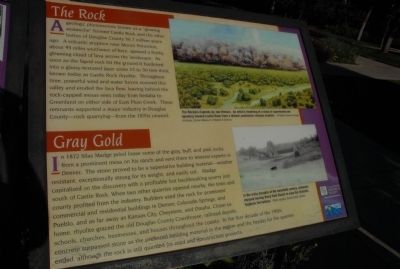
Photographed by Charles T. Harrell, July 3, 2011
1. The Rock Marker
Gray Gold
In 1872 Silas Madge pried loose some of the gray, buff, and pink rocks from a prominent mesa on his ranch and sent them to mineral experts in Denver. The stone proved to be a superlative building material-weather resistant, exceptionally strong for its weight, and easily cut. Madge capitalized on the discovery with a profitable but backbreaking quarry just south of Castle Rock. When two other quarries
this page online
Captions:
The Rockies Explode by Jan Vrieson. An artist’s rendering of a cloud of superheated ash spewing toward Castle Rock from a distant, prehistoric volcanic eruption. All rights reserved, Image Archive, Denver Museum of Nature and Science. In the early decades of the twentieth century, motorists enjoyed touring Perry park Ranch to view the dramatic hogback formations.
Photo courtesy Denver Public Library.
Colorado Historical Society
Topics. This historical marker is listed in these topic lists: Industry & Commerce • Natural Features. A significant historical year for this entry is 1872.
Location. 39° 22.347′ N,
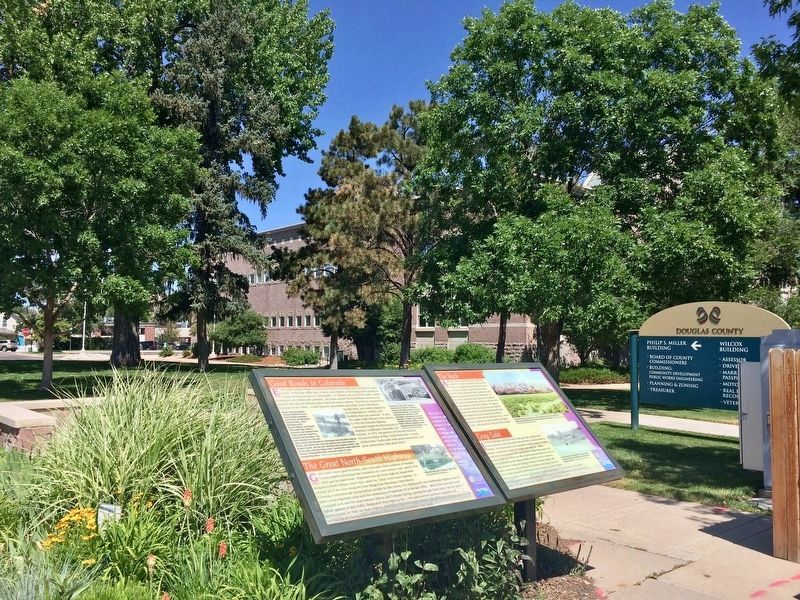
Photographed by Mark Hilton, July 1, 2017
2. View of marker looking northwest towards Douglas County Government buildings.

Regionally, this marker is in Colorado’s Front Range. It is also in the American Mountain West. Globally, it is in North America, the Rocky Mountains, the Western Hemisphere, the Western World, and the Anglosphere. Historically, it finds itself in what was once the Louisiana Purchase.
Other nearby markers. At least 8 other markers are within 3 miles of this marker, measured as the crow flies: Good Roads in Colorado (here, next to this marker); Original Douglas County Courthouse & Bank (about 300 feet away); Keystone Hotel (about 400 feet away); City Hotel (about 600 feet away); Victoria’s House (about 700 feet away); Denver & Rio Grande Railroad Depot (approx. 0.2 miles away); Rock Park (approx. 0.6 miles away); Founders Village (approx. 2½ miles away). Touch for a list and map of all markers in Castle Rock.
Other markers
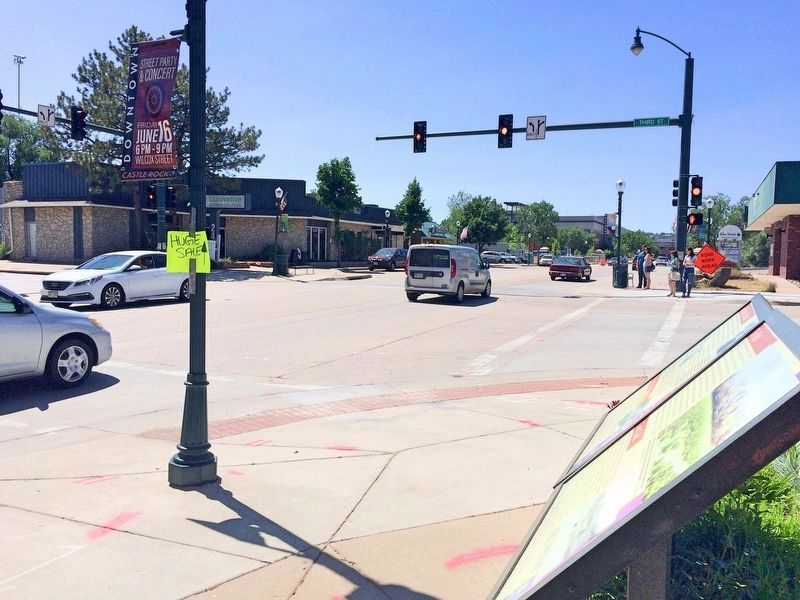
Photographed by Mark Hilton, July 1, 2017
3. View from marker of intersection of Wilcox and Third Streets.
Credits. This page was last revised on December 23, 2024. It was originally submitted on August 15, 2011, by Charles T. Harrell of Woodford, Virginia. This page has been viewed 1,733 times since then and 78 times this year. Photos: 1. submitted on August 15, 2011, by Charles T. Harrell of Woodford, Virginia. 2, 3. submitted on July 1, 2017, by Mark Hilton of Montgomery, Alabama. • Bill Pfingsten was the editor who published this page.
