Perryville in Boyle County, Kentucky — The American South (East South Central)
Battle of Perryville
October 8, 1862
Photographed by Bernard Fisher, August 18, 2011
1. Battle of Perryville Marker
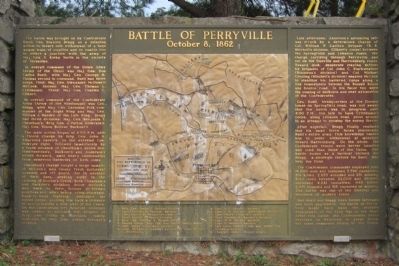
The battle was brought on by Confederate Lieut. Gen. Braxton Bragg as a delaying action to insure safe withdrawal of a huge wagon train of supplies and to enable him to effect a junction with the army of Maj. Gen. E. Kirby Smith in the vicinity of Versailles.
In overall command of the Union Army (Army of the Ohio) was Maj. Gen. Don Carlos Buell, with Maj. General George H. Thomas second in command. Buell had three corps. First: Maj. Gen. Alexander McDowell McCook. Second: Maj. Gen. Thomas L. Crittenden. Third: Maj. Gen. Charles C. Gilbert.
In overall command of the Confederate Army (Army of the Mississippi) was Gen. Bragg, with Maj. Gen. Leonidas Polk commander of the Right Wing and Maj. Gen. William J. Hardee of the Left Wing. Bragg had three divisions: Maj. Gen. Benjamin F. Cheatham’s; Brig. Gen. J. Patton Anderson’s; and Maj. Gen. Simon Bolivar Buckner’s.
The main action began at 2:00 p.m. with a fierce charge by Brig. Gen. John A. Wharton’s cavalry, on the extreme Confederate right, followed immediately by a rapid advance of Cheatham’s entire line. Simultaneously, Buckner’s and Anderson’s moved
this page online
Cheatham’s charge caught a large number of McCook’s men (many fresh enlistees) unaware and off guard, far in advance of their lines, seeking water in the vicinity of Doctor’s Creek. Both Cheatham’s and Buckner’s divisions drove McCook’s men back to their former ill-formed positions and, after heavy, often desperate, hand-to-hand fighting, dislodged his entire corps, pushing him back a distance of approximately a mile west of the Creek. On the Confederate left, however, Anderson was unable to dislodge the division of Brig. Gen. Philip H. Sheridan, timely enforced by Brig. Gen. Albin Schoepf’s division.
(center panel)
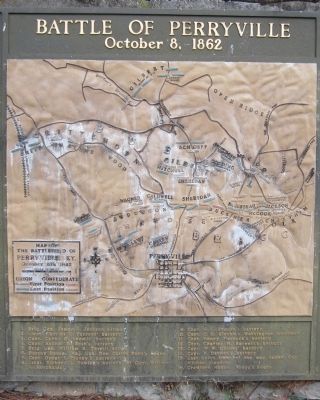
1. Brig. Gen. James S. Jackson killed
2. Lieut. Charles C. Parson's battery
3. Capt. Cyrus O. Loomis' battery
4. Capt. Asahel K. Bush's battery
5. Brig. Gen. William R. Terrill killed
6. Dorsey House, Maj. Gen. Don Carlos Buell's hdqrs.
7. Capt. Oscar F. Pinney's battery
8. Lieut. Richard L. Dawley's battery (of Capt. William A. Hotchkiss)
9. Capt. H. C. Semple's battery
10. Capt. C. H. Slocum's Washington Artillery
11. Capt. Henry Hescock's
Photographed by Bernard Fisher, August 18, 2011
2. Battle of Perryville Map
12. Capt. Charles M. Barnett's battery
13. Capt. W. W. Carnes' battery
14. Capt. P. Darden's battery
15. Last Union fight of the day under Col. Micahel Gooding
16. Crawford House, Bragg's hdqrs.
(right panel)
Late afternoon, Anderson’s advancing left was struck by a determined charge of Col. William P. Carlin’s brigade (R. B. Mitchell’s division, Gilbert’s Corps) between the Springfield and Lebanon roads, the charge carrying through Perryville and out on the Danville and Harrodsburg roads. Toward dusk, desperate staying actions by brigades of Col. John C. Starkweather (Rousseau’s division) and Col. Michael Gooding (Mitchell’s division) enabled McCook to stabilize his battered corps along a line immediately beyond the Russell house and Benton road. In his favor too were the coming of darkness and near exhaustion of the Confederates.
General Buell, headquarters at the Dorsey house on Springfield road, was not aware that the battle was in progress until 4:00 p.m., too late to have Crittenden’s corps, along Lebanon road, pivot around in an attempt to envelop the enemy forces.
After nightfall, Bragg finally realized
Photographed by Bernard Fisher, August 18, 2011
3. Battle of Perryville Marker
The Confederate commander employed only 16,000 men and sustained 3,396 casualties; 510 killed, 2,635 wounded, and 251 missing. Buell used between 22,000 and 28,000; sustained 4,421 casualties; 845 killed, 2,851 wounded and 515 captured or missing. The battle was one of the fiercest and bloodiest of modern times.
Had Buell and Bragg been better informed and more aggressive, the battle of Perryville might have been the decisive engagement of the Civil War in the West. After this battle, the Confederates never returned to Kentucky in great force; the state remained firmly in the Union.
Erected 1962 by Kentucky Historical Society and Kentucky Department of Highways. (Marker Number 553.)
Topics and series. This historical marker is listed in this topic list: War, US Civil. In addition, it is included

Photographed by Bernard Fisher, August 18, 2011
4. Perryville Battlefield (2 miles north of marker)
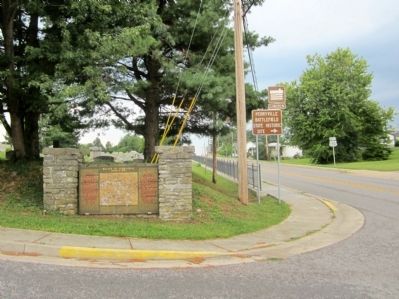
Location. 37° 39.017′ N, 84° 57.194′ W. Marker is in Perryville, Kentucky, in Boyle County. It is at the intersection of South Jackson Street and West 2nd Street (U.S. 150), on the right when traveling south on South Jackson Street. Touch for map. Marker is in this post office area: Perryville KY 40468, United States of America. Touch for directions.

Regionally, this marker is in Kentucky’s Bluegrass Region. It is also in the American South and specifically in the Upper South. Globally, it is in North America, the Western Hemisphere, the Western World, and the Anglosphere. Historically, it finds itself in what was once the territory of the Mississippian Culture and also the Antebellum South.
Other nearby markers. At least 8 other markers are within walking distance of this marker: A different marker also named The Battle of Perryville (about 400 feet away); Bragg's Invasion of Kentucky (about 400 feet away); Merchants' Row / Street Fighting (about 400 feet away); The Hard Hand Of War (about 400 feet away); In The Crucible Of War (about 400 feet away); Addison Parks (about 400 feet away); Perryville (about 500 feet away); Carry Nation (about 500 feet away). Touch for a list and map of all markers in Perryville.
Another marker is no longer nearby. Battle of Perryville (was about 300 feet away, measured in a direct line but has been replaced with another marker now near it).
Credits. This page was last revised on April 29, 2021. It was originally submitted on August 19, 2011, by Bernard Fisher of Richmond, Virginia. This page has been viewed 2,176 times since then and 48 times this year. Photos: 1, 2, 3, 4. submitted on August 19, 2011, by Bernard Fisher of Richmond, Virginia.
